Nobel prize for economics awarded for work on New Keynesian models
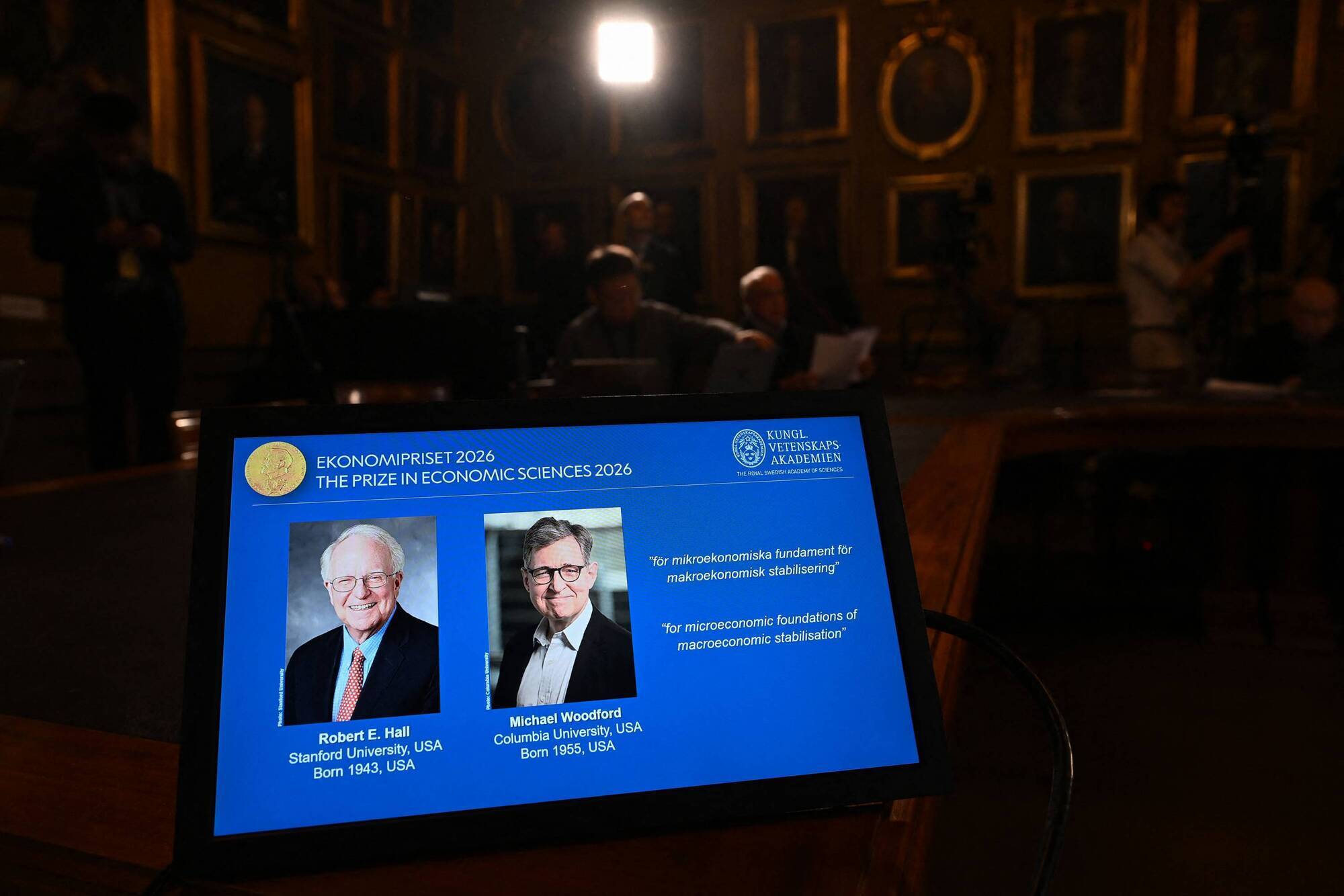
Portraits of US economists Robert E. Hall and Michael Woodford are seen at the Royal Swedish Academy of Sciences in Stockholm on Oct. 12. Photographer: Jonathan Nackstrand/AFP/Getty Images
Two US-based academics who reframed the thinking of John Maynard Keynes after the oil crises of the 1970s won the Nobel Prize in Economics.
Robert E. Hall of Stanford University and Michael Woodford of Columbia University will share the 12 million-krona (€1.07m) award for their work on the “microeconomic foundations of macroeconomic stabilisation,” the Royal Swedish Academy of Sciences in Stockholm said in a statement on Monday.
“It’s a tremendous honour,” Woodford told the press conference by phone. “It’s a surprise, but I’m feeling very good about it.”
Hall was praised for a 1978 article on how consumers prefer consumption to stay stable, while Woodford then developed the so-called New Keynesian model that has since proven highly influential among global policymakers to this day.
“The laureates’ work has provided us with a stable theoretical foundation for the models that are now used by central banks and governments around the world,” John Hassler, chair of the prize committee, said in a statement. “With them, we are better equipped to deal with shocks in the economy, such as energy crises or sudden changes in how much households consume.”
Woodford was asked if any economic event or shock had ensured that his new framework had really stood up to the test. He cited how central banks adapted their toolkit to the global financial crisis of 2008 as they confronted a slump in demand that reductions in borrowing costs on their own couldn’t solve.
“Forward guidance about policy, so making more explicit statements about the likely future path of interest rate policy as opposed to relying on simply being able to cut interest rates further immediately — that was an important part of the policy response,” he said. “It did contribute to better stabilisation. It didn’t magically solve the problem, but I think it was an important contribution.” The award in economic sciences was established by Sweden’s central bank in 1968 and is presented annually alongside the Nobel Prizes in physics, chemistry, medicine, literature and peace. The five original honours were established in the will of Alfred Nobel, the Swedish inventor of dynamite, who died in 1896.
Last year, two US-based economists shared the prize with a European-based peer for research explaining how innovation drives sustained economic growth.
The money for winners this year was increased by 1 million kronor per category in connection with the 125th anniversary of the awards. When the first Nobel Prizes were given out in 1901, the amount was 150,782 kronor each.
On Friday, the Norwegian Nobel Committee in Oslo awarded the Nobel Peace Prize to international jurist Navi Pillay for her efforts to prosecute war crimes, crimes against humanity and genocide.
Bloomberg


CONNECT WITH US TODAY



Be the first to know the latest news and updates