'Same mistakes' leading to budget overruns every year, warns fiscal watchdog
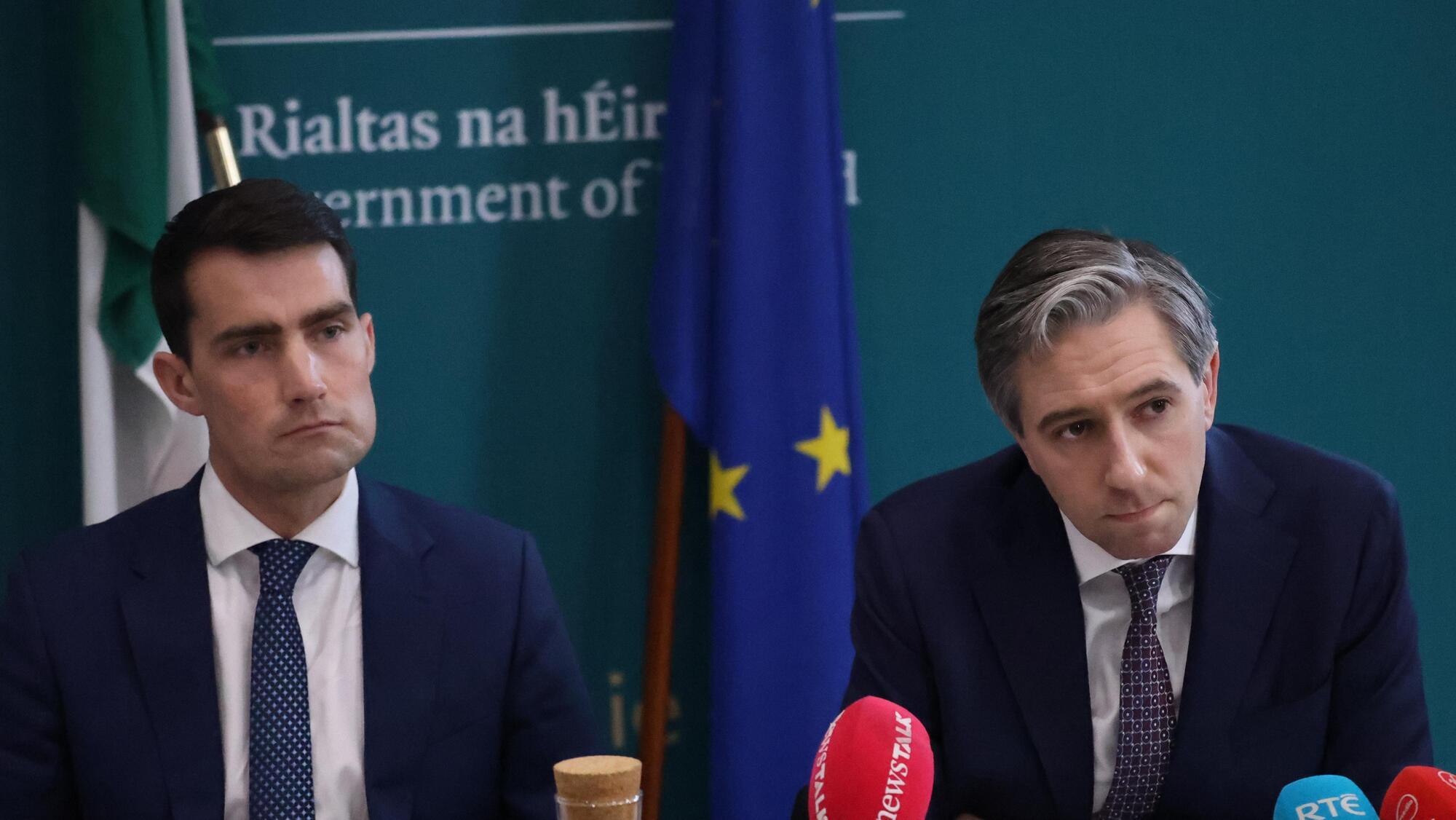
Minister for Public Expenditure, Infrastructure, Public Service Reform and Digitalisation Jack Chambers and Tánaiste and Minister for Finance, Simon Harris. Pic: Stephen Collins/Collins Photos
The "same mistakes" are being made every year with consistent spending overruns impacting Ireland's public finances, the government's fiscal watchdog has said. In a memo written by Killian Carroll of the Irish Fiscal Advisory Council (Ifac), the senior economist said that overruns have averaged more than €5bn per year since 2023, with around half of the total every year arising from "bad budgeting and poor expenditure management."
"Policymakers should respond to crises. Nearly half the 2023 and 2024 overruns came from one-off cost-of-living measures, designed to provide immediate relief to households and businesses against high inflation.
"However, this leaves overruns of €2bn in 2023, €3.2bn in 2024 and €2.4bn in 2025, which can be attributed to bad budgeting and poor expenditure management."
Read More
Mr Carroll said the starting point for the government budget has been "persistently wrong", noting that building next year's Budget requires having a good idea of what is currently being spent.
"Get the starting point wrong, and the endpoint will be wrong too. Have we been getting it right? No.
"Over the past three budgets, the base year has been significantly underestimated at the time of the budget.
"Between the forecasts on Budget day and the end of the year, current spending has overrun by an average of €750m. That's a significant forecast error for a three-month window, in which there haven’t been any policy changes. This is bad budgeting."
The senior economist said that more was being spent on teachers, doctors and nurses, among other public sector jobs, by December every year than previously forecasted just three months earlier in the Budget month of October.
"Was this predictable? Yes. The Fiscal Council has warned for three consecutive years that the starting point was wrong," Mr Carroll said. "The Department of Public Expenditure has consistently underestimated the cost of maintaining existing services."
"The budgetary allocation was too low from the start. Delivering planned services on budget becomes nearly impossible if funding is never sufficient. That responsibility lies with the Department of Public Expenditure."
The economist added that estimates for maintaining existing service levels, before any policy changes, emerge from negotiations between spending departments and the Department of Public Expenditure, calling in a "central weakness."
"Post-budget overruns create problems for the following year. Budget 2026 made the same mistake again. Year after year, we repeat the same mistakes, expecting different results. Now is the time to shout stop."


CONNECT WITH US TODAY



Be the first to know the latest news and updates