Ireland forecast to spend €300bn on infrastructure by 2050
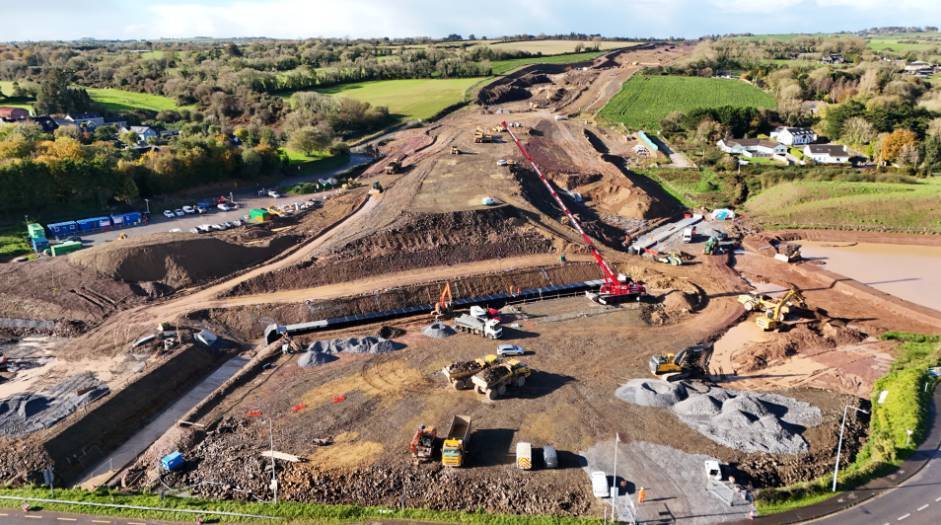
Spending on transport infrastructure will reach €38.5bn, according to PwC's global infrastructure outlook report. File picture
Annual infrastructure spending in Ireland is forecast to rise from €7.9bn in 2024 to €13.7bn by 2050, driving cumulative investment of €295bn.
According to PwC's global infrastructure outlook report, the spending rise will make Ireland the 14th largest infrastructure market in Europe by 2050.
The projected spending growth reflects Ireland’s well-publicised infrastructure deficit. The investment over the next 25 years will be dominated by digital spending at €71.8bn, mainly through data centres.
Spending on power infrastructure will reach €55.6bn, followed by social spending at €51.3bn, transport with €38.5bn and water with a €34.2 billion spend. Together, these five sectors account for over 85% of Ireland’s projected total spend on infrastructure.
Globally, PwC said annual spending will rise from €3.8tr in 2024 to €5.9tr in 2050. For Ireland, Rob Costello, Capital Projects and Infrastructure Partner at PwC, said our pipeline is ambitious and needs to be.
"Public and private investors must work together to deliver the transformative change that is needed over the next couple of decades," he said. "Investment cannot happen in silos.
"Developing the digital infrastructure that will drive our economy forward will require significant investment in our energy infrastructure. New, sustainable communities will be made possible only through investment in transport, health and education."
As the world races to unlock the full potential of AI, a global surge in spending on data centre buildings is rapidly unfolding and comes in addition to investment in ICT equipment, such as chips and servers.
Between 2024 and 2027, annual global investment in data centre buildings rises 2.2 times, from €97.3bn to €215.3bn.
Total investment from 2024 to 2032 will top €1.28tr in a remarkable short-term escalation, which will be followed by a period focused on improving the utilisation, efficiency, and adaptability of existing built stock.
Over the full period, other key subsectors will see significant growth. For example, ageing populations are expected to drive annual spending on health and aged care facilities to rise 1.7 times higher in 2050, for the first time coming close to parity with spending on educational facilities.
While the resources sector is broadly flat, there will be targeted growth in mining for metals and minerals critical for the energy transition, such as copper, lithium and rare earths, where annual spending will rise 1.4 times to €109.5 billion in 2050.
Transport and power will continue to be the biggest areas of investment, accounting for about half of global infrastructure spending to 2050. As mobility networks modernise and cities grow, annual transport spending will rise from €1.2tr in 2024 to €2.1tr in 2050, representing a cumulative total of €43 trillion.
Annual spending on both rail and airport infrastructure will nearly double from 2024 levels, with annual airport spending 1.9 times higher in 2050 at €131.9 billion, and rail spending 1.8 times higher at €577.5 billion in 2050.
Annual spending on power infrastructure will increase from €539.6 billion in 2024 to €940 billion in 2050, totalling €21.4 trillion over the period.
Reflecting the pace of electrification, by 2050, annual investment in power storage will be nearly €77.8 billion — 3.7 times 2024 levels, while transmission and distribution spending will grow 2.6 times to €403.7 billion.
Defence is the fastest growing sector for infrastructure spending globally. Annual spending on physical installations, such as barracks, will be 2.3 times higher in 2050 (€143.7 billion) than 2024 (€62.4 billion), as governments respond to intensifying geopolitical risks.
The other sectors measured in the report are industrial manufacturing, water and social infrastructure, each of which is expected to grow about 1.5 times to 2050; as well as digital infrastructure and agricultural infrastructure, which are expected to grow about 1.3 times; and natural resources which will be broadly flat.

CONNECT WITH US TODAY



Be the first to know the latest news and updates