Global aviation will never fully recover from covid
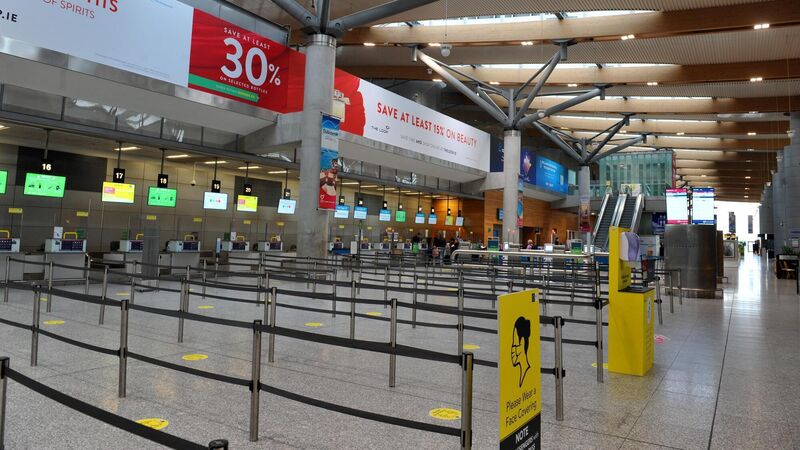
The Cork Airport terminal during the pandemic lockdown. Global air travel will grow strongly up until 2050.
Global air passenger demand is expected to more than double by 2050, driven by rising populations, growing economies and more affordable air fares, but the impact of the covid pandemic on aviation is permanent.
The International Air Transport Association (IATA), the representative body for the world's airlines, said demand is forecast to reach 20.8 trillion revenue passenger kilometres (RPKs), from the 9 trillion RPKs seen in 2024, growing at a rate of more than 3% each year under their mid-range scenario.
In their Long-Demand Report, IATA said growth will be driven mainly by rising global incomes and economic expansion that will increase people’s ability to fly. The report highlights steady population and employment growth, which will enlarge the pool of potential travellers. Improvements in connectivity, such as more airports, higher flight frequencies, and larger aircraft, are also making air travel more accessible. IATA said fuel‑price trends and lower airfares also support demand.
Willie Walsh, former chief of Aer Lingus and British Airways, is IATA's Director General. He said the outlook for air travel is positive. "People want to travel and, under all our modelled scenarios, the demand to fly is expected to more than double by mid-century. That is good news for global economic and social development because aviation growth will catalyse opportunities, including jobs, around the world."
"Our Long-Term Demand report gives governments, industry, and energy suppliers a robust basis for long term planning. It underscores the need for policy frameworks to support key success enablers such as efficient infrastructure development, market access facilitation, regulatory harmonisation, and an effective clean energy transition."
Europe, one of the world's largest aviation markets, will see slower growth than other regions but is still expected to rise from 2.3tr RPKs in 2024 to 4.5tr RPKs by the middle of the century.
Asia Pacific and Africa are expected to be the fastest growing regions over 2024-2050, growing 3.8% and 3.6% respectively. Europe and North America are projected to grow more slowly, at 2.5% and 2.8%.
The report identifies the fastest growing markets as within Africa (4.9%), Africa–Asia Pacific (4.5%), Asia Pacific–Middle East (3.9%), intra Asia Pacific (3.9%), and Africa–North America (3.8%), highlighting the importance of investment in aviation infrastructure and regulatory frameworks in developing regions. By contrast, several Europe-centred markets are among the slowest growing.
The report notes that the covid pandemic, which caused the greatest structural shock to the airline industry in the history of air travel, will still impact air travel right up to 2050.
Prior to the pandemic, global air‑travel demand closely matched global GDP growth for nearly 30 years. Covid broke that trend, and the report said it is clear that the gap will persist permanently.
Although air travel continues to recover and grow from 2024 onward, it does so along a lower trajectory than before the pandemic, reflecting the enduring impact of lost years of demand and deep disruptions to flight frequency, capacity, and connectivity.


CONNECT WITH US TODAY



Be the first to know the latest news and updates