War could dent commercial property's 'cautious recovery', warns Society of Chartered Surveyors
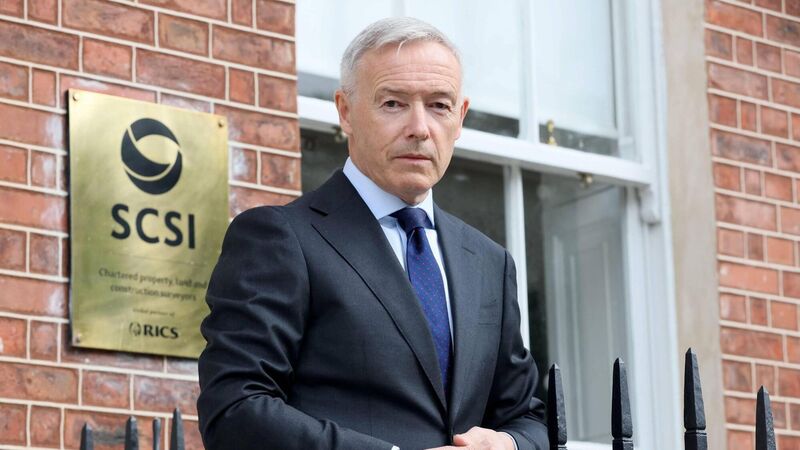
Gerard O'Toole President of the Society of Chartered Surveyors Ireland. Ireland’s commercial property market is experiencing a “cautious recovery” but the war in Iran could stunt any progress, a report by the SCSI said.
Ireland’s commercial property market is experiencing a “cautious recovery” but the war in Iran could stunt any progress, a report by the Society of Chartered Surveyors Ireland (SCSI) said.
The SCSI findings pointed to a modest recovery of commercial property take-up, clearer pricing signals, and more stable credit conditions. However, the SCSI warned of a potential inflationary impact of the unfolding situation in the Middle East.
SCSI expects national prime industrial property values to rise this year by 4% and rents to rise by 4.4% on average. Prime office capital values are forecast to rise by 2.4%, with rents expected to increase by 2.9% on average. Prime retail values and rents are expected to rise by just over 1% on average.
“Both occupier and investor expectations have strengthened relative to previous years,” said SCSI Commercial Agency Group chair Bernardette Hogan.
“Respondents are reporting increasing enquiry levels and a notable improvement in investor confidence. We anticipate that a number of larger office transactions will materialise later in the year.”
“Our survey found that 50% of respondents now view valuations as close to fair value, suggesting that repricing across several segments may be approaching its cyclical floor. Together with the recent stabilisation in credit conditions, the data suggests that the market is entering an early recovery phase.”
SCSI president Gerard O’Toole said commercial property performance is continuing to vary by sector with prime industrial assets are still leading the way, supported by steady demand from logistics, pharma, and distribution occupiers. Office and retail markets are seeing more mixed conditions, with performance differing by location and asset quality.
Mr O’Toole warned Ireland is "not immune" to the impact of persistent geopolitical instability and international conflict. “In that context, the potential economic impact of the unfolding situation in the Middle East is naturally concerning,” said Mr O’Toole.
“This research was clearly carried out before the current outbreak of hostilities. While the situation is fluid and the timeline is as yet uncertain, there is no doubt a protracted war could lead to a period of sustained higher energy costs and an unwelcome increase in construction inflation, which in recent years has returned to more moderate levels.”
For prime industrial properties, 69% of surveyors expect the capital value to increase and 71% anticipate an increase in rental values. Sentiment towards secondary industrial assets is more moderate, 50% expect capital values to increase, and 51% expect rental prices to rise. However, a significant portion, 41% for capital and 40% for rental, respectively, expect prices to remain the same.
For prime retail spaces, 42% of surveyors expect capital values to increase in 2026, and the same percentage anticipate an increase in rental values. With regard to capital values, a majority, 45% believe they will remain unchanged while for rental, the figure is 44%.
In contrast, secondary retail spaces face more pronounced challenges. Twenty-one percent of surveyors expect capital values to decrease, along with 30% expecting a decrease in rental values. A majority of 48% for capital and 53% for secondary retail rental expect the values to remain the same.
The survey found student housing remains one of the stronger-performing sectors, with rental growth projected at 3.2% and capital values expected to rise by 3.1% on average, supported by resilient demand and constrained supply.
Data centres also demonstrate comparatively robust momentum, with rents forecast to increase by 3.5% and capital values by 3.2% on average, underpinned by ongoing expansion in the digital economy and sustained occupier demand.
CONNECT WITH US TODAY



Be the first to know the latest news and updates