US Supreme Court rejects Donald Trump's global tariffs
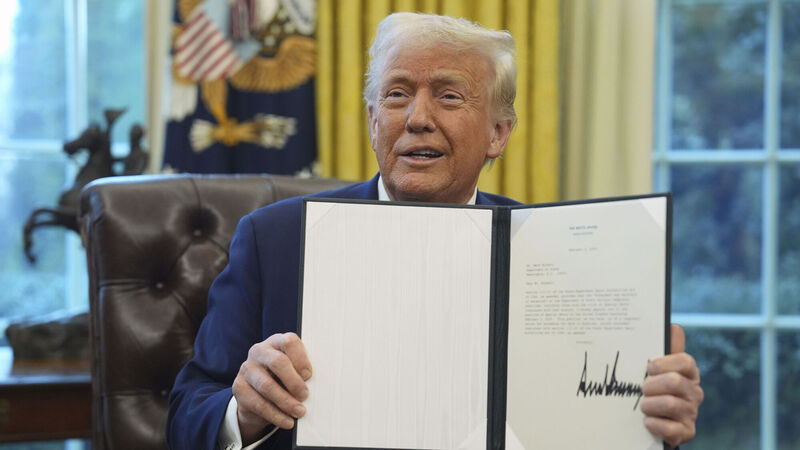
The court ruled that the Trump administration's interpretation that the law at issue. File picture: AP Photo/Evan Vucci)
The US Supreme Court struck down on Friday president Donald Trump's sweeping tariffs that he pursued under a law meant for use in national emergencies, rejecting one of his most contentious assertions of his authority in a ruling with major implications for the global economy.
The justices, in a 6-3 ruling authored by conservative Chief Justice John Roberts, upheld a lower court's decision that the Republican president's use of this 1977 law exceeded his authority.
The court ruled that the Trump administration's interpretation that the law at issue — the International Emergency Economic Powers Act, or IEEPA — grants Mr Trump the power he claims to impose tariffs would intrude on the powers of Congress and violate a legal principle called the "major questions" doctrine.
The doctrine, embraced by the conservative justices, requires actions by the government's executive branch of "vast economic and political significance" to be clearly authorised by Congress. The court used the doctrine to stymie some of Democratic former President Joe Biden's key executive actions.
Mr Roberts, citing a prior Supreme Court ruling, wrote that "the president must 'point to clear congressional authorisation' to justify his extraordinary assertion of the power to impose tariffs," adding: "He cannot."
Mr Trump has leveraged tariffs — taxes on imported goods — as a key economic and foreign policy tool. They have been central to a global trade war that Mr Trump initiated after he began his second term as president, one that has alienated trading partners, affected financial markets and caused global economic uncertainty.
The Supreme Court reached its conclusion in a legal challenge by businesses affected by the tariffs and 12 US states, most of them Democratic-governed, against Mr Trump's unprecedented use of this law to unilaterally impose the import taxes.
The three dissenting justices were conservatives Clarence Thomas, Samuel Alito and Brett Kavanaugh. Joining Mr Roberts in the majority were conservative Justices Neil Gorsuch and Amy Coney Barrett, both of whom Mr Trump appointed during his first term in office, along with the three liberal justices.
The Supreme Court, which has a 6-3 conservative majority, previously had backed Mr Trump in a series of other decisions issued on an emergency basis since he returned to the presidency in January 2025 after his policies were impeded by lower courts.
Mr Trump's tariffs were forecast to generate over the next decade trillions of dollars in revenue for the United States, which possesses the world's largest economy.
Mr Trump's administration has not provided tariffs collection data since December 14. But Penn-Wharton Budget Model economists estimated on Friday that the amount collected in Trump's tariffs based on IEEPA stood at more than $175 billion. And that amount likely would need to be refunded with a Supreme Court ruling against the IEEPA-based tariffs.
The US Constitution grants Congress, not the president, the authority to issue taxes and tariffs.
But Mr Trump instead turned to a statutory authority by invoking IEEPA to impose the tariffs on nearly every US trading partner without the approval of Congress. Trump has imposed some additional tariffs under other laws that are not at issue in this case. Based on government data from October to mid-December, those represent about third of the revenue from Trump-imposed tariffs.


CONNECT WITH US TODAY



Be the first to know the latest news and updates