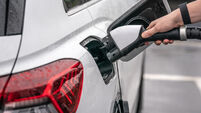
No more oil changes: Ireland's car dealers face a changed landscape as electric vehicle sales surge
EV sales jumped last year, but every new car sold in Ireland would have to be either an electric car or a plug-in hybrid to meet 2030 targets.
The high rate of electric car adoption over the last few years has been a “positive story” but unfortunately the Government’s climate target of 845,000 electric cars on the road by 2030 was an “unrealistic target” and it “shouldn’t undermine what we’re trying to achieve,” the director general of Society of the Irish Motor Industry (SIMI) has said.
During 2025, new electric car registrations saw a significant resurgence, rising by 36% to 23,398 after a concerning drop-off in 2024. In 2023, new electric car registrations stood at 22,493.
A high adoption rate of electric cars is a significant pillar of the Government’s climate action plan. The country hit an initial target of 195,000 electric cars on the road by the end of 2025; however, the target for 2030 is to have 845,000 private electric cars on the road.
This means that 650,000 additional electric cars will have to be registered in five years or, on average, 130,000 a year.
Read More
The director general of SIMI, Brian Cooke, said every new car sold would have to be either an electric car or a plug-in hybrid to meet those targets.
“The first climate action plan to highlight those targets was in 2019. We said at the time that that target was not realistic, and it never has been realistic,” he said.
“I don’t want to be negative about electric vehicle sales, because there are going to be hundreds of thousands of electric vehicles on the road in 2030, coming from basically zero in 2020. We’re probably on track for maybe 450,000, which is a bit more than half of their targets, and we might do a bit better than that,” he said.
“This is a positive story. We are moving towards electric, we’re moving towards zero-emission vehicles.
“In many ways, that’s been used as a negative to knock electric vehicle sales, which have been really good from a standing start so far.
“It’s unfair to expect Ireland to hit an unrealistic target, but it shouldn’t undermine what we’re trying to achieve.”
He added that the Government needs to continue to incentivise their adoption.
“I think EV sales will increase this year, and I think there’ll be further increases in hybrid, plug-in hybrid vehicle sales,” he said, adding that early indications show that electric car sales are up in the first few weeks of January compared to last year.
One area that electric cars have the potential to disrupt the dealership sector is around after-sales care, repair, and servicing, which is a large part of any dealer’s business — as electric vehicles have very few moving parts when compared to a regular internal combustion engine vehicle.
“There still is going to be an after-sales business in electric vehicles. It may not be the same; there are not as many moving parts, but there are some parts of the vehicles that require more attention, particularly the braking systems, which are important for regeneration, the tyres as well,” he said.
He added that the independent repair sector is also showing a strong appetite for training in hybrid and electric vehicles because they are now actually starting to see used electric cars coming into their places.
“The outlook is a bit more positive than some people are saying, and I do think aftercare is still going to be a hugely important part of everyone’s business going forward,” he said.
“Because of the nature of electric vehicles and the potential dangers with significant batteries, I think what you’re going to see is more specialised staff and those vehicles are all going to find their way into workshops that are properly equipped with the properly qualified technicians.”
Another potential issue for the sector was moves by manufacturers towards direct-to-consumer agency models for dealerships rather than through franchises, which are the most common in Ireland.
Franchise dealers operate the business themselves; they buy it from the manufacturer and sell it on for a profit — whereas the agency model sees the dealer owned by the manufacturer, and the seller earns a commission on sales.
Tesla operates on these direct-to-consumer agency sales.
Volkswagen attempted to move towards a model like this in Ireland but abandoned it last year.
Mr Cooke said most of their members like the franchise model, because “they’re business people, and they’re creative business people”.
“They provide a lot of jobs. They generate a lot of tax for the government as well, and they like to have a large degree of control over their business,” he said.
“The agency model may well come back in a few years, but at the moment, over the next couple of years, the vast majority of new car retailers in Ireland will remain on the franchise model.”
On the trends in the market, Mr Cooke said that there has been a significant reduction in diesel sales over the last decade, which once accounted for 70% of all sales. They are now down 17% according to the CSO.
One of the significant trends in new cars over the last 10 years, for Mr Cooke, is the cost, which he said has gone up “significantly” for a number of reasons.
One factor for these rises is energy costs, while another is the additional important safety and emission regulations.
“I do think the cost has also impacted the size of the new car market, which is down probably 10 to 15% in most European markets compared to where it was,” he said.
CLIMATE & SUSTAINABILITY HUB
CONNECT WITH US TODAY



Be the first to know the latest news and updates