Global rivals hover as EU stalls on Mercosur deal
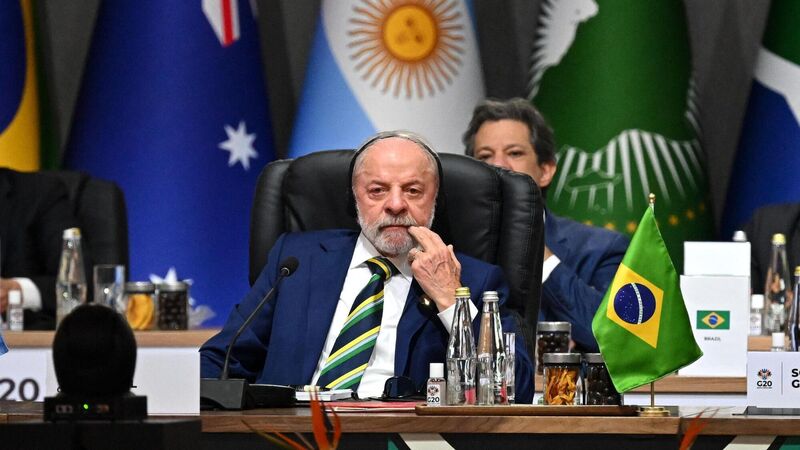
Brazil's President Luiz Inacio Lula da Silva said Mercosur will 'continue working with other partners' as the EU stalls on a deal. Picture: Leon Neal/PAÂ
As the European Union struggles to complete a trade deal with Mercosur, competitors eyeing South America’s consumer market and vast mineral resources are taking note.
Spurred by Donald Trump’s tariffs, talks between the South American bloc and partners such as United Arab Emirates, Canada and India are gaining renewed importance while a divided EU wavers after more than a quarter-century of talks. The prospect of rivals locking in preferential access to Mercosur’s markets — including critical minerals — is sharpening attention in capitals from London to Tokyo.
“We’re determined to deepen our trade ties,” Yasushi Noguchi, Japan’s ambassador to Brazil, said in an interview this week. Japan is “very interested in how things happen” on the EU-Mercosur deal since Japanese companies often compete directly with European firms, he said.
Impatience about the EU surfaced at a meeting of Mercosur government leaders on Saturday after resistance from European farmers — particularly in France and Italy — once again caused a delay.
“Without political will and courage from its leaders, it will not be possible to conclude a negotiation that has dragged on for 26 years,” Brazilian president Luiz Inacio Lula da Silva told the summit he hosted Saturday. “Meanwhile, Mercosur will continue working with other partners.”Â
European Commission president Ursula von der Leyen had been expected at the summit to sign the EU-Mercosur deal. She abruptly canceled her trip after the EU didn’t muster the votes to approve it.
European officials are now aiming for a mid-January ratification. Italian Prime Minister Giorgia Meloni, who holds the key vote, told Lula this week she’s confident she can support the agreement if she gets more time to rally domestic support.
Mercosur, which groups Brazil, Argentina, Uruguay and Paraguay, previously accepted a last-minute EU demand for safeguard measures to protect its farmers but critics in Europe say they don't go far enough, arguing that giving access to South America’s agricultural industry would hurt European farmers, whilst stressing that food safety controls in Mercosur are insufficient.
As tariffs reshape global trade, the EU stands to gain the most geopolitically by expanding in a part of the world where China is increasingly gaining ground, according to the analysis. The EU-Mercosur deal remains the holy grail for South America. It would create an integrated market of some 780m consumers and likely boost industries like agriculture while increasing European investment in the region.
Mercosur signed a free-trade agreement this year with the bloc made up of Switzerland, Norway, Iceland and Liechtenstein, known as EFTA. It’s hoping to conclude negotiations with the UAE and Canada in 2026.
The trade bloc is also seeking to begin negotiations soon with the UK, has kicked off talks with Vietnam and El Salvador and is working on a developing a trade framework with Japan.
“We are willing to move forward, understanding that Europe has its own timelines to address its internal institutional matters,” Paraguayan Foreign Minister Ruben Ramirez told journalists Friday. “But at the same time, those timelines are not infinite.”Â
BloombergÂ