ESRI revises house completion predictions up for 2025 but down for 2026
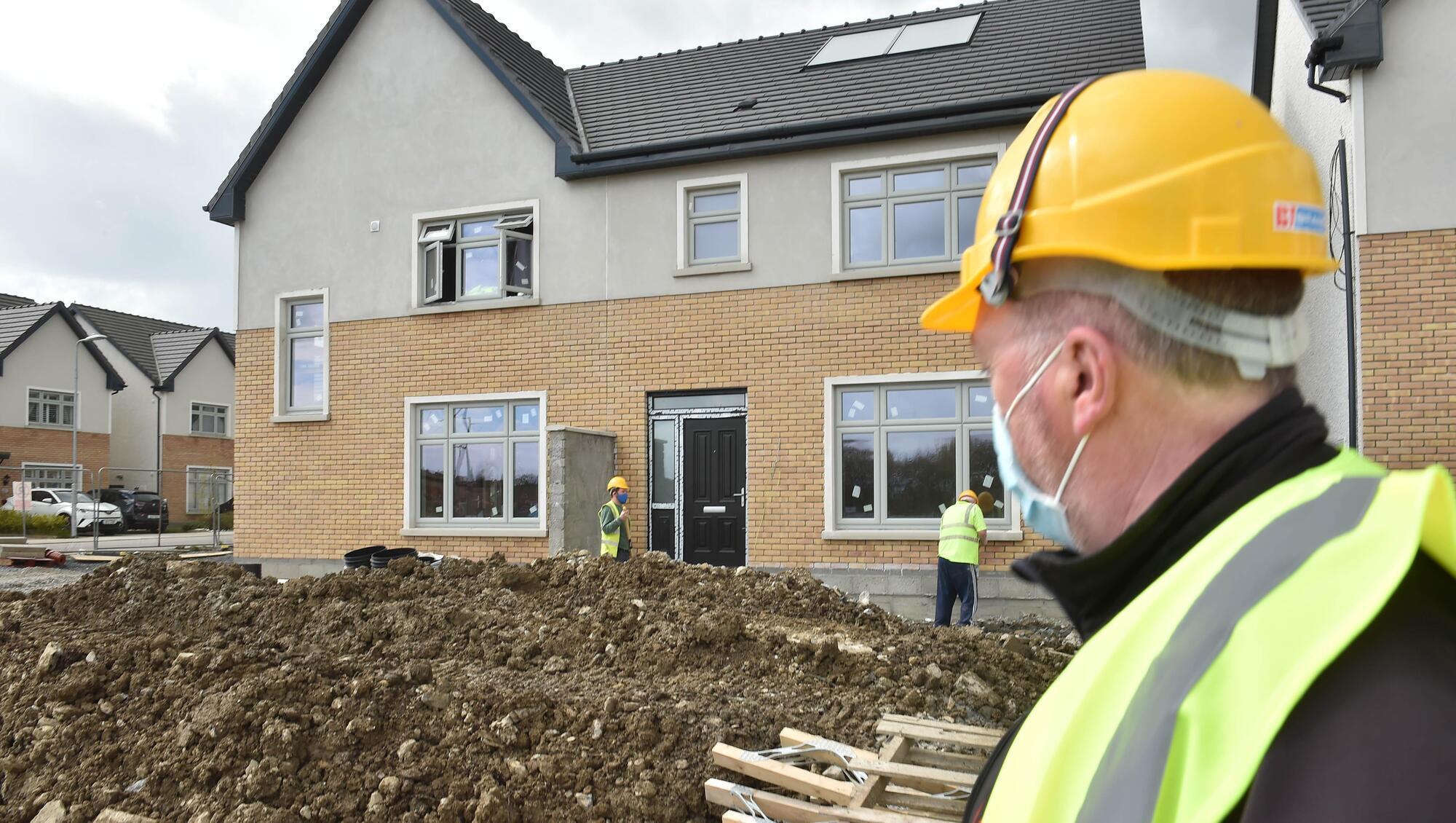
The ESRI has revised its annual forecast for housing completions upwards to 35,000 for 2025 but revised down its forecast for 2026 completions to just under 36,000. Picture: Dan Linehan
The Government must make hard choices on housing policy amid an 80% fall-off in commencements, a “rapid fall-off" in apartments, and a construction industry at risk of overheating, the Economic and Social Research Institute (ESRI) has warned.
In its quarterly economic commentary for autumn 2025, the ESRI revised its annual forecast for housing completions upwards to 35,000 for 2025, after second quarter housing this year saw a welcome increase to 9,200 completions. However, the ESRI revised down its forecast for 2026 completions. “We are raising our forecast to over 35,500 units for 2025, but lowering our forecast for 2026 to just under 36,000,” the ESRI report said. “The outlook beyond the forecast horizon appears to be weakening with falling planning permissions and low commencements.”
The ESRI said a major increase in housing commencements took place in 2024, largely as a result of Government “policy shock” supports – specifically, the development and water levy waivers that were offered for commenced activity by the end 2024. There was an 80% year-on-year drop-off in commencements in 2025.
“The level of planning permissions would indicate that, in the medium term, no sustained increase in trajectory is evident,” the report noted. "It is very clear that the number of units given planning has not been rising overall. However, looking across the types of housing, the general weakness has been driven by a rapid fall off in apartment units. Scheme housing had increased through 2022 to 2024 but appears to have stalled in 2025.”
The ability to expand construction output is also likely to be hampered by capacity constraints, with construction wage inflation rising rapidly. The report notes increasing housing output is coming at a time of ongoing increases in other non-dwelling construction activity, such as retrofits and infrastructure expenditure. "We're going to have to make choices about what we are prioritising," said report co-author Prof Alan Barrett.
The ESRI report expects the economy will continue to perform robustly, predicting modified domestic demand (MDD), which excludes foreign direct investment, growing by 3.8% in 2025 and by 3.2% in 2026.
A tariff deal between the US and EU removed some of the trade uncertainty but the 15% tariff agreed represents a clear deterioration in Ireland’s trading environment, the ESRI said, placing renewed focus on policies around trade diversification and competitiveness.
The ESRI urged the Government to clarify its position on the EU trade agreement with Mercosur (Argentina, Brazil, Paraguay and Uruguay). The deal is fiercely opposed by Irish farm leaders who warn beef and poultry sectors will be decimated as a result of increased tariff free imports. "We would urge the Government to reflect carefully on its reservations," the ESRI report said. "The estimated outcomes that have been provided to the Government show net positive outcomes. In such cases, those who lose as a result of the deal can be compensated and supported (and should be). There might be good reasons why the losses of one group should be weighted disproportionately compared to the gains for others, but it is important to be transparent on this. More broadly, at a time when economic policy should be directed towards protecting and enhancing free trade, it seems counterproductive to be opposing free trade agreement."

CONNECT WITH US TODAY



Be the first to know the latest news and updates