Real wages fell by 1.3% during first three months of the year
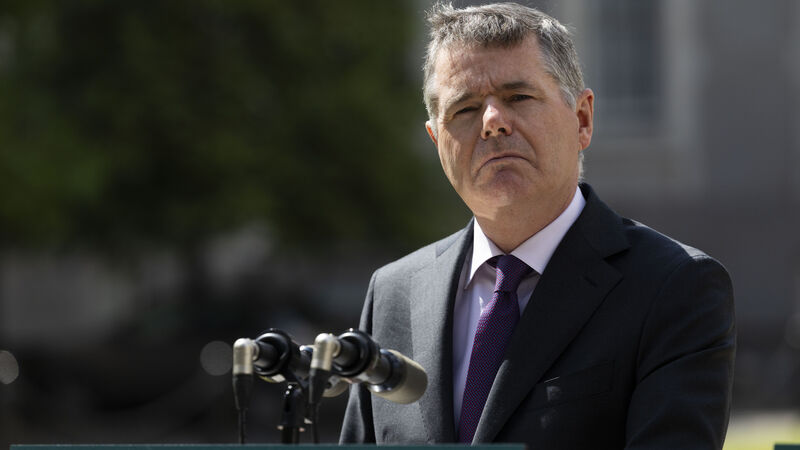
Finance minister Paschal Donohoe said given the uncertain global economic outlook, 'we need to continue to calibrate economic and budgetary policies that recognise the changed external backdrop'.
Employee wages saw a decline in real terms of 1.3% during the first three months of the year, new data from the Central Statistics Office (CSO) shows, as gross domestic product (GDP) growth is revised down.
According to the latest quarterly national accounts for the first three months of the year, €36.2bn was paid to employees, a decline of 1.3% compared to the previous three-month period.
The fall was in part driven by a 3.1% decrease in the manufacturing sector. The distribution, transport, hotels, and restaurants sector saw a wage decline of 3.2%, while industry was down 2.9%, and public administration, education, and health was down 2.6%.
However, some sectors saw large increases in employee wages, particularly in real estate activities, up 15%, as well as agriculture, forestry, and fishing, up 9.8%.
Between January and March, modified domestic demand (MDD), the preferred measure of domestic economic activity, grew by 2% between January and March this year. Personal spending on goods and services, which is a key part of this measure, grew by 0.3%.
The CSO has revised down GDP growth during the first quarter, from an initial 9.7% estimate to 7.4%. The reason for the revision was due to the inclusion of new data published in the annual national accounts for 2024.
GDP is not the most reliable measure of the Irish economy as it is heavily influenced by the presence of the numerous multinational companies with operations here.
According to the CSO, multinational-dominated sectors grew by 13.6% during the first three months of the year, with domestic sectors largely flat.
Total exports expanded by 9.6% during that period, an increase of €19.2bn, largely due to the surge in pharmaceutical products exported to the US prior to the implementation of US president Donald Trump’s tariffs.
Finance minister Paschal Donohoe said the high level of export activity seen at the start of the year was “likely to moderate somewhat over the remainder of this year” and looking ahead, “we are facing into a period of “considerable uncertainty in the global economic environment relating to the introduction of tariffs and the rise in geo-fragmentation”.
“From a policy perspective, we need to continue to calibrate economic and budgetary policies that recognise the changed external backdrop,” he said.
While sectors focused on the domestic economy were flat during the quarter, there was a notable increase of 7.9% in the construction sector, and a more modest growth of 1.7% in the professional and administrative services sector.
The agriculture, forestry and fishing sector saw a contraction of 5.1%.
The CSO also published the finalised accounts for 2024, which found MDD grew by 1.8% over the course of the year, with personal spending on goods and services, a key measure of domestic activity, increasing by 2.9%.
Modified gross national income, a de-globalised measure of Ireland’s economic performance, expanded by 4.8% in 2024.
Domestic dominated sectors expanded by 3.6% in 2024, with multinational-dominated sectors increasing by 1.5%. Total exports grew by 8.6% last year.


CONNECT WITH US TODAY



Be the first to know the latest news and updates