Budget should focus on infrastructure and tax measures, says Central Bank governor
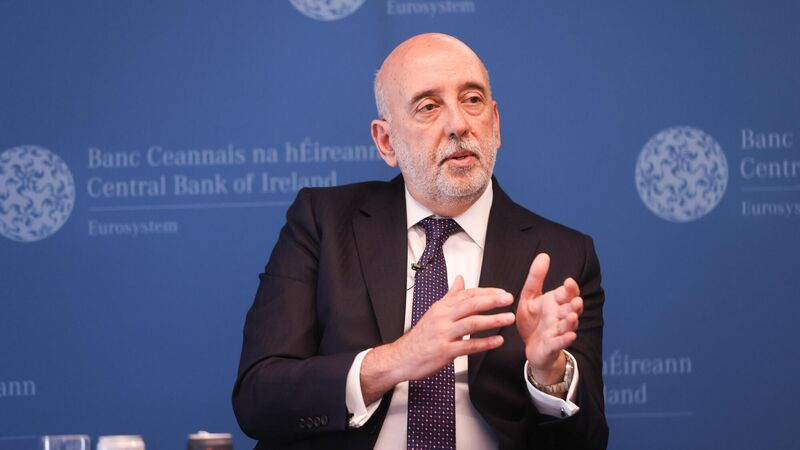
Central Bank of Ireland governor, Gabriel Makhlouf, has previously warned that housing and infrastructure shortages will have a negative effect on the country’s competitiveness and addressing these matters should be considered a high priority. Photo: Eamonn Farrell / © RollingNews.ie
Given the global economic uncertainty, the governor of the Central Bank of Ireland has called on the Government to focus on what it can control by investing in infrastructure, broadening the tax base, and installing a "credible fiscal anchor” to guard against repeating past mistakes.
In his annual pre-budget letter to the finance minister Central Bank governor Gabriel Makhlouf said as a small open economy that has a heavy reliance on trade, Ireland is “exposed to the fall-out from changing geo-economic relationships and priorities”.
He said this year’s budgetary measures should advance areas such as broadening the tax base given the risk of the sustainability of corporation tax, addressing infrastructure gaps in a sustainable manner, and planning for the fiscal impact of long-term challenges.
“Achieving progress in these areas will entail trade-offs and require choices and commitments to be made on public expenditure and taxation along with reforms to improve efficiency in the delivery of public capital expenditure and the crowding in of private investment,” the governor said.
The Central Bank has previously warned that housing and infrastructure shortages will have a negative effect on the country’s competitiveness and addressing these matters should be considered a high priority.
In his letter, Mr Makhlouf warned that “public capital investment alone will not be sufficient to address the housing and wider infrastructure gaps that have emerged” and that broader fiscal policy “should more actively consider reforms to crowd in private investment and to promote productivity growth”.
He said that reforms to reduce delays in planning and construction are needed so the benefits of public investment for longer-term growth are fully realised.
Mr Makhlouf said the tax base also needs to be broadened in order to address known emerging funding needs and to mitigate the reliance on corporation tax.
“Analysis by Central Bank staff indicates that government expenditure will need to rise by 6.5 percentage points of national income, or €265bn, between 2025 and 2050 to fund higher age-related spending and the additional public investment required to meet housing and net zero targets,” he said.
“It is important that transfers to the Future Ireland Fund (FIF) and Infrastructure, Climate, and Nature Fund (ICNF) continue as planned but also that the funds are not seen as a panacea.
"For example, the FIF will be insufficient – on its own – to fund the higher level of public expenditure that will be required to meet the needs of an older population and to fund climate and housing investment.”
Mr Makhlouf said that taking action now to broaden the tax base would help to ensure that additional known expenditure needs can be met sustainably even if corporation tax was to decline significantly.
The governor added that to avoid past mistakes and shift budgetary policy away from an excessive short-term approach, the Government should commit to a “credible fiscal anchor” for budgetary policy to ensure the overall fiscal stance is suitable and guards against “procyclicality and boom-bust dynamics and safeguards long-run fiscal sustainability”.
The Government had had a fiscal rule in place for several years whereby current spending increases should not exceed 5% annually.
However, the Government have yet to adhere to the rule since its introduction in 2021.
CONNECT WITH US TODAY



Be the first to know the latest news and updates