Central Bank governor Gabriel Makhlouf warns 'uncertainty the new certainty'
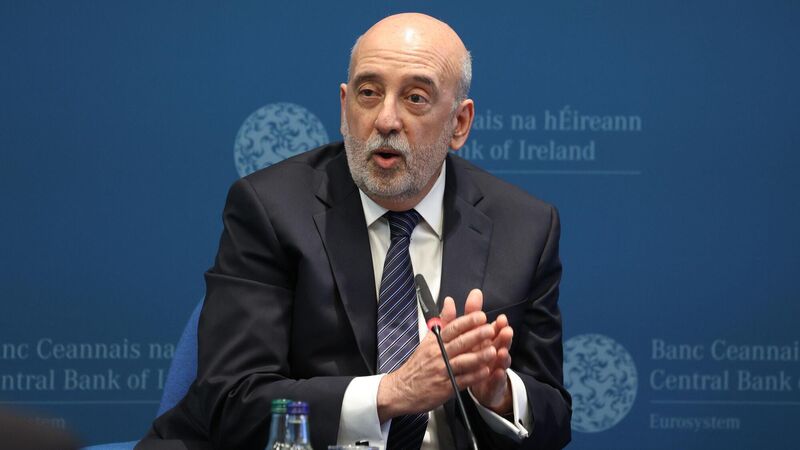
The governor of the Central Bank Gabriel Makhlouf has said the European Central Bank must be prepared to react quickly if economic growth and inflation diverge from expectations, with "uncertainty the new certainty".
The governor of the Central Bank Gabriel Makhlouf has said the European Central Bank should not rely on its baseline outlook and must be prepared to react quickly if economic growth and inflation diverge from expectations, with "uncertainty the new certainty".
Mr Makhlouf and fellow ECB governing council member Jose Luis Escriva said on Tuesday that the new trade environment will need a fluid policy.
Speaking at the International Economic Symposium in Dublin, co-hosted by the Central Bank of Ireland and the National Association for Business Economics, Mr Makhlouf said monetary policy must adapt to the new nature of supply shocks generated by geoeconomic fragmentation. “With so much uncertainty around what the new geoeconomic framework will turn out to be, scenario analysis gives a sense of the range of possible outcomes,” he said.
Mr Escriva agreed, saying in times of elevated uncertainty, “the centralized scenario becomes less informative and I think the way out is to rely more on fully fledged, well-designed alternative scenarios that should gain relevance”.
The bulk of the current uncertainty is down to US president Donald Trump’s erratic trade policies, which look set to curb growth in the euro zone’s 20-nation economy while weighing on inflation — at least in the near term.
With consumer prices set to return to the 2% goal in the months ahead, policymakers are considering adding to the seven reductions in borrowing costs they’ve made since June 2024. Investors are leaning toward two more by year-end.
Scenarios plotting the possible outcomes of the US tariffs could come when the ECB publishes its next quarterly outlook in June. It’s previously used projections to present alternative economic paths, for instance during the pandemic and the war in Ukraine.
For Mr Escriva, it’s obvious that Mr Trump’s trade levies will dampen growth, though the effects on inflation are less clear.
“We need to be now agile in potentially changing the monetary-policy response,” he told a conference in Zurich, advocating a greater focus on high-frequency data at the current juncture. The need for full optionality is “more present than ever”, he said.
In a speech, Makhlouf went into more detail on the how the current trade strife could pan out, offering three scenarios.
The first envisages short-lived tariff threats but persistent uncertainty over trade policy that drags down investment and sentiment. This could prove deflationary.
The second assumes “reciprocal” tariffs become permanent, prompting retaliatory measures that have a more negative impact on growth. The effects on consumer prices here are less clear.
A third sees the US agreeing on a trade deal with Brussels, but tensions with China continuing that could result in exports from that nation being diverted to the EU.
“Uncertainty is the new certainty and navigating such an environment requires adaptability from both policymakers and businesses,” Makhlouf said. “Agility and flexibility will be important.”
Bloomberg


CONNECT WITH US TODAY



Be the first to know the latest news and updates