ECB's Philip Lane warns strong inflationary pressures warrant holding back economic growth
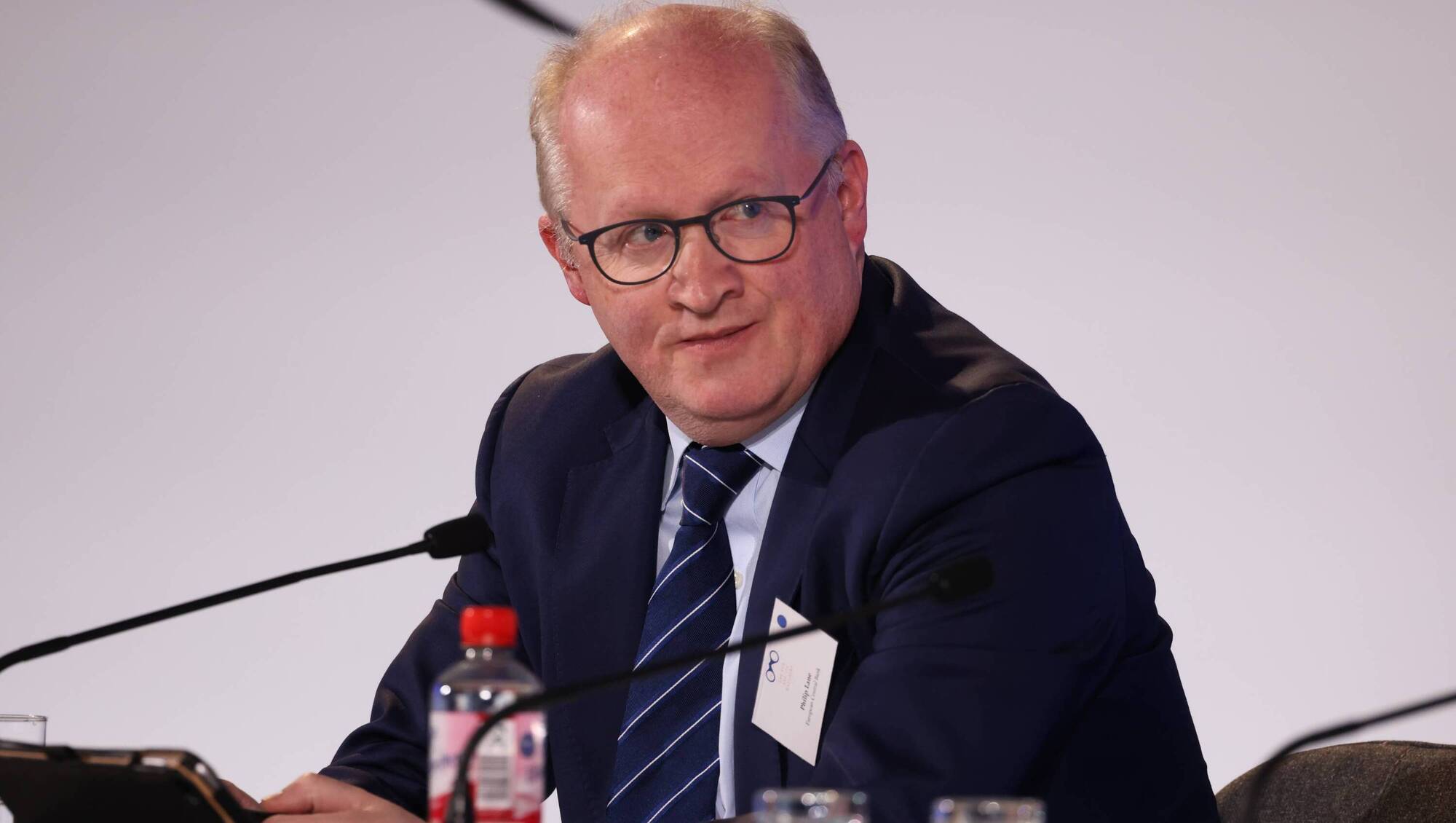
ECB chief economist Philip Lane said wage growth — the key driver of inflation — was 'still elevated', as firms adjust wages in response to past inflation, but he was expecting a slowdown next year.
Inflationary pressures are still strong enough to warrant the European Central Bank (ECB) keeping rates higher and holding back economic growth, its chief economist Philip Lane has said.
Last week, the European Central Bank announced a 0.25% reduction to its main lending rate following an aggressive campaign of interest rate hikes used to drive down high inflation.
However, further rate reductions at its next meeting in July is not guaranteed, with various ECB governors repeating the party line there is unlikely to be a rapid fall in interest rates.
Inflation across the eurozone is projected to average out at 2.5% this year and 2.2% next year. This is compared to the averages of 8.4% and 5.4% seen in 2022 and 2023 respectively.
Speaking at a conference organised by the Banking and Payments Federation, Ireland Mr Lane said the current task of monetary policy was to ensure “full disinflation is secured” with the goal of returning to the ECB’s 2% annual target.
However, Mr Lane noted wage growth — the key driver of inflation — was “still elevated”, as firms adjust wages in response to past inflation, but he was expecting a slowdown next year.
"The high level of uncertainty and the still-elevated price pressures that are evident in the indicators for domestic inflation, services inflation and wage growth mean that we will need to maintain a restrictive monetary stance," he said.
The growth in compensation per employee ticked up from 4.9% at the end of 2023 to 5% during the first three months of 2024.
“The set of forward-looking wage trackers also signal that wage dynamics will remain elevated in 2024 but will decelerate in 2025,” Mr Lane said.
"This negatively-sloped profile for wage growth helps to underpin the projected decline in inflation in 2025, with less pressure from labour costs next year.”Â
Mr Lane said the ECB was not committing to any further policy easing after last Thursday's rate cut, and any follow-up decisions would be taken meeting by meeting.
Â
Mr Lane added corporate profit margins were also set to shrink further and that too would absorb some of the wage increases, taking pressure off consumer prices.
While economic growth has picked up, this does not seem to be threatening to boost price pressures since demand in sectors most sensitive to interest rates remains subdued.
On Monday, ECB governing council member Peter Kazimir said the bank’s September policy meeting would be key for officials to determine whether to cut interest rates again. The Slovak central bank chief implicitly ruled out a rate cut next month, saying he and his colleagues would need more data and time to assess the price risks to the economy.
Another governing council member, Joachim Nagel, echoed Mr Kazimir and said the ECB may not cut interest rates again for a while as it watches to see how quickly inflation recedes to its 2% target.
Central Bank of Ireland governor Gabriel Makhlouf went as far as suggesting the ECB might not carry on with further loosening policy at all.