Anthony Foley: How many public sector workers are there in Ireland?
Health and education are by far the largest two sectors for public service employment, accounting for 276,042 jobs or 69.5% of all public sector workers
Anthony Foley: How many public sector workers are there in Ireland?

The number of people working in health, which now accounts for 37.7% of all public-sector jobs, has increased since 2015. File picture

How many public servants are there, where do they work, and are there too many or too few of them?

There were 400,000 full-time equivalent jobs in the public sector, or one public-sector worker for every 13.3 persons in the population, in 2020, which compares with 13.8 persons for the population in 2008.

(My figures are based on full-time equivalent jobs, with part-timers converted to equivalent full-time jobs. I also count people directly employed by the State, but not people who work for organisations that are part-funded by the State.)

Public-sector employment exceeded 300,000 people for the first time in 2006, and reached its maximum pre-austerity level of 325,100 in 2008.

For context, total employment by last year had expanded to 2.7m people, or 2.4m people when measured as full-time equivalent workers. 

Education accounts for 31.8% of all public-sector jobs. File picture

Public-service employment accounted for 16.2% of total employment, a ratio of one public-sector job for 6.2 other jobs. 

In 2008, that share stood at 16.7%; meaning that in 2023 there were relatively fewer public servants.

The pattern is for increases in numbers from 1990 to 2008, decreases from 2009 to 2013, and increases from 2014, as the public finances improved. There was an increase of 19,811 public-sector jobs in 2023.

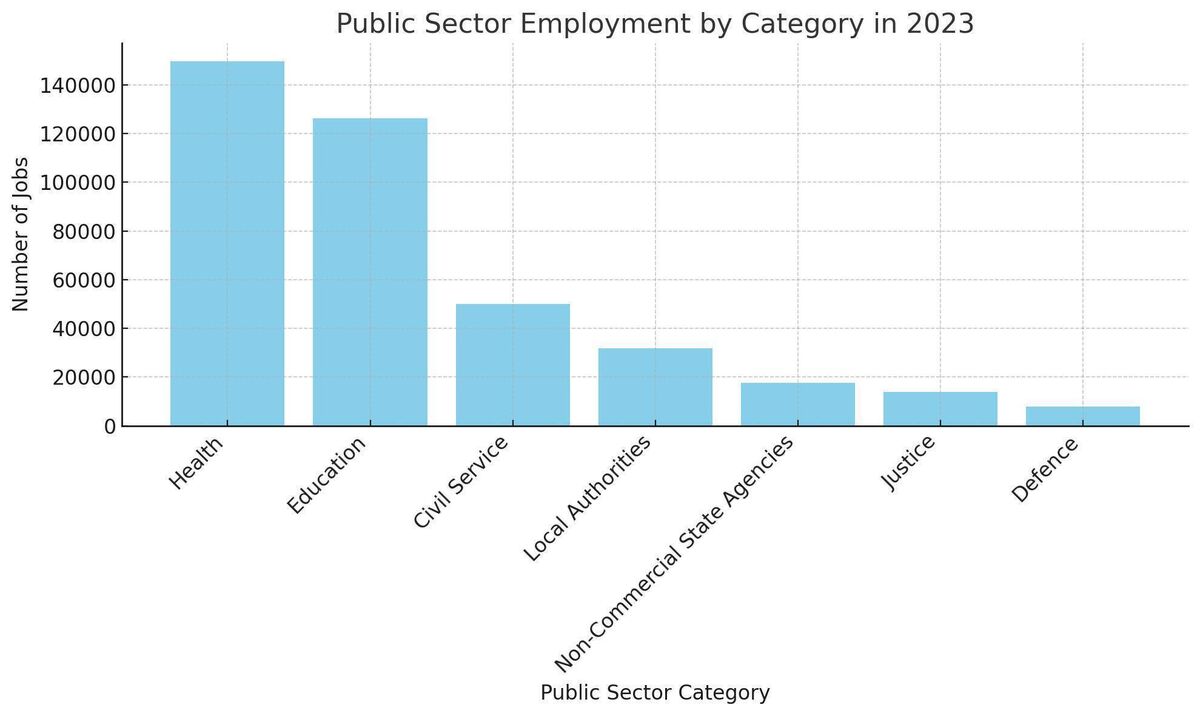
Health and education are the largest two sectors for public-service employment, accounting for 276,042 jobs or 69.5% of all public-sector workers.

Health provided 149,700 jobs and education 126,300 jobs. 

Other major public sectors include the civil service, with 49,900 jobs, local authorities, with 31,800, non-commercial state agencies, with 17,500 jobs, and the justice and defence sectors, with 13,900 and 7,9000 jobs, respectively.

Surprisingly, defence, justice, and local authorities all employ fewer people than they did in 2008, although some differences reflect changes in activities and responsibilities.

The number of people working in health, which now accounts for 37.7% of all public-sector jobs, has increased since 2015 and did so through the pandemic more quickly than the growth in the population.

The number of people in the population over 65 years, and who have a relatively large demand for health services, has, however, increased sharply.

Education accounts for 31.8% of all public-sector jobs and the numbers in the sector have increased by almost 33% since 2008, partly reflecting an increase of 20.6% in the five- to 19 year olds in the population. (The number of jobs in third-level education has increased only slightly since 2008, to 21,670.)

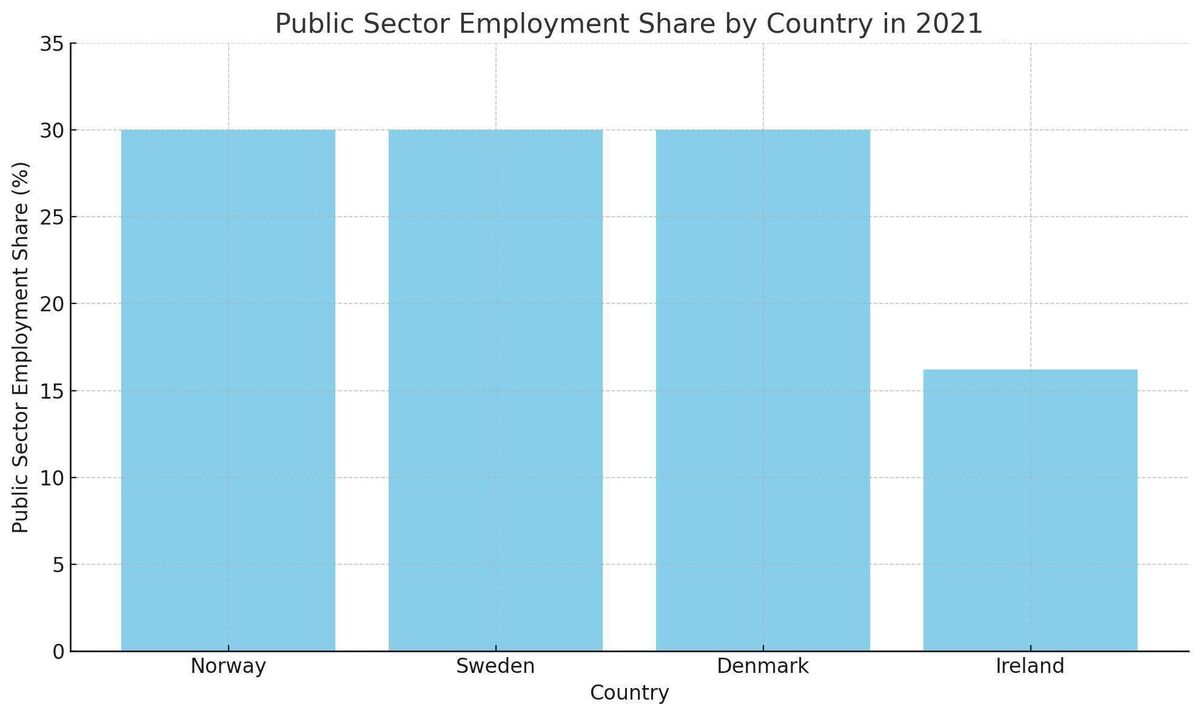
According to the Organisation for Co-operation and Development, the Nordic countries, Norway, Sweden, and Denmark, have the highest public employment shares, close to 30% of total employment in 2021, while Ireland was ranked the 11th-highest for public-sector employment.

The appropriate levels of public-sector employment depend on several factors, including affordability (workers have to be paid from tax revenues), targets for service quality (smaller class sizes require more teachers), level of demand (more patients require more medical staff if the quality of service and productivity are unchanged), and productivity and efficiency.

We must consider quality of service and the level of demand in assessing the appropriate levels of staff and increased funding.

  • Anthony Foley is emeritus associate professor of economics at Dublin City University Business School

x

More in this section

The Business Hub

Newsletter

News and analysis on business, money and jobs from Munster and beyond by our expert team of business writers.

Cookie Policy Privacy Policy Brand Safety FAQ Help Contact Us Terms and Conditions

© Examiner Echo Group Limited