Pensions: Your simple guide to getting retirement ready

Sleeping soundly in retirement: Your guide to funding the retirement of your dreams.
By rights, you should be planning for your retirement as soon as you land your first job. These days, however, young workers have enough to do trying to make the rent each month.
What might or might not happen 40 or 50 years down the line doesn’t get much of a look in.
The simple truth is this, however. The earlier you start, the greater the potential for your pension pot to grow. Conversely, the longer you leave it, the more you’ll have to put away in the future to secure any kind of retirement nest egg. Starting early also gives much better capacity to deal with stock market volatility, because when share prices fall, your fund can buy more cheaply. This helps smooth out returns over time.
In each of these four scenarios in the accompanying graphic, we look at how much you will need to save per year to earn a given proportion of your current salary. Each assumes no prior pension savings and all calculations are worked out using the Pension Authority’s online calculator. While these figures aren’t definitive, they offer a good working example of how much you will need to put away to fund your post-working life.
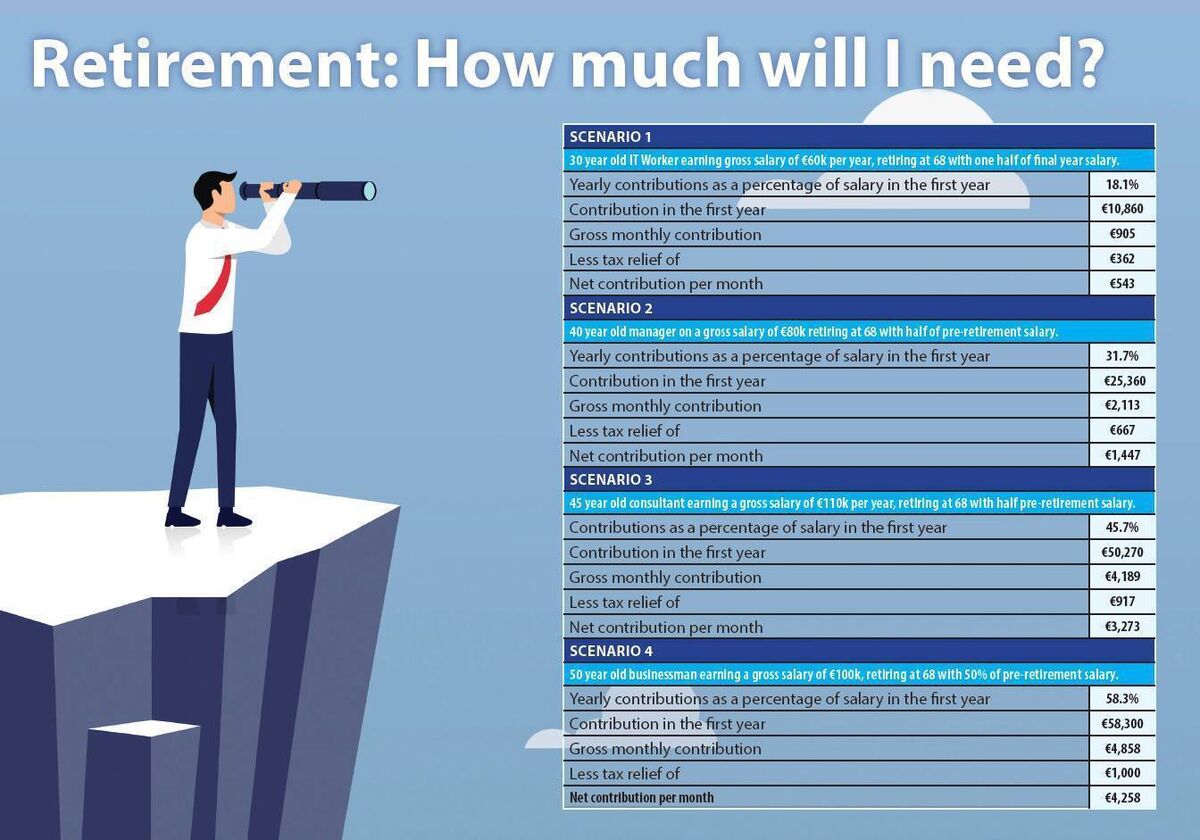
To know how much you’ll need in retirement, you need to have some sense of what your expenses will be. For most retirees, daily costs decline when you clock out for the last time.
There are no more commuting expenses for a start. Many people will also have their mortgage paid off at this point, so the costs of accommodation will also decrease.
In the normal course of events, you’d expect that children will no longer be a source of expense, but with no sign of an end to the housing emergency, many adult children continue to live at home, and often rely on parental support to get onto the property ladder.
And then there’s healthcare. It’s great that we’re all living longer, but these years usually require a lot more medical intervention and the associated costs that come with it.
Once you know how much you’ll need, you then turn your attention to income, and for most of us, that means pension. The pension remains one of the most important financial products you’ll ever have and continues to play a crucial role in the type of lifestyle you’ll have in retirement.
The point at which you can start receiving pension benefits depends on the type of plan you have. Most pensions allow you to take benefits early if you have to give up work due to a serious illness. If you retire early, your pension will likely be much lower than if you continue to work and make contributions up to the expected retirement age for your pension plan.
If yours is a personal pension plan, you can usually retire at age 60 if you wish, but the option is there to continue working and contributing, and delay taking benefits up to age 75.
If you’ve got a personal retirement savings account (PRSA), you can access your funds from age 50 if you are an employee and retiring from that employment. If you’re self-employed or you’re not earning an income, you can’t access PRSA funds until age 60, and again, you can continue to contribute right up to age 70.
With employer pension plans, you can usually retire and begin receiving payment from age 60, but if you retire early, it is possible to access funds from age 50 with the employer’s consent.
Providing for retirement is one thing. Providing enough for retirement is quite another. If your pension contributions won’t deliver the lifestyle you want at retirement, there are ways and means of upping your contributions and/or making lump sum investments into your pension pot.
If you already have an occupational pension, the best way to do this is via the Additional Voluntary Contribution, or AVC.
Basically, you decide the level of AVC you want to pay. Tax relief is available just as it is with standard pension contributions, subject as always to age criteria. The older you get, the greater the relief. The AVC is paid into an investment fund, which is usually invested in a mix of shares, bonds, property and cash. Like all investments of this nature, the value can fall as well as rise.
At retirement, your AVC fund is used to top up your retirement benefits. You can decide how to use the fund, within certain limitations.
You can use your AVC fund to top up your tax-free lump sum, or you can use it to transfer any balance to an Approved Retirement Fund or ARF, which you can draw down in retirement. Alternatively, you can use it to buy an annuity. This is a contract with a life insurance company that will pay a regular pension income for life in return for a capital sum.
The other pension boosting tool is the PRSA – the Personal Retirement Savings Account.
If there’s no facility for AVCs in your employer’s pension scheme, you can set up your own independent PRSA into which you can then pay AVCs. In this case, your contributions will not be automatically deducted from your salary before tax. You will have to arrange to pay the AVCs and claim tax relief yourself.
The other point to make here is that pensions can be complex products, so you may wish to get financial advice. The financial advisor will discuss your options and recommend a product based on suitability.
CONNECT WITH US TODAY



Be the first to know the latest news and updates