Central Bank: Government's budget plans will add to short-term inflation

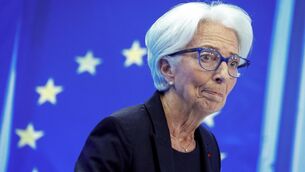
The Central Bank is forecasting inflation to average out at 5.4% this year and drop to 3.2% next year. Photographer: Jason Alden/Bloomberg
The Government's “expansionary” budget plans will “amplify demand” in the economy and contribute to inflationary pressures, the Central Bank of Ireland has warned.
In advance of the budget next month, Finance Minister Michael McGrath has said there would be €6.5bn worth of new measures with €5.25bn going to extra expenditure and €1.15bn in tax cuts. Additional funding for once-off measures are also expected.
Earlier in the summer, the Central Bank warned the Government against an expansionary budget saying it should stick to its own rule of limiting net spending increases to 5% a year.
According to the Central Bank latest quarterly bulletin, the path back to lower rates of headline inflation is likely to be “gradual and uneven”. Annual inflation in Ireland rose to 6.3% in the year to August — up from 5.3% in July.
Should there be no further energy or supply chain shocks, inflation is expected to average out at 5.4% this year.
The bank is now forecasting inflation to moderate to 3.2% next year and 2.3% in 2025 as energy, food and industrial goods price growth slows. Core inflation, which excludes energy and food prices, is expected to be more persistent and average out at 2.7% in 2025.
However, Robert Kelly, director of economics and statistics at the Central Bank, said the Government’s Summer Economic Statement (SES) is “significantly more expansionary” than what was outlined in the Stability Programme Update in April which will “contribute to short-term inflation”.
“That will amplify demand within the economy. Given the capacity constraints we face, it would feed short-term inflation and ultimately if allowed to be maintained into the medium term, it would start to impact the competitiveness of the Irish economy,” Mr Kelly said.
"We are definitely entering a period where fiscal [policy] is now making a larger contribution to demand stimulus than had been anticipated six months ago. It will produce inflationary pressures.”
The bank is also expecting growth rates in the economy to slow further as capacity constraints become more of an issue.
Since the last quarterly bulletin in June, revisions have been made to the national accounts which showed that the domestic economy, as measured by Modified Domestic Demand (MDD), grew by 3% more than previously thought last year. MDD is a measure of the economy that excludes the activity of multinationals and focuses on underlying domestic activity, including government spending and investment.
The Central Bank said when this growth is placed in the context of already obvious capacity constraints, it highlights the strength of underlying demand relative to supply conditions putting upward pressure on inflation. According to the Central Bank, economic growth is expected to moderate with MDD forecast to grow by 2.9% this year, dropping to 2.6% next year and 2.3% in 2025.
The tight labour market is predicted to persist for the coming years with the pace of jobs growth expected to slow due to various constraints, including housing supply. Unemployment is projected to remain close to 4% out to 2025. The resulting tight labour market conditions will place upward pressure on wages, allowing for a catch-up in real incomes following the decline in 2022.
CONNECT WITH US TODAY



Be the first to know the latest news and updates