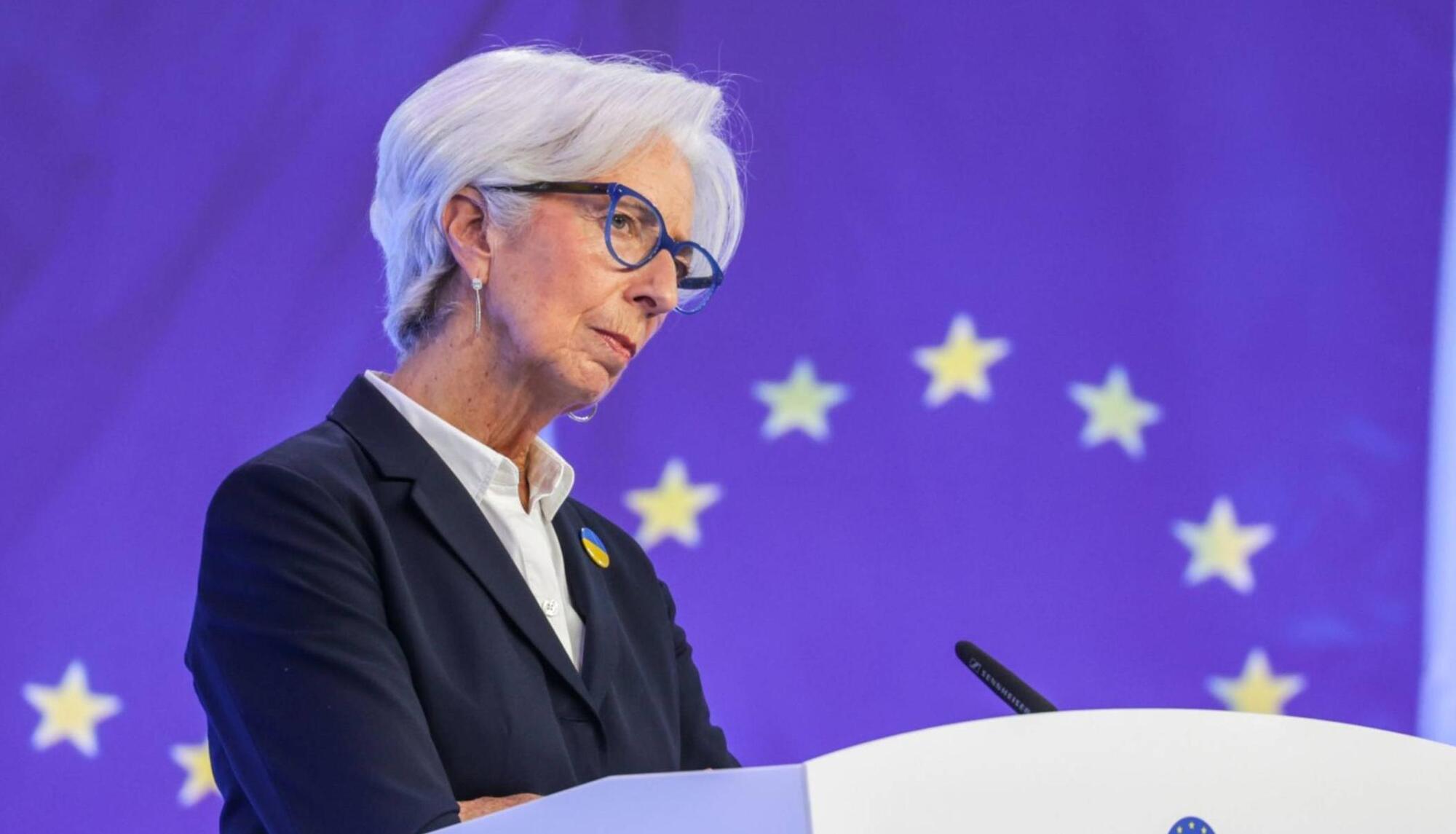
On September 14, the Governing Council of the European Central Bank (ECB) will meet to decide on future interest rate policy.
Central bank actions are not always predictable, but there is now particular uncertainty regarding what it might or might not do at that meeting.
This uncertainty really stems from the fact that a lot of tightening has already been delivered and there is a long-time lag for the full effect of rate increases to feed through the system and achieve the desired objective.
The desired objective is to get inflation back to its 2% target.
At the end of July, the ECB increased rates by 0.25%, which means that since last July, rates have been increased by a cumulative total of 4.25%.
By any historical standard, this is a dramatic tightening of monetary policy in a relatively short period of time.
There is certainly now a sense that it may have done enough, but one cannot be certain as central bankers occasionally engage in overkill on the way up or indeed on the way down.
Just like economic forecasting, central banking is far from being an exact science, putting it mildly.
In the statement following the July increase, the ECB said that it would ensure that interest rates “will be set at sufficiently restrictive levels for as long as necessary”.
Subtle but significant change
This represents a subtle and significant change in language from the prior meeting, when the ECB said that it would ensure interest rates would be brought to levels that were “sufficiently restrictive” to bring inflation down to the 2% target.
The change in language suggests that the ECB perhaps thinks that it has now done enough but is still not certain.
While global economic data has generally been mixed and confusing over the past year, there are clear signs that economic growth and inflationary pressures across the eurozone are abating.
The bottom line is that the ECB is now doing what many of us are doing, namely data watching.
Headline inflation in July declined to 5.3%, which is still well above the desired 2% target, but it is down from a peak of 10.6% in October of last year.
The problem is that much of this decline has been driven by declines in oil and gas prices. Core inflation, which excludes energy, food, tobacco, and alcohol is still running at an unacceptably high 5.5%.
Inflation in services sector
Of particular concern is the inflation rate of 5.6% in the services sector.
This is exactly the situation in Ireland, where service sector inflation is running at 10% and goods inflation at just 0.6 %.
Service sector inflation across the eurozone, and indeed in the US, is being largely driven by the tightness of labour markets.
The unemployment rate in Ireland is close to a historic low of 4.1%, and 6.4 % in the eurozone, which is the lowest since the euro was created in 1999.
The ECB would like to see unemployment rise and would regard this as a price worth paying to bring inflation back under control.
Other indicators of activity in the eurozone suggest weakness, particularly in manufacturing activity, which is a particularly important sector in Germany.
The Purchasing Managers Index (PMI) for manufacturing is at 42.7 and the PMI for services is at 50.9.
These indices are constructed on the basis that a reading above 50 means that more firms are expanding rather than contracting, and a reading below 50 suggests more firms are contracting than expanding.
Manufacturing
Manufacturing is clearly in dire straits, while service sector activity is trending weaker. GDP growth in the eurozone declined by 0.1% in the final quarter of 2023.
It was flat in the first quarter of 2023 and expanded by 0.3% in the second quarter.
These data are suggestive of an economy that is bouncing along the bottom, and inflation is gradually moving towards its target.
The ECB would now be sensible to cease its rate tightening and wait to see how the past year’s rate increases work through the system.
Meanwhile, the Irish banks will continue to earn substantial net interest margins at the expense of the deposit base.
We can only guess what the Irish banks will do when the ECB starts to loosen monetary policy.
Jim Power is a leading Irish economist
CONNECT WITH US TODAY
Be the first to know the latest news and updates