American food outlets are taking big steps in Irish market
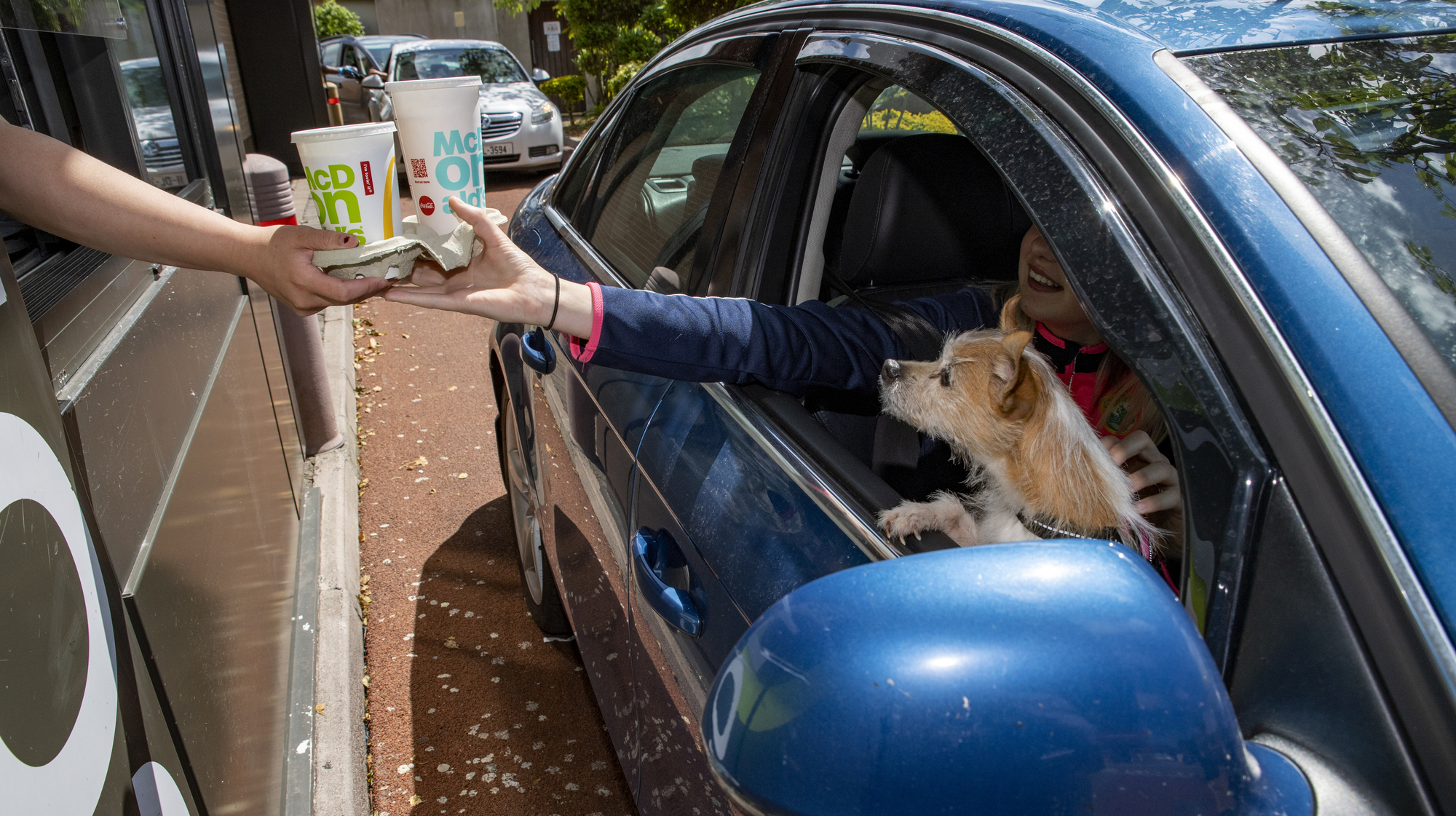
Buttons the dog and his owner Shannon Lawlor arrive at McDonalds Tralee. Photo: Domnick Walsh
explains why American food outlets are big players in Ireland, an important market in itself and a key gateway into Europe.

American food outlets are big players in Ireland. We all know this. Walk down any high street in the country and chances are you’ll see storefronts showcasing their logos and brands.
The first McDonald’s to open in Ireland was on Dublin’s Grafton Street. There had been lots of talk in advance. Mention of milkshakes, which as a youngster, sounded cool in a Hollywood diner way.
I don’t remember getting the bus to town, or first walking through the restaurant doors — just shuffling along in the line and asking for a milkshake. “What sort?” was the tired looking server’s immediate response. Clueless as to what might be an appropriate reply, I scanned the too-bright menu on the wall behind her, before requesting a chocvanstraw.
The silence that followed was acute, then broken by the crew member who advised — as if she were talking to the thickest person she’d ever met — that this was not an option.
“You have to pick,” she prompted loudly, as the queue shifted and sighed at the momentary hold-up, a shadow on the fast-food promise. “Chocolate. Or vanilla. Or strawberry.” Years passed. “Strawberry,’ I replied, the colour of my mortified face.
That was 1977. The year the butter mountain threatened to capsize the European Economic Community (EEC). A time when dairy was the talk of every town, yet milkshakes were for so many of us — from blenderless, liquidiserless and foodprocessorless Irish families — a glamorous untried treat, until Ronald’s crew came to stay. And stay they did.
46 years later the American food outlet has 95 branches here. Doubtless, it helps that they showcase the Bord Bia Quality Assured logo, verifying their beef comes from one of the Irish farms that supply them.
The power yielded by McDonald’s is substantial. It’s the largest buyer of Irish beef by volume every year, purchasing 40,000 tonnes. That Ireland is a key gateway to Europe, is apparent when we consider that one in every five burgers sold in their restaurants across Europe is of Irish origin.
Ireland's restaurant and takeaway market is booming, with Bord Bia the industry worth over €6.1 billion in 2022. While American food outlets are thriving here, naturally the trading relationship flows both ways.
Ireland’s food and drink exports to the US increased by almost 40% last year to reach an estimated €1.75 billion. So says Bord Bia CEO, Jim O’Toole, adding: “The US is an important and valuable market for Irish food and drink exporters.”

It is for sure. But US beef imports from Ireland halved in 2022 compared with the previous year — a titanic fall that was confirmed by the United States Department of Agriculture (USDA). Bad news for Irish dairy farmers for sure. But if there is a plus side, it’s this: fewer animals enduring a nightmarish Atlantic crossing before the fate from hell befalls them.
Concern for our fellow sentient beings, or for the environment, or both are leading a trend towards plant-based foodstuffs. Burger King sells plant-based beef alternative patties here. Glimpse at their website and you will find out why.
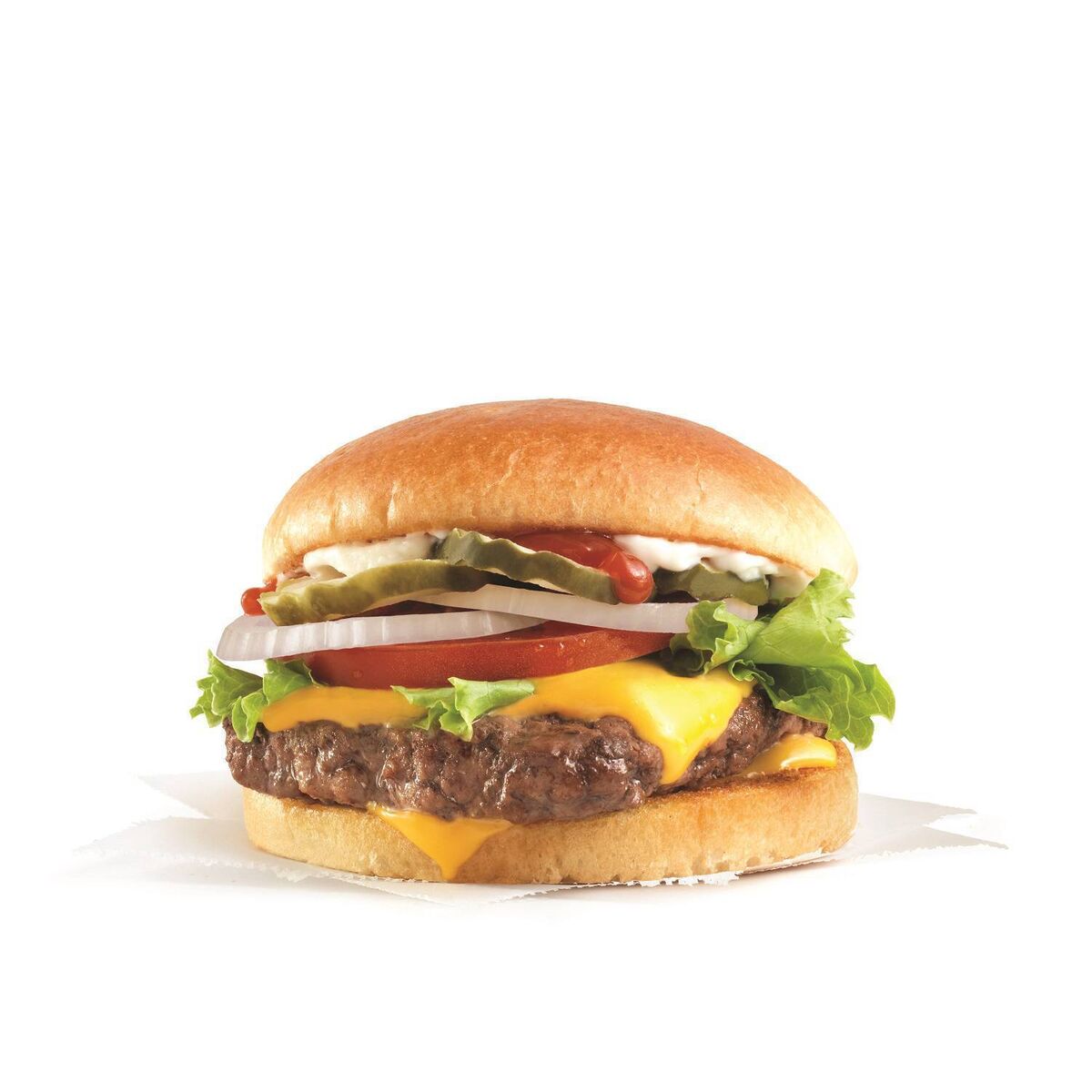
Reference is made on the Burger King website to Mother Earth. So too is confirmation that their plant-based patties contribute up to 90% less CO2e emissions than their regular beef variety. Also, that their supplier for plant-based beef and chicken alternative patties is committed to sourcing Non-GMO soy from areas of low risk for deforestation.
Nature is a mystery to many of us, but we’re learning more about our planet and our impact on same with every passing year. Years ago, at my first biology class, when asked whether seaweed was plant or animal, I — presuming until that very moment, that any old eejit would think it was the former — replied ‘animal’. Hindsight.
Back then, if we’d been asked the same question about burgers or almost any other fast-food, my answer would have been right. Today, not so much. Irish fast food outlets are also providing plant based options. Some, including The Rolling Donut offer a wide vegan range. Others, such as Supermac’s — while their beef is 100% traceable and Irish farm assured — also offer a vegetarian friendly ‘veggie burger’ and a vegan sub sandwich.
Ireland’s American hamburger scene is set to become more competitive. Wendy’s recently announced plans to enter the Irish market with a view to further expand brand presence across Europe. The chain which was founded in Ohio over 50 years ago, is currently recruiting franchise partners here.
It might be vaguely fun to say the American food outlet business in Ireland is dog-eat-dog, but there’s doubtless a better description. Either way, expansion is everywhere. Krispy Kreme recently announced the opening of 18 new outlets here, generating jobs across Ireland.
While they already have partnerships here with Tesco and Circle K, recent collaborations include those with Applegreen and The Plaza Group. This extends their territory beyond the Leinster area. The retailer has gone on record as stating a desire to ‘create a significant number of jobs in Ireland,’ with the opening of new stores this year.
Declan Foley, country manager, Ireland, says the company is ‘really excited to continue opening new shops and locations in Ireland’.
“Our fans have shown their love for Krispy Kreme since we launched in September 2018,” he says. “Their favourite doughnut continues to be our irresistible Original Glazed, which is made fresh each day, locally in Ireland.”
In case you wondered, that same doughnut is the American favourite as well, with 36% of those polled selecting it as their ‘top choice’.
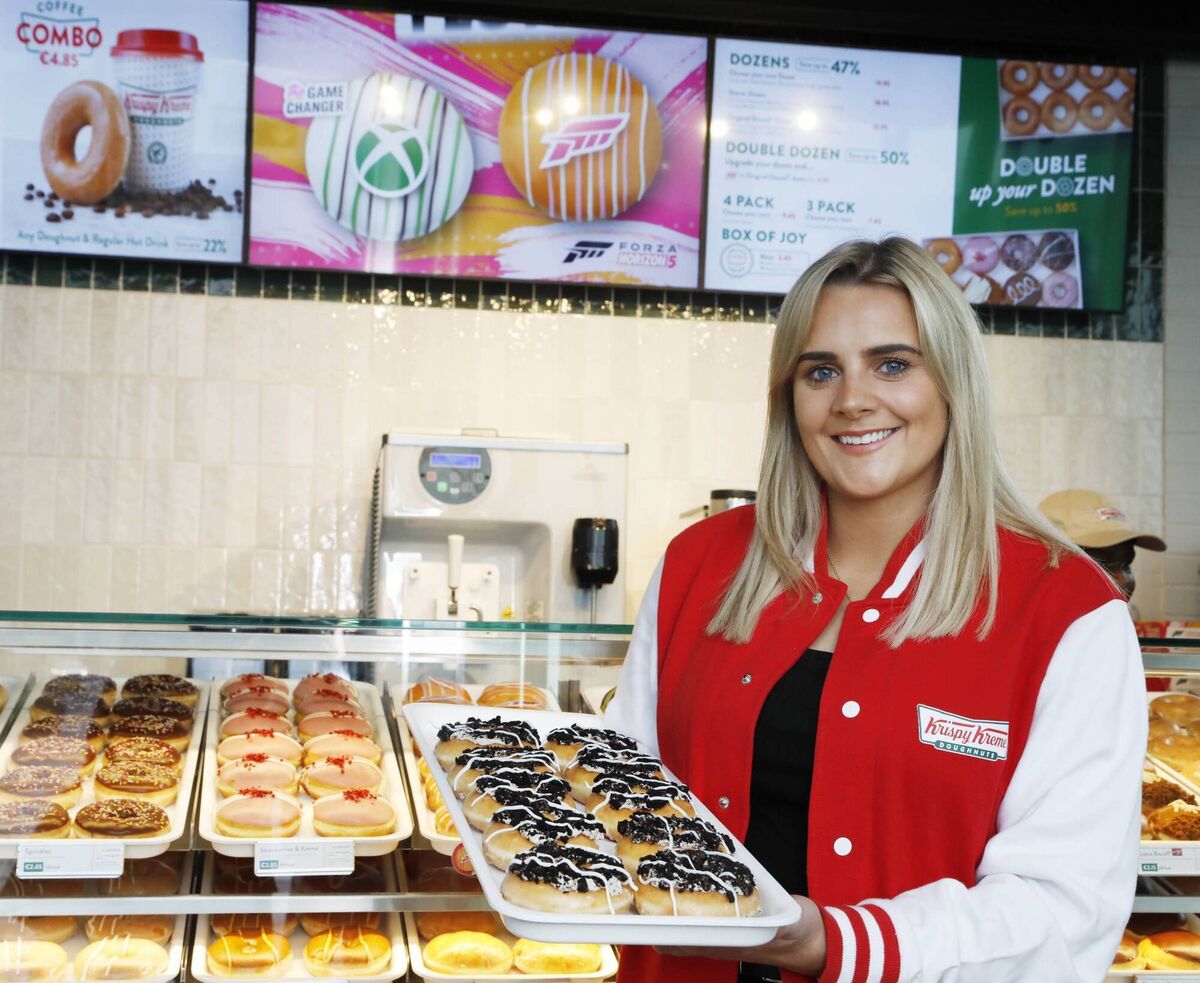
Foley says Krispy Kreme’s ‘on a mission to lift the mood of the nation, bringing happy moments that can be shared with loved ones.’ It’s an aspiration that makes sense. Fast food being comfort food and the availability of in-store seating, providing an affordable dining experience for the sweet of tooth.
On Ireland’s success at attracting US investment over the decades, Mark Redmond, AmCham CEO, says the many factors that contribute include the pro-enterprise policy approach provided by consecutive governments, our EU membership, talent pool and the continued messaging that inward investment is a national priority.
Redmond says the multinational community, and decision-makers at corporate headquarters, appreciate the consistent message from Ireland, that it really welcomes inward investment, in particular large-scale capital and jobs-intensive investments, adding: “As a result, more than one-third of US MNCs have been here for more than 20 years."
He adds: “Ireland’s pro-enterprise ecosystem is supported by extensive and timely consultation processes by government with key stakeholders, before policy changes are announced or implemented. This is key in providing certainty and stability for business.”
Redmond believes EU membership has transformed our country and helped us to build a global location of choice for talent and innovation: “The transatlantic economy is the largest and wealthiest in the world and Ireland is now the only English-speaking, common-law gateway to the European Union for the United States,” he says, adding: “This has been a factor in many US MNCs choosing to locate their European headquarters here.”
We don’t know the origin of the burger but some think it all began in Harmburg, which sounds credible, if nothing else. Still, they’re largely associated with the US.
In a struggling economic climate, having celebrity names positively linked to your brand helps drive sales. Kylie Jenner, posted the words I love McDonald’s on her Instagram stories a few years back. She’s the most influential woman on the free photo and video-sharing app, with over 375 million followers.
While the billionaire businesswoman’s endorsement likely hiked that brand’s burger sales, it’s possible that the photograph of Donald Trump eating KFC on a private plane was — given his niche following — somewhat less, for that brand.
With 23.3 m followers on Insta, he has, along with said fried chicken, been snapped eating tacos and burgers from large American food chains. It’s possible the desired message being sent is that he’s a man of the people, fast food being his PRs’ chosen catalyst in promoting the equalising message. The foods being consumed on a private plane, telling another story altogether.
Other competition for fast food outlets has already arrived in the UK, with Sainsbury’s signing a deal with the food delivery app Just Eat to offer speedy delivery of groceries from 175 stores. The collaboration which is due to kick off at the end of this month offers consumers outlets in London, Bristol and Edinburgh the choice of 3,000 products being delivered within a 30-minute timeframe.
Last month, the World Economic Forum (WEF) annual meeting took place, as usual, in Davos, Switzerland. There, despite the certainty of sobering statements and predictions being exchanged, it’s not yet known whether this year’s hotdogs are more affordable than the $43 reportedly paid by a CNBC International journalist who was there one time.
Last year, Bloomberg reported that the ties that bind the global economy and deliver goods in abundance across the world are unravelling at a frightening pace. Russia’s invasion of Ukraine and China’s Covid Zero lockdowns, it stated, were disrupting supply chains, hammering growth and pushing inflation to forty-year highs. These were the prime reasons behind Bloomberg Economics lopping $1.6 trillion off its forecast for global GDP in 2022.
In January, Reuters reported that The World Bank (WTB) predicted a global recession for 2023, anticipating GDP growth of 1.7%, the slowest pace - outside the 2009 and 2020 recessions - since 1993. In its previous Global Economic Prospects report in June 2022, the bank had forecast 2023 global growth at 3.0%.
The WTB predicted major slowdowns in advanced economies, including sharp cuts to its forecast to 0.5% for the United States and flat GDP for the eurozone, could foreshadow a new global recession less than three years after the last one.
Closer to home, IFA president, Tim Cullinan says: “From a farming perspective, American food outlets play a significant role as some of the largest purchasers of Irish produce, particularly meat. The fact that these global brands buy so much is recognition of the quality beef produced from our grass-based production system. The impact of their closure during the pandemic was felt acutely and drove home just how important they are to the ongoing success of our sector.”

CONNECT WITH US TODAY



Be the first to know the latest news and updates