University spinouts need more cohesive support, says lawyer
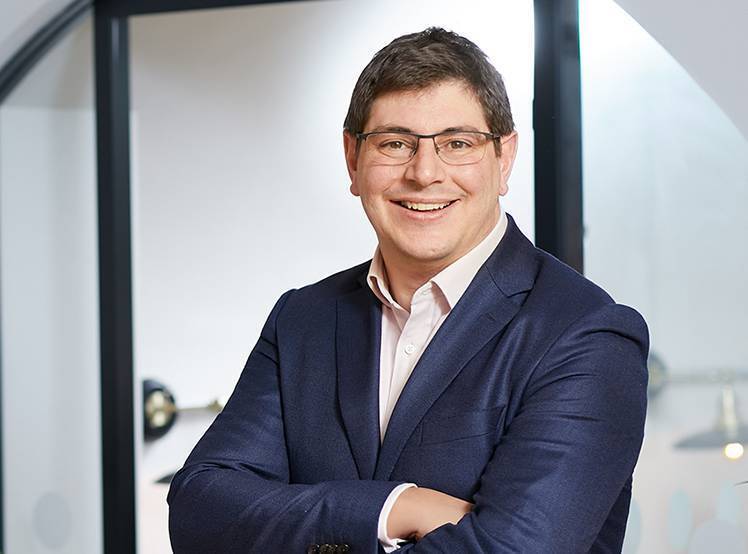
Adam Griffiths, partner and head of the Irish office of global law firm Taylor Wessing, who says Ireland can sharpen its approach to supporting third level spinout entrepreneurs.
Irish technology and life science spinouts can benefit significantly from national efforts to foster links between universities, state agencies and the global investment community, says a leading corporate lawyer.
Adam Griffiths leads the Irish office of global law firm Taylor Wessing, which is partnering with UCC’s Tyndall Institute in hosting the ‘Launching Future Disruptive Technologies’ (LFDT) Summit on Wednesday and Thursday, September, 7 and 8, in UCC’s Western Gate Building.
“The Irish ‘start-up and scale’ eco-system is currently performing strongly, and we have seen numerous recent examples of its capacity to produce and nurture world-class technology companies. However, indigenous enterprises are still disproportionately reliant on international capital to fund their growth,” said Adam Griffiths.
“At a time of global economic uncertainty, it is critical that the Irish Government look at new ways to support domestic innovation, particularly in key growth industries, including artificial intelligence, blockchain, digital, deep-tech and robotics technologies.”
Taylor Wessing endorsed the Irish Venture Capital Association’s recent call for a percentage of new pension scheme payments to be allocated to funds investing in indigenous enterprises.
Taylor Wessing has advised clients on several recent high-profile deals, including Dawn Capital, Europe's largest specialist B2B software investor, on its investment in Fonoa, a Dublin-based digital tax automation platform, as part of its $60m Series B funding round.
The LFDT Summit features contributors such as technology transfer expert Kathy Ku, chief licensing advisor in the Palo Alto office of Wilson Sonsini Goodrich & Rosati; Denis Purcell, founder of Aisling Therapeutics; Marc Sedam, VP for technology opportunity ventures, NYU Langone Center, along with founders of highly regarded Irish spinouts and leading global angel investors.

“We are just doing what we can to improve collaboration between the key stakeholders,” said Adam Griffith. “We want to create a dialogue for people to collaborate effectively, to bring the ideas, the money and the supports all together in one place.
“At the LFDT summit, the founders of the HPSUs in academic research colleges, mostly led by PhDs, will get to meet with the investors, angel groups, and Government agencies including Enterprise Ireland and Knowledge Transfer Ireland.
“Ireland is not performing as well as some other international communities in this space. In the longer term, what we are looking for is a more coherent policy bringing all the strands together.”
Mr Griffith welcomes Irish Government ambitions to increase the number of spinouts growing from spinouts by 25% by 2024, as outlined in ‘Impact 2030’, Ireland’s research and innovation strategy, accompanied by plans for significant investment to support this growth, perhaps as much as €600m annually.
He also welcomes Ireland’s interest in studying the best practice models used by the Cambridge, Oxford, Stanford and other universities in nurturing the progress of tech and life science spinouts.
“The Government is talking about increasing the number of spinouts by 25% by 2024, but we know we are not going to achieve that with money alone, which they fully recognise,” said Mr Griffith.
“There are great opportunities to increase the level of co-operation between the colleges and the PhDs creating the start-up companies, supported by Government agencies like Knowledge Transfer Ireland and Enterprise Ireland.
“At Taylor Wessing, we are also very well placed to help with the transfer. We want to work with deep tech HPSUs. We are very prominent in Europe, and we know that there are opportunities for Ireland to be part of a larger global tech community.”
Taylor Wessing is a law firm specialising in areas such as deep tech, life sciences, artificial intelligence, and in helping spinouts with knowledge transfer, with protecting intellectual property and with other challenges as they grow into new jurisdictions. The firm has a presence in the UK, EU, US, China and the Middle East.
Several of Taylor Wessing’s EU and global connections will be represented at the LFDT Summit. For instance, TenU, a new international tech transfer collaboration bringing together UK universities in London, Cambridge, Oxford, Manchester, Edinburgh, linking them to Columbia, Stanford and elsewhere.
“With the LFDT Summit, we are hoping for two main outcomes. One is the soft outcome of having the main stakeholders in the HPSU space to participate with one another in the context of spinning out,” said Adam.
“So that means the students who founded the spinouts, the advisor base with firms like Taylor Wessing, the venture capitalists and the Government agencies who are there to help accelerate and act as a catalyst to Ireland’s participation in that space.
“The second stream is that we would really like to participate in a debate where certain conclusions are reached around best practice, both domestically with all the other academic institutions which do such good work, and the international best practice from organisations like TenU.
“We’d like to end up with four or five conclusions that can be shared with the academic community and with Government agencies and with the venture capital communities. We could commit to those conclusions and commit to improving our collective participation in that ecosystem in order to really drive innovation and be part of something positive.”

CONNECT WITH US TODAY



Be the first to know the latest news and updates