Austin Hughes: There is scope in budget for large €2bn package to fight inflation
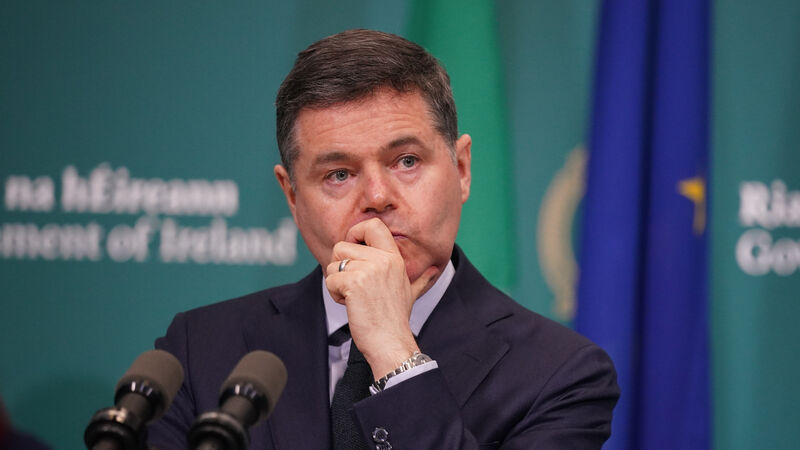
Finance Minister Paschal Donohoe: Economist Austin Hughes says the Government could deliver large €2bn cost-of-living package while posting a material surplus in the budget next month.
Irish weather is unpredictable at best.
So, when the sun shines brightly for several days and conversation turns to how hot it is, it’s not entirely surprising that the dark economic clouds overhead might weigh a little less heavily on Irish consumers.
Although lovely weather may have eased the pain a little, it wasn’t enough to prevent Irish consumer sentiment falling for the sixth month in the past seven in August.
A marginal decline was enough to bring the KBC Bank consumer sentiment index to its lowest reading in almost two years.
Irish consumers aren’t looking at their economic and financial prospects through sunshine-tainted glasses. The past couple of years has seen as sequence of storms from Brexit, through the pandemic, and, more recently, a cost-of-living crisis amplified dramatically by the invasion of Ukraine.
Through recent months, increasingly gloomy forecasts have warned of a threatening and turbulent winter to come while consumers have grappled with sharply higher grocery and fuel bills.
In July, the first European Central Bank interest rate increase in 11 years was accompanied by a warning that borrowing costs will rise significantly further in coming months.
In these circumstances, the question to ask is not why Irish consumer sentiment weakened but why it hasn’t collapsed entirely. It certainly can’t be because of a few days good weather. One reason not to despair is that the Irish economy is doing well on many counts.
The unemployment rate fell to just 4.2% in July, the lowest figure in 21 years while numbers at work reached record levels above 2.5m this spring.
Healthy levels of activity are also suggested by buoyant income tax and Vat receipts. In addition, surging corporation tax receipts and controlled public spending mean that the Irish public finances are an important source of comfort rather than concern at present.
I think that consumer sentiment is supported by the Irish economy’s resilience and a sense that significant fiscal space can and will be used to ease some of the pain.
A balanced budget next month must not be a "giveaway" that puts public spending or tax revenues on an unsustainable path, but it can and should do two things. It can materially counter current inflationary pressures and it should take bold steps against longer lasting Irish economic difficulties.
The specific nature of current price pressures, centred on supply shocks affecting energy and food costs, means that budget measures that are considered and considerable should lessen rather than boost inflation by reducing the risk of an economically damaging and socially divisive free-for-all where firms and workers try to insulate themselves by charging more, possibly much more, for their goods or services.
The bulk of fiscal support needs to be focused on those with very limited means who suffer disproportionately from higher energy and food bills.
However, almost everyone uses energy and eats food. There is a real risk arbitrary cut-offs backfire.
The July sentiment survey found that only 5% of consumers said they were not facing severe price pressures. The degree of support must vary markedly but it should reach most if not all households.
My best guess is that there is scope for almost twice the speculated €1bn cost-of-living package in the upcoming budget but I think this could still be consistent with a material fiscal surplus, and the real prospect of materially larger surpluses in the next couple of years.
I think a balanced September budget should also look not to waste a crisis by meaningfully addressing longstanding difficulties with cost and capacity in areas such as housing, healthcare, education, and digital infrastructure as well as accelerating action in relation to climate change.
Returning to the issue of weather with which this piece started, I find it strange to hear talk of the need to put money aside now in a "rainy day" fund for the public finances when we face such severe economic storms today.
The best way now to ease long-term problems is to enhance the Irish economy’s capacity to grow rather than squirrel money away. For efficiency reasons and to avoid purely politically driven initiatives, a technically managed infrastructure investment fund should be established, or involve a radical rescaling of the current Irish Sovereign Investment Fund.
That body would be charged with overseeing both strategic and operational aspects of the delivery of large domestic infrastructure investment projects over the next decade using currently available "surplus" public funds.
A September budget that makes small but serious steps in this direction could offer weatherproof support to Irish consumer confidence.