Anthony Foley: Big risk to the Irish economy would come from a Russian invasion of Ukraine
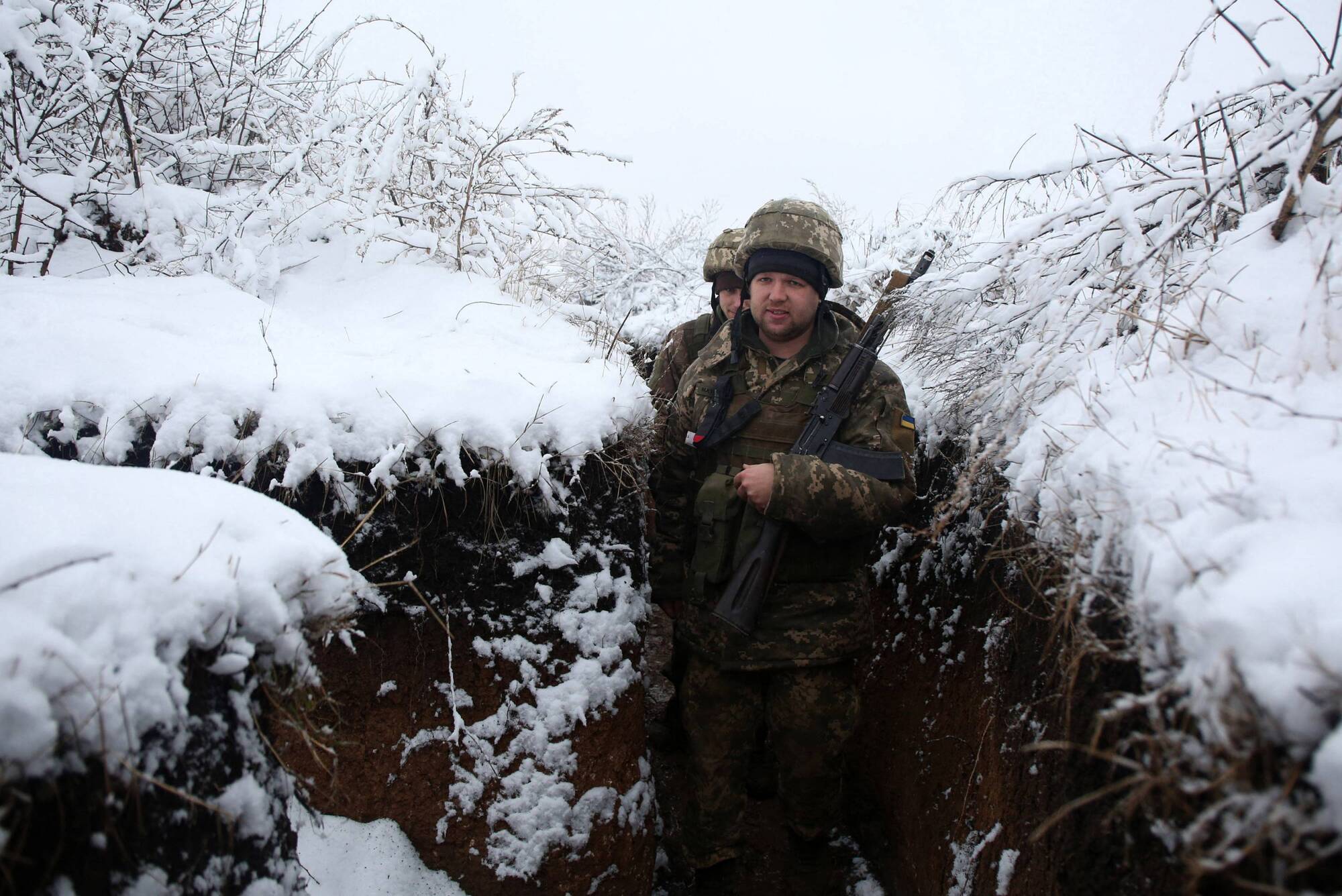
Ukrainian servicemen walk in a trench on their position on the front line with Russia-backed separatists near the small town of Svitlodarsk, in the Donetsk region.
Despite Covid-19 hitting hospitality and entertainment in particular, the Irish economy’s output performed reasonably well compared to other EU economies and prospects for 2022 are good.
It was the only one of the 27 EU economies to post growth in 2020, with Italy, Greece, Croatia, France, Malta, as well as Portugal posting significant contractions.
Of course, GDP measures overstate the Irish output performance and a more appropriate indicator is modified gross national income (GNI).
The Irish comparative performance on this indicator is still good — the economy fell by 3.5% in 2020 which was better than the GDP performance of 19 EU countries.
The Irish economy will also likely perform well in the coming year and be replicated throughout the EU — with the eurozone expected to grow by 4.3%.
The Irish economy was expected to grow next year by about 7% on both GDP and GNI measures, and average unemployment was seen dropping from 16% in 2021 to just below 6% in 2022.
Earnings per employee will grow by just under 5% and taking into account the enormous increase in Government borrowing due to Covid, the 2022 public finances will be in a very good condition with an annual deficit of only 1% of GDP.
In 2020, the Government borrowed over €18bn, a deficit which next year will shrink to around €5bn.
There are risks, however.
The most notable risk to the potentially good 2022 performance is Covid-led restrictions.
There may be a need for prolonged, wide, and deep restrictions which would, of course, lower GDP and GNI performances, increase unemployment, lower investor and consumer confidence, and worsen the public finances.
Any tough new restrictions would knock several percentage points off the output forecast.
Apparently paradoxically, a widespread international increase in Covid pressures would boost Irish exports of pharmaceuticals and other products and more severe outbreaks would also require additional public expenditure which would boost economic growth.
Lockdown restrictions, should they be necessary, are more likely to be targeted once again at the hospitality, travel, entertainment, and sports sectors than at the overall economy.
That would mean a longer drag on jobs in these vulnerable sectors.
Brexit continues to be an issue. At worst, with no agreement on the Northern Ireland Protocol there could be a trade war between the UK and the EU.
The inflation increase and its direct link to global central bank interest rate policies pose a threat to economic growth.
Central banks do not like the current levels of price increases and the British central bank has already increased its base rate in 2021 and is likely to do so again in 2022.
The US Federal Reserve intends three increases for 2022 but the ECB will be slower to increase rates.
Overall, this linked inflation and interest rate threat is more of an issue for 2023 and beyond.
Another concern is the Covid-related debts of small firms.
However, the public policy framework should be capable of limiting the economy-wide impact whatever about specific negative effects on individual enterprises and sectors.
The international geo-political environment could prove to be the biggest short-term impact on 2022 economic growth should things go wrong with the two main flashpoints, Russia-Ukraine, and China-Taiwan.
Despite substantial risks, the Irish economy will perform well in 2022.
However, any dramatic increase in the Covid threat and a Russian invasion of Ukraine, then all bets are off.

CONNECT WITH US TODAY



Be the first to know the latest news and updates