Carbery revenues hit €723m but 'challenging' market lies ahead
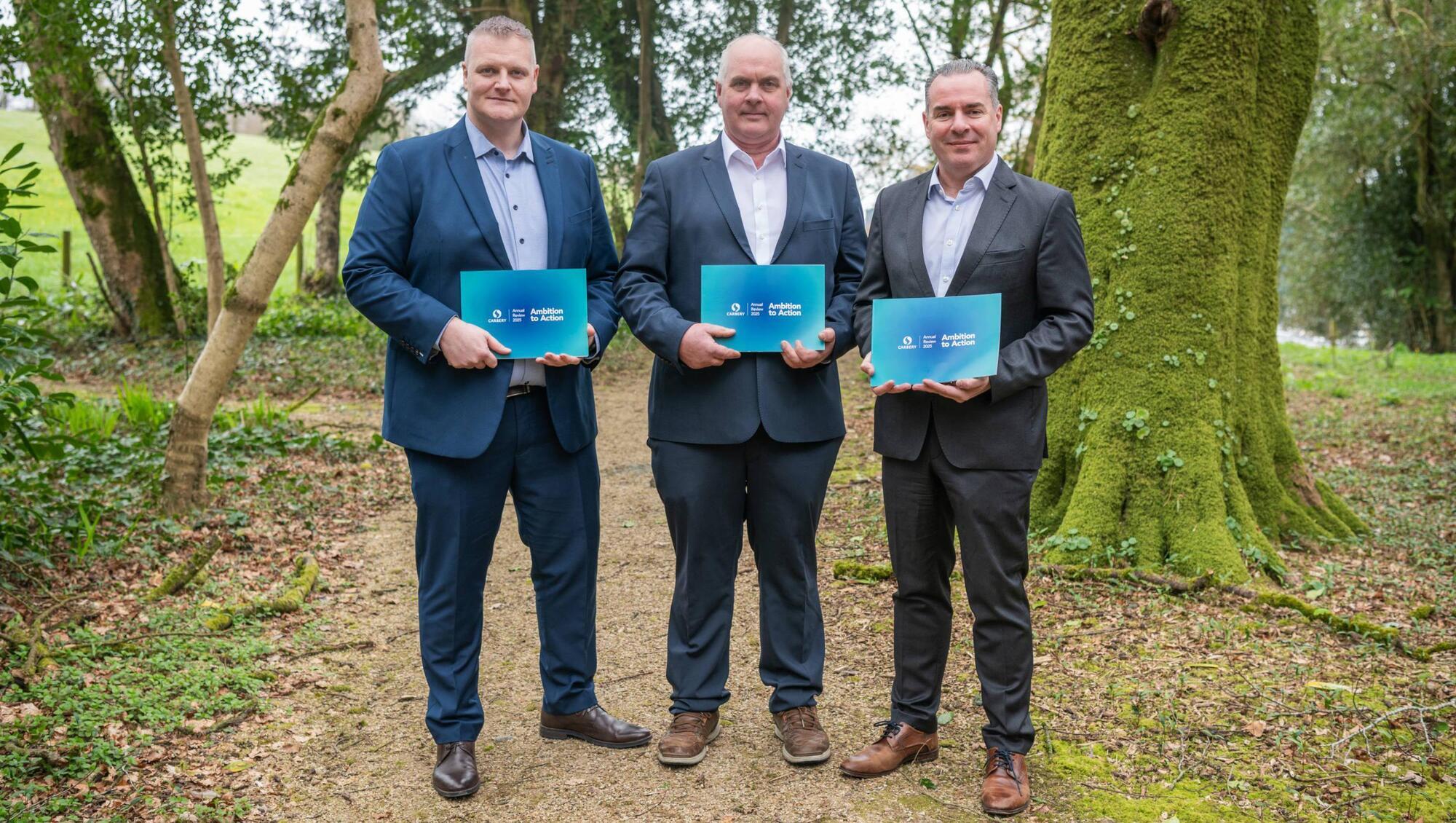
Carbery chief financial officer Liam Hughes, chair Vincent O'Donovan, and chief executive Jason Hawkins as the food and ingredients producer reported strong results for 2025. Picture: Anna Groniecka
International dairy and food business Carbery has reported operating profits of €52.3m, with revenue increasing 8% to €723m despite a "challenging market environment".
Headquartered in Ballineeen, West Cork, Carbery is one of Ireland’s leading producers of cheese for industrial, foodservice, and retail sectors. The company has diversified into a global food, beverages, and nutrition business, with operations in the UK, US, Italy, Brazil, Singapore, Thailand, and Indonesia.
The company reported strong performance across the business in its results for 2025 published on Wednesday, with its nutrition and taste divisions delivering significant profit growth, while dairy processing increased 5.9% to 608.8m litres, the second highest yield recorded by Carbery.
Nevertheless, group EBITA (operating profit before interest, tax, amortisation of goodwill and other intangibles and exceptional items) decreased 3% to €29.7m over the year, reflecting weaker global dairy markets in the last six months of 2025, primarily driven by a global over-supply of milk.
"With dairy market returns dropping significantly in the second half of the year, this has impacted on final reported revenue. However, the health and outlook across all three divisions remains very positive," said Carbery chief executive Jason Hawkins.
"This year is a bit more challenging because the prices have continued to stay weak and the new factors like gas and fertiliser costs as a result of the crisis in the Middle East are impacting farmers. So this is looking like it's going to be a tougher year for farmers, with pressure on the milk price and pressure on input costs.
Earlier this month, Carbery signed a long-term agreement milk supply agreement with North Cork Creameries. "We've had a commercial arrangement with North Park for many years. We have expanded that arrangement. It's a multi-year agreement that we continue to take some of their milk and use it in our facilities and add value, which is good for our farmers and it's good for their farmers."
The company has continued to diversify its portfolio considerably, part of a wider strategy to insulate the company from dairy price shocks and to secure long-term stability. "We're definitely continuing on that journey from a mergers and acquisitions perspective. We hope to have something, in the next next four to eight weeks," said Mr Hawkins.
Carbery produced its highest volume ever of mozzarella in 2025, "reflecting the strong market returns for mozzarella".
The Carbery chief executive said the company was well positioned to meet the increased global focus on protein consumption, with "several offerings aligned to the high protein formats increasingly demanded by customers".
Carbery's taste division, Synergy, completed the acquisition of Solutaste, a flavours and ingredients manufacturer and distribution company based in Sao Paulo, Brazil, in November. This week, the Carbery board has travelled to Brazil, opening a new multimillion-euro manufacturing facility outside Sao Paolo. Carbery chief financial officer Liam Hughes said the company has invested €22m in its Brazilian business in recent years. "Realistically, we've grown the business in Brazil significantly over the last five years, so we were out of capacity and out of room. This new facility is much larger and it helps us to on-board as well with the new acquisitions."
The company is expecting dairy markets to improve marginally in the second-half of 2026 but is cautiously watching events in Middle East, with consumers pinched. "There is going to be an impact on overall consumption. If it continues longer, obviously there's been recessionary risk," warned Mr Hawkins.
Carbery contributed €3m to its stability fund to support milk price of its suppliers through periods of market volatility. The pressure on milk prices saw March milk prices topped up with 1.5c/litre through the stability fund.

CONNECT WITH US TODAY



Be the first to know the latest news and updates