Deloitte Ireland and Meta project to help NGOs develop AI solutions
Engineers from Deloitte Ireland and Meta hosted a Llama for Good Hackathon to empower Irish non-governmental organisations (NGOs) to harness the power of AI for public good
Deloitte Ireland and Meta project to help NGOs develop AI solutions

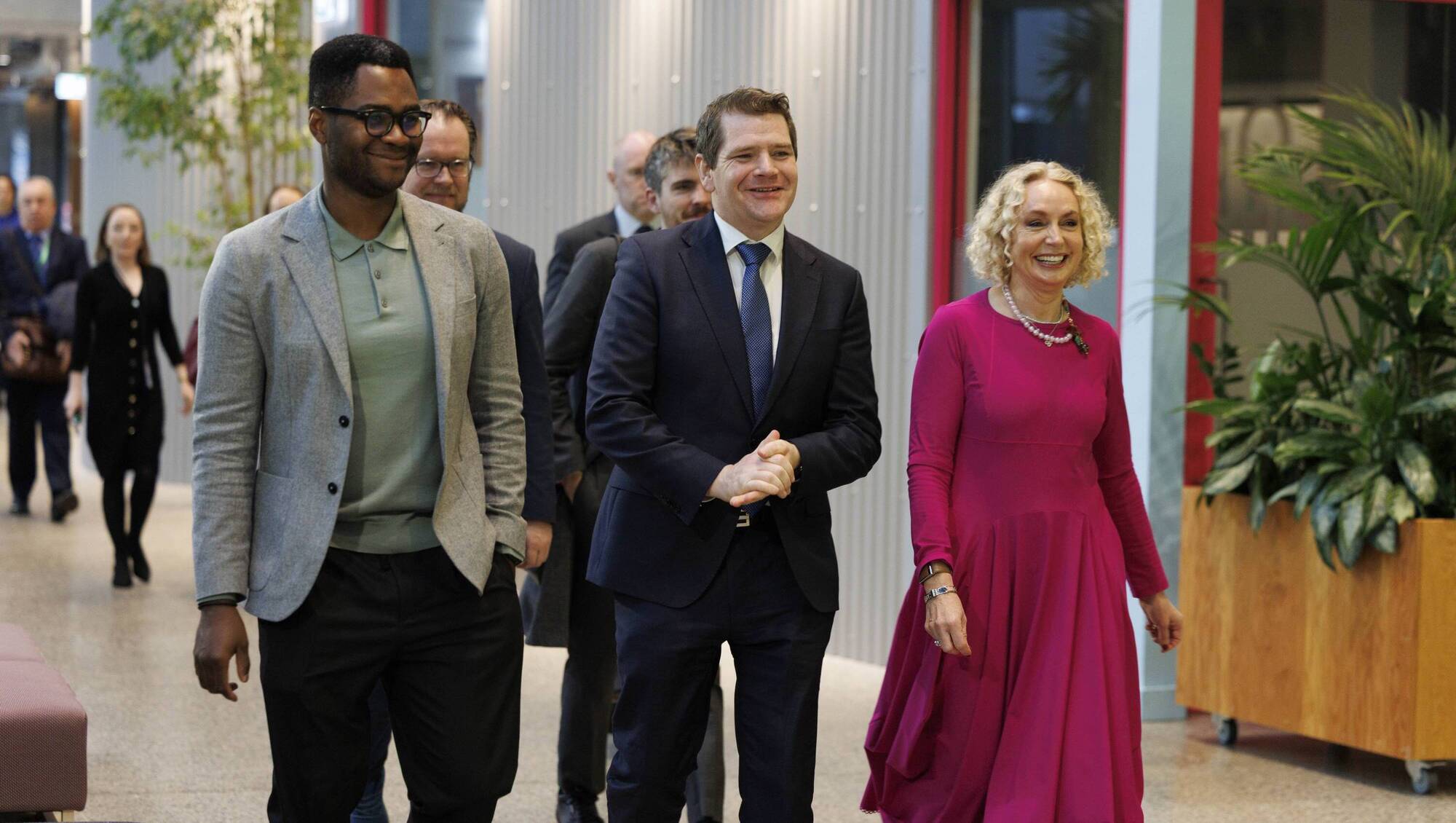
Emmanuel Adeleke, Deloitte Ireland, Peter Burke, Minister for Enterprise, Tourism and Employment, and Anne O’Leary, Meta Ireland, at the Llama for Good Hackathon hosted in Meta's International HQ in Ballsbridge.

Workers in non-profit aid agencies are to benefit from Meta’s Llama project to develop workable AI prototypes designed to address real-world challenges.

Sixteen engineers from Deloitte Ireland and Meta recently led a Llama for Good Hackathon aimed at empowering Irish NGOs (non-governmental organisations) to harness the power of AI for public good.


The event, hosted at Meta's International HQ in Ballsbridge, brought together leading NGOs the Open Doors Initiative, Citywise Education and NOW Group to co-create innovative solutions using Meta’s Llama AI model.

Anne O’Leary, head of Meta Ireland, said: “Meta’s Llama is a game-changer for NGOs. As an open source and free-to-use AI, Llama removes financial barriers and empowers organisations to innovate locally, building solutions tailored to their communities and missions.

“Our Llama models have been downloaded over 1.2 billion times, with real-world projects already making a difference – a massive endorsement of the potential for Meta’s AI to drive innovation, economic growth, and competition.” 

Emmanuel Adeleke, technology and transformation partner in Deloitte Ireland.

In this Q&A interview, Emmanuel Adeleke, technology and transformation partner in Deloitte Ireland, outlines how participating NGOs are using Meta’s Llama AI model to develop AI solutions ranging from partnering mentors with mentees, to streamlining course delivery for inclusive education programmes.

Please outline some examples of the workable AI prototypes that Meta and Deloitte are developing to help NGOs?

During our hackathon, Meta and Deloitte Ireland brought a team of engineers together to work with three incredible NGOs – Open Doors Initiative, Citywise and NOW Group – to show how AI can be harnessed to address real-world challenges. After a representative from each of the NGOs outlined their problem statement in the morning, we spent the day working in teams to find solutions. It was a really exciting room to be in.

By the end of the day, a couple of prototypes had emerged. Open Doors Initiative, who connect underrepresented jobseekers with experienced professionals, have traditionally spent countless hours manually matching mentees with mentors. But on the day an AI prototype was developed that can do the heavy lifting by matching mentors and mentees based on shared skills and aspirations mentioned in their application, using a traffic light system to measure how strong the match was. This isn't just about efficiency; it's about fostering more meaningful, life-changing connections and giving the Open Doors team precious time back to focus on their invaluable community work.

Another example is Citywise, which supports young people in underserved communities on their path to third-level education, and faces the common challenge of mountains of paper forms. In collaboration with Citywise, Deloitte and Meta engineers created an interface where scanned hand-written paper forms could be uploaded. The AI then instantly sorts and extracts vital data, like names and date of births. This eliminates the need for tedious and time-consuming manual entry, and leaves Citywise more time for initiatives that support students participating in their programmes. Engineers also created a tool which help students have a more interactive learning experience; it translates complex course material into a simplified format with analogies to help students better understand the content.

NOW Group, which supports neurodiverse people across Ireland with access to training, employment and community opportunities, explored how AI can be used to link siloed data to better identify potential users and business partners of the JAM card. This card – Just A Minute – is a simple, effective tool that shows when you need a little extra time or help to reduce stress in social situations, such as shopping or on public transport. On the day, the team assessed how AI could create better insights that could drive more growth and impact.

What are your hopes for the Open Doors Initiative, boosting AI skills by partnering mentors with mentees?

This hackathon was really important to me and everyone involved. Seeing the dedication of these NGOs, who are genuinely transforming lives in our communities, was inspiring. 

Participants in the Meta and Deloitte Ireland Llama for Good Hackathon, which was hosted in Meta's International HQ in Ballsbridge.

My hope for the day was that we could leverage AI more effectively by prototyping solutions that will enhance their organisation’s operational processes or increase their insights. I was proud that Meta and Deloitte could share our AI expertise because I strongly believe AI can be a force for sustainable and equitable progress.

For the Open Doors Initiative specifically, I hope the AI system developed can be a real catalyst for change. It was incredible to see a prototype developed that will match mentors and mentees, a process that is currently manual. This should help increase the impact of the connections made and will also hopefully give more time back to the amazing team at Open Doors Initiative to do more of their impactful work in our community.

We also ran an AI fluency training to help these groups get a better insight into how the tech is evolving and we had a really engaging Q&A session.

Can organisations in general learn from tools like Meta’s Llama AI model and some of the non-commercial use cases being developed with NGOs?

AI fluency is a vital skill for everyone, and I encourage everyone to engage with AI tools to learn more about them. What’s exciting about Meta’s Llama, which we used during the hackathon, is that it’s a free, open source AI model. For non-commercial use cases this is really important because it removes costs barriers and makes advanced technology accessible to organisations of all size. Llama also allows you to build custom solutions, so any organisation can design a system specific to them.

If you were to gaze forward 12 months, what would you hope to see these AI skills development models deliver for businesses and communities in Ireland?

The pace of technological development is breathtaking. Its impact and influence is growing every day, so learning about AI and how it can help you and your organisation is unavoidable. The amount of change can be overwhelming, and I recognise that even as someone who works in technology every day. It’s why I’m passionate about hackathons like this, and it’s where large and global organisations like Meta and Deloitte can really come together to make a positive impact that matters. 

In days like this, one of our goals was to help share some of our expertise in AI so that businesses and communities can better use it to drive meaningful change. I would hope that by showing these groups what is possible, they walk away thinking differently about how they can use AI to enhance their operations and increase their insights, and ultimately have more time to do more for their community.

More in this section

The Business Hub

Newsletter

News and analysis on business, money and jobs from Munster and beyond by our expert team of business writers.

Cookie Policy Privacy Policy Brand Safety FAQ Help Contact Us Terms and Conditions

© Examiner Echo Group Limited