Enlightened hiring managers can boost ethnic inclusion, says Bank of Ireland's HR lead
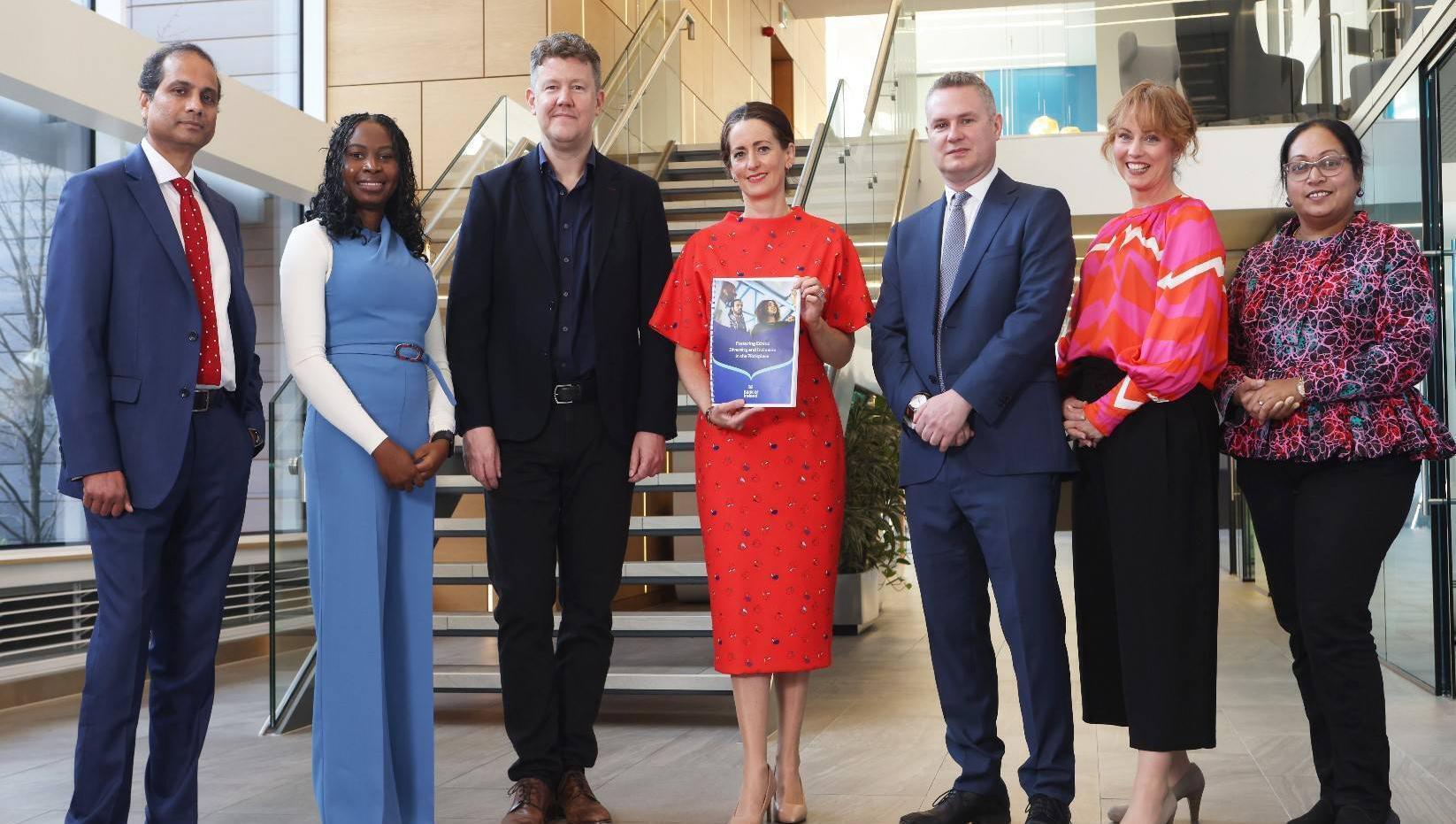
Prasad Shastri, chair of Race Equality Task Force, Bank of Ireland, Edima Inyang, African Professional Network of Ireland, Matt Elliott, chief people officer, Bank of Ireland, Kate Butler, head of inclusion and diversity, Bank of Ireland, Conall Mac Coille, chief economist, Bank of Ireland, Laura O’Donovan, Irish Centre for Diversity, and Meena Karunanidhi, Bank of Ireland Multicultural Network pictured at Bank of Ireland, Baggot Plaza, Dublin, launching the bank's new 'Fostering Ethnic Diversity and Inclusion in the Workplace' report. Photo: Leon Farrell/Photocall Ireland
Hiring managers who have attended training on inclusiveness are far more likely to recruit people from ethnic minority backgrounds, according to Matt Elliott, chief people officer, Bank of Ireland.
After Bank of Ireland's hiring managers attended a series of mandatory workshops on unconscious bias, the bank found that its recruitment of people from ethnic minorities rose to 19% of all new hires in 2024, up from around 7% in 2022.
“Giving hiring managers training around unconscious bias really worked for us,” said Matt Elliot. “We realise that hiring managers would have been aware of the possibility of ethnic bias, but attending training on the subject really makes a difference over time.
“In our case, we wanted to ensure that our staff is as representative as possible of the people we are serving in our communities. We feel that it is important that we give all of our colleagues access to the right training.”
The bank had noticed that it was not receiving what it felt was a representative volume of job applications from people from ethic minority backgrounds. It reviewed and altered its job adverts to ensure they were as inclusive as possible.
“We want to make sure that we are consistent and fair,” said Matt. “In terms of training models, we’ve found that the most impactful training has involved getting colleagues within the company to tell their own stories and their real experiences.
“Connecting with people makes the training more real and feels less like a corporate training situation. If the role play is based on people’s real life experiences, then the training is very impactful.”
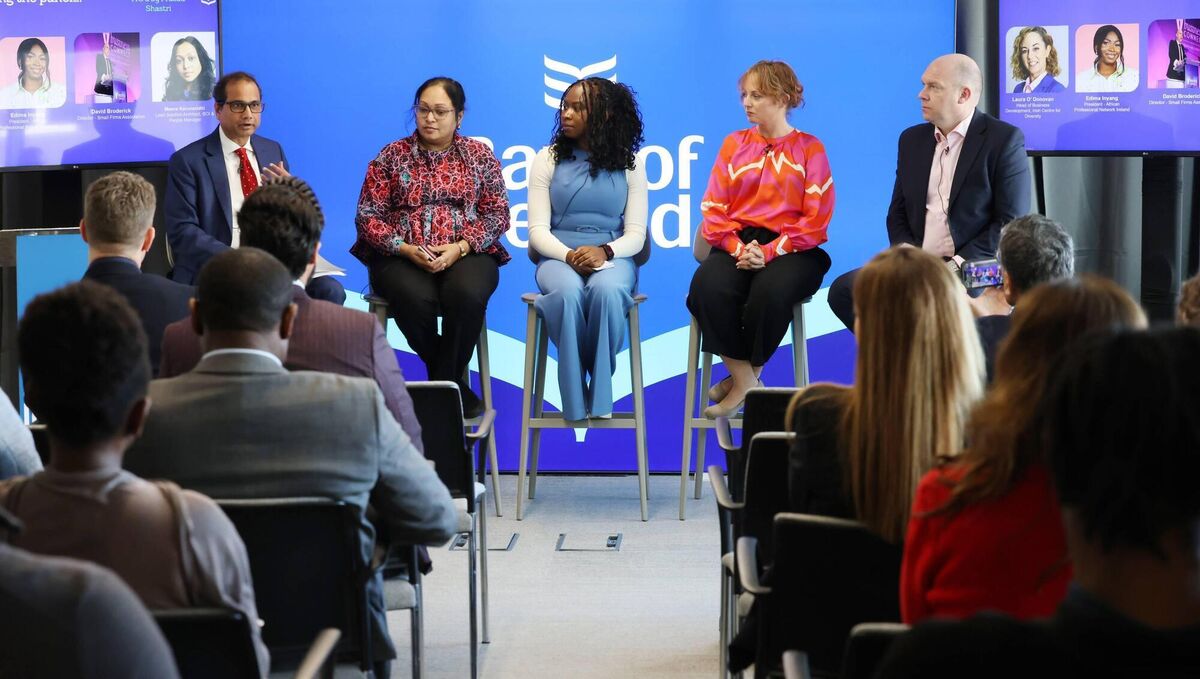
Bank of Ireland has also hosted a dedicated ethnic minority catalyst talent programme delivered in partnership with INvolve to support colleagues to maximise their potential.
The bank also hosted ‘Inclusive Dialogue’ listening sessions, launched its embRACE inclusion campaign called to help colleagues and customers in being inclusive and always treating others with respect.
The bank developed a new scripting for colleagues to use in the event of experiencing racist remarks or insensitive comments during customer interactions.
To date, 320 of the bank’s staff have begun their Accredited Ally training pathway, learning supports on how to be a good and visible ally.
Some 7% of Bank of Ireland staff self-disclose as ethnic minority. The bank believes its many training initiatives will lead to more inclusiveness in its staff.
“Our iCount platform empowers colleagues to self-declare their demographic data and enables us to identify any representation gaps. At December 2024, 64% of colleagues had self-declared,” said Matt Elliot.
““Better understanding of the challenges ethnic minority groups face in accessing and progressing within the workforce is good for those individuals, but is also commercially important for companies like ours.
“Our ambition is to build a company that attracts the best talent in the market, from all backgrounds, and to reflect the diversity that is inherent in our more than four million customer base.”
Bank of Ireland has also worked with Morgan McKinley to produce a new report entitled ‘Fostering Ethnic Diversity and Inclusion in the Workplace’. The report sheds light on the specific challenges faced by ethnic minority individuals when accessing employment and advancing within Ireland's labour market.
The report includes ten Irish-based company case studies. Grant Thornton and Workday are among those, like Bank of Ireland itself, whose efforts towards inclusion are positively impacting ethnic balance and awareness in their workplaces.
“Our report showed mixed findings about people’s experiences in Ireland,” said Matt Elliot. “About a third of the 2,700 people from ethnic minority backgrounds surveyed said they had encountered barriers to accessing employment in Ireland.
“As a consequence, many said that they are hiding aspects of their ethnicity when applying for jobs. The report isn’t just about Bank of Ireland’s strategies. For Ireland to be at its most competitive level possible, we have to utilise people in the best way, recruit the best people and ensure that they are placed in the best roles that they can be in to match their skills.”
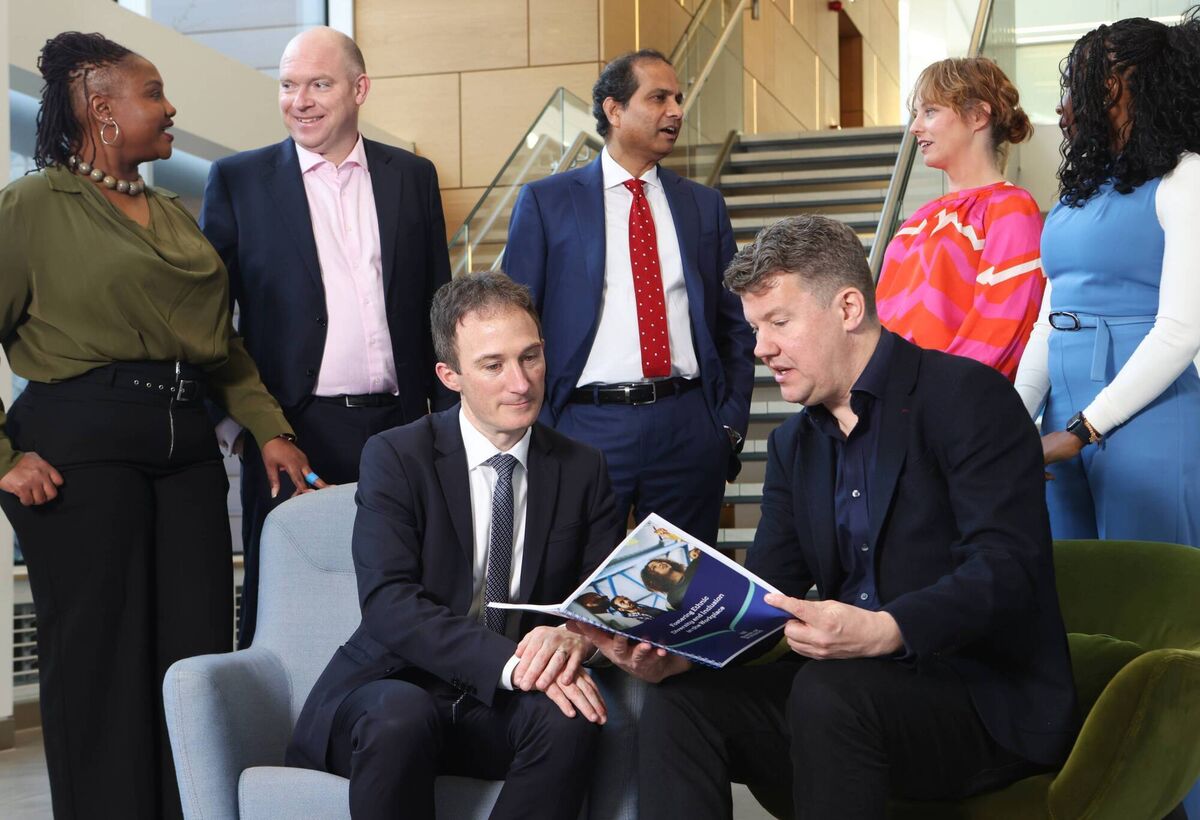
The report offers practical steps employers can take to ensure that the potential of the working-age population from ethnic minority groups is fully realised.
The report suggests that these steps, if taken, should benefit the individual, their employer, and the economy and wider society. The report offers detailed recommendations for actions and training around company culture, recruitment and career development, training and support, collaboration and policy alignment.
Of course, some industry sectors in Ireland are already enjoying a talent boost thanks to their positive approach to inclusion. Of those surveyed, 22% are currently working in IT, 15% in financial services, 9% in manufacturing, 5% in healthcare and another 5% in education. Of this group, 32% required an employment permit.
Minister Alan Dillon, Minister of State at the Department of Enterprise, Trade and Employment, attended the report’s launch. He cited the need for a diverse labour market as being key to the Government’s goal to create 300,000 extra jobs by 2030.
Also present was Conal Mac Coille, chief economist with Bank of Ireland, who said: “Ireland’s economic performance has beaten all expectations over the past five years. Employment is 2.8 million, up 17% since the outbreak of the Covid-19 pandemic. Part of this success has reflected Ireland’s openness to immigration, crucial as a small European economy, to help alleviate labour shortages.”

CONNECT WITH US TODAY



Be the first to know the latest news and updates