SIPTU: Exploitation of workers in subcontracting roles must stop
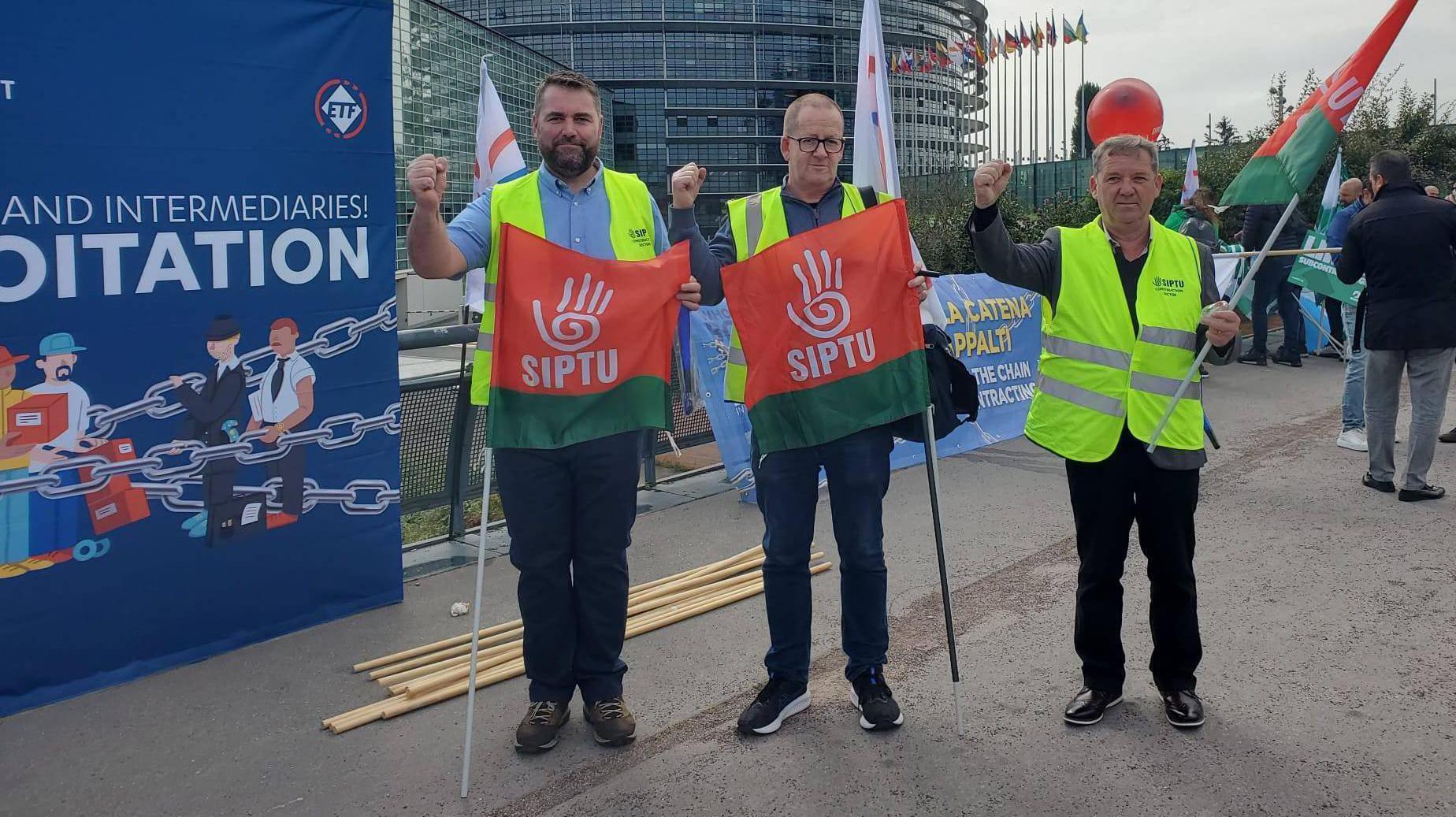
Willie O'Shaughnessy, SIPTU NEC member, John Murphy, SIPTU transport sector organiser, and John Regan, SIPTU construction sector organiser, at the protest against exploitation in subcontracting chains outside the European Parliament in Strasbourg, France.
MEPs in Strasbourg, France, have committed to work towards regulatory changes to reduce the multiple layers leading to worker exploitation in construction, transport and other subcontracting industries.
Activists from Irish union SIPTU were prominent among the more than 700 workers and trade union representatives who rallied in front of the European Parliament in Strasbourg, France, earlier this week.
The European action organised by the European Federation of Building and Woodworkers (EFBWW), the European Federation of Food (EFFAT), Agriculture and Tourism Trade Unions, and the European Transport Workers’ Federation (ETF) aims to demand an EU-binding initiative to limit subcontracting and regulate labour intermediation and to bolster the frequency and effectiveness of labour inspections.
Following the demonstration, MEPs hosted a meeting with union representatives inside the European Parliament. The meeting focused on testimonies from workers affected by exploitative subcontracting practices and unscrupulous intermediaries and had the participation of MEPs from various political groups in the European Parliament.
John Regan, SIPTU sector organiser, said: “We had a very productive meeting in the Parliament, with the MEPs from left of centre groups proving particularly supportive, committing to bringing down the layers within subcontracting within their five-year term of office in the Parliament.
“The projects within subcontracting have layer upon layer, leading to exploitation of workers in a number of ways. It has become a huge problem across Europe, impacting everyone from shop stewards to general workers across construction, transport, manufacturing and services.
“This is what the MEPs have committed to helping to work to regulate. They want to help protect workers because this has become an EU-wide problem. It won’t be solved overnight. This will take time.”
Mr Regan said that overseas workers taking up roles in Ireland need to be given information around their rights and protections, notably citing Ireland’s Sectoral Employment Orders (SEO) covering rates of pay, sick pay, and pensions.
Unions have a vital role to play in informing workers of their rights. The layers within subcontracting, however, often mean that workers often arrive on work sites without engaging with a union.
Mr Regan said: “Very often, there’s no inspectorate to make sure that the standards are kept, like the SEO covering everything from pensions and sick pay to minimum rates of pay. It’s happening across so many industries, with workers having no idea about their entitlements.”
On top of the rise in worker exploitation, Mr Regan said that another key impact was a diminution in standards. He cited the case of construction, his own sector of industry, where standards within subcontracting have steadily disimproved over the past 40 years.
“The lack of enforcement around workers’ rights has seriously impacted standards in construction,” said Mr Regan. “Back in the 1980s, when local authorities had control of housing, people had far greater access to affordable housing. I was a beneficiary of that model myself, so I now own my own house.
“I believe that the availability of affordable housing would be seriously enhanced with state-owned companies leading the construction. They would be focused on standards; they would be talking with the unions and agreeing regulations and standards.
“If we went back to that 1980s model, the focus would shift away from private sector construction companies competing for margins and focusing on profits. The likelihood of exploitation of workers would also be dramatically reduced.”
SIPTU members see the Strasbourg meeting as a valuable initiative in drawing attention on the plight of workers within subcontracting companies. They will join with Europe’s other unions in pushing this issue into the spotlight going forward.
Tom Deleu, general secretary of EFBWW, said: “On the day in which the president of the Commission, Ursula von der Leyen, unveils the portfolios of the new commissioners, workers from all over Europe gathered to put workers’ rights at the top of the European agenda.
“The EU cannot ignore what is happening with posted, migrant and third-country nationals. In construction, we witness high levels of exploitation, fraud, and other labour abuses, especially in a cross-border context. Subcontracting is always a major risk factor. We need to break the chain of exploitation. The new European Commission and the new European Parliament must act urgently, limit subcontracting and ban intermediaries in posting.
“Abusive subcontracting practices is an exploitative business model which is increasingly dominating many sectors of the economy. Migrant and mobile workers are the main victims. Today a strong message goes to the EU institutions. It is time for urgent EU action to ensure real equal treatment at the workplace.”
John Murphy, sector organiser with SIPTU, added: “SIPTU is not prepared to allow the exploitation of workers across the supply chain within the transport industry. We need to ensure public money is invested to create decent jobs and not simply funnelled into multinational companies, investors and subcontractors’ pockets.”

BLACK FRIDAY
Already a subscriber? Sign in

CONNECT WITH US TODAY



Be the first to know the latest news and updates