Our money is fuelling climate change
Since the Paris Agreement in 2015, the world’s 65 biggest banks have committed US$7.9 trillion to the fossil fuel industry, writes Karol Balfe.
Our money is fuelling climate change

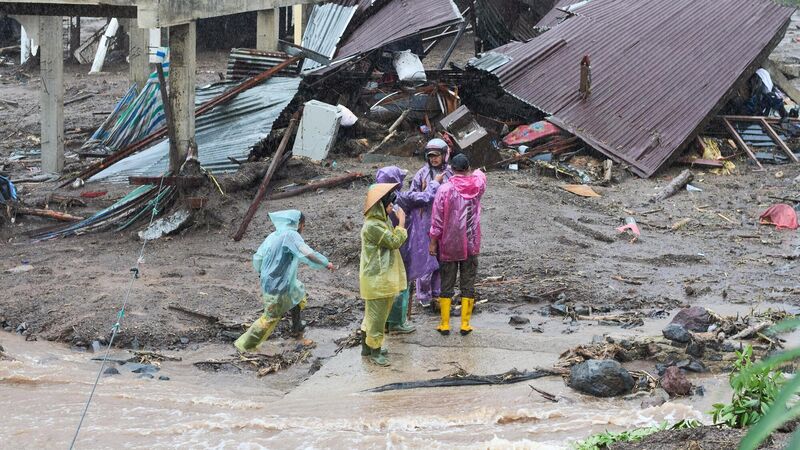
Residents inspect houses damaged during a flood in Malalak, West Sumatra, Indonesia, last November. Picture: Ade Yuandha/AP

Another year, another Cop summit. The dust has now settled on the latest Conference of the Parties, the annual climate change summit that serves as the core multilateral mechanism to try to keep the world within 1.5C of warming.

This task of limiting global warming to safe levels is a monumental one. Droughts, floods, record heatwaves, collapsing glaciers, and failing harvests are no longer exceptions, but the new normal. Scientists now warn there’s an 80% chance that at least one of the next five years will surpass 2024 as the hottest on record.


In Ireland, we are seeing storms becoming more intense, flooding more extreme, and weather in general becoming more and more unpredictable.

Cork County Council workmen with sandbags in Bantry, Co Cork. Picture: Andy Gibson.

Broadly, the public accepts we must act on climate change. But for most people in Ireland, the roots of this crisis and its global fallout feel a bit removed from their everyday experience. The climate crisis has at its heart a fundamental injustice so profound that it is replicating and enforcing global inequality between richer and poorer countries.

CLIMATE & SUSTAINABILITY HUB

Colonial powers built their wealth by extracting labour and resources from much of the Global South, keeping those countries in poverty while industrialising themselves. 

It is this industrialisation and extraction by richer nations that is warming our planet to dangerous levels.

The frontline of climate change

Africa is responsible for just 4% of global emissions, and yet is now plagued by devastating droughts, floods, and cyclones. Global news coverage of the ongoing drought in East Africa has been minimal, but its impact on people’s lives is immense. There is also very little coverage of other crises, from floods in Southeast Asia, to the wildfires in the Amazon, to droughts in Nepal. Those at the frontline of a crisis they did not create.

The odds are particularly stacked against women when crisis hits. Some 80% of those displaced by climate disasters are women. When food runs short, women and girls are usually the first to go without. When water sources dry up, they are the ones walking longer distances to find it. The climate crisis is deeply gendered.

It is addressing these fundamental injustices that is the test of Cop outcomes. Will rich countries recognise the debt we owe for climate damage caused? Especially as Global South countries are also crippled with debt, driven and fuelled by the climate crisis.

The magic formula of just climate action is that we reduce our emissions and make life better in Ireland, with more public transport, less pollution, sustainable food systems, and renewable energy warming our homes. And that we show global solidarity and pay our debts to those who did little to cause the crisis.

This Cop30 failed on many fronts to deliver climate justice.

André Corrêa do Lago, Cop30 president, sits as Simon Stiell, United Nations climate chief, left, speaks with other UN officials during a plenary session at the Cop30 climate summit. Picture: AP

A lot of attention was given to the failure to secure agreement to phase out fossil fuels. It is beyond belief that, in 2025, we do have this clear roadmap to phase out oil, coal, and gas, given that they cause 75% of global greenhouse gas emissions.

Beyond belief, but not a mystery as to why this hasn’t happened. 

The Paris Agreement, signed in 2015, included a pledge to make all financial flows consistent with a pathway towards low-emissions and climate-resilient development. Since then, the world’s 65 biggest banks have committed US$7.9 trillion to the fossil fuel industry. Almost all of these banks increased their fossil financing in 2024 in comparison to the previous year. One core reason is clearly there are still incredible profits to be made.

No relief without justice

We do need to phase out from fossil fuels, but this must be embedded with a justice approach. The richest go first, fastest, and with support to those bearing the brunt of climate disasters. What was on the table at Cop30 for a fossil fuel phase-out did not explicitly include these principles. This is unacceptable and unworkable.

The European Union’s push for fossil fuel phase-out rings hollow due to its failure to deliver fair climate finance for countries on the frontlines. If the EU keeps fighting hard for a phase-out without stepping up on finance and fairness, it turns climate ambition against those who did least to cause this crisis, and weakens the Paris Agreement.

Much lauded was the tripling of adaption finance at Cop30. This is money to support countries to adapt and respond to climate change. This so-called tripling had no clear baseline, so we can’t tell what it is tripling from and to where. It is not new money, rather it is €100bn contained within the already-committed underwhelming €300bn from Cop29.

We already know this is hugely inadequate, and richer countries insisted that this would come in 2035, rather than 2030 — a delay so preposterous it is a farce. Grossly inadequate amounts were also pledged to loss and damage funding to help countries recover.

There was one ray of light from this Cop, as there was the agreement for a new mechanism for a just transition. A just transition is about ensuring that climate action works for people, not against them. As the world slowly transitions away from fossil fuels and harmful industrial agriculture, we cannot repeat old patterns of inequality where the costs of change are pushed onto workers, women, and communities least able to bear them.

The new mechanism means that there will be global principles on human rights, gender equality, labour rights, and recognition of indigenous rights that should shape all national work in this crucial area.

Ireland's role

Cop is over for another year. Ireland needs to do its own work to reduce our emissions and ensure a greener, safer world for its people.

But we also need to make sure that the principles of fairness and justice are deeply embedded in this work. We need to pay our fair share of climate finance, and we need to push for the EU to have justice in its approach. We need to stop enabling billions to flow through our foreign direct investment to fossil-fuel expansion.

Ireland has become the 14th biggest conduit for fossil fuel finance in the world. Research by ActionAid Ireland and Trócaire found that, as of June 2024, Irish-based subsidiaries of investment companies held €31.7bn in bonds and shares issued by fossil fuel corporations. Some 91% of those investments were in companies with active expansion plans for oil, gas, or coal.

The injustice of climate change continues to be experienced every day, by men, children, and women who did nothing to cause it. This must be at the heart of our climate action. 

This is not only a matter of justice and fairness — but it will also make the world safer and better.

CLIMATE & SUSTAINABILITY HUB

More in this section

The Business Hub

Newsletter

News and analysis on business, money and jobs from Munster and beyond by our expert team of business writers.

Cookie Policy Privacy Policy Brand Safety FAQ Help Contact Us Terms and Conditions

© Examiner Echo Group Limited