Stocks jump as retail sales rebound
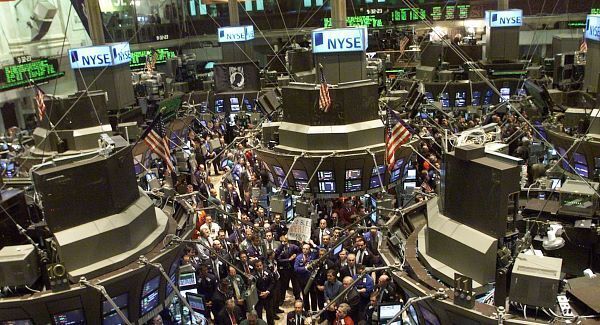
Investors kept the stock market’s upward momentum going today, sending shares sharply higher as the dollar extended its slide and after retail sales rebounded more than expected in October.
Major stock indexes rose more than 1% to new 13-month highs, including the Dow Jones industrial average, which jumped 136 points. The Standard & Poor’s (S&P) 500 index closed above the 1,100 mark for the first time in more than a year.
The weaker dollar lifted gold to a new record and pumped up prices of other commodities, including oil. That, in turn, helped shares of energy and materials companies.
Stocks added to their gains after Federal Reserve chairman Ben Bernanke reaffirmed in a speech that the central bank would hold interest rates at record-low levels for an “extended period”, and that he didn’t see signs that the money being pumped into the economy by the government was creating speculative bubbles. Bond prices jumped after Mr Bernanke said inflation appeared contained.
Some analysts have cautioned that the surge in stocks, which has been hastened by a sliding dollar, might not be justified by the still struggling economy. In fact, they say some investors might misread the big advance in stocks as a sign that the economy is stronger than it actually is.
The market’s own dynamics also fed some of the day’s gains.
Dan Deming, a trader with Stutland Equities, said the S&P 500’s move above 1,100 gave some investors a shot of confidence and led to short-covering, which tends to amplify gains in the market. Short-covering occurs when investors have to buy stock after having earlier sold borrowed shares in a bet they would fall.
“We’re breaking through the 1,100 mark, which is psychologically significant, and the market is seeing a little pop from that,” Mr Deming said.
Stocks began rising from the start after the US Commerce Department said retail sales rose 1.4% in October, easily surpassing the 0.8% increase forecast. It was a sharp rebound following the 2.3% drop in September. Excluding the gain from autos, however, sales rose just 0.2%, half of what economists predicted.
The Dow rose 136.49, or 1.3%, to 10,406.96 after rising nearly 164 points.
The broader S&P 500 index rose 15.82, or 1.5%, to 1,109.30. It traded above 1,100 in mid-October but hasn’t closed above that benchmark since October last year. The S&P 500 index first finished above 1,100 more than a decade ago, in March 1998.
The Nasdaq composite index rose 29.97, or 1.4%, to 2,197.85.
The Russell 2000 index of smaller companies advanced 16.59, or 2.8%, to 602.87.
The ICE Futures US dollar index, which measures the dollar against other currencies, fell 0.6% to a 15-month low. Gold reached a record 1,143.40 dollars an ounce.
Investors have been using the weak dollar to finance purchases of higher-yielding assets. The move, what’s known as a “carry trade”, can further weaken the dollar.
Bond prices rose, pushing down yields. The yield on the benchmark 10-year Treasury note fell to 3.33% from 3.42% late Friday.
General Motors said it lost 1.2 billion dollars in the period since emerging from bankruptcy and the end of the third quarter on September 30. Despite the loss, GM said it will begin to repay 6.7 billion dollars in government loans and was seeing a stabilisation in its business.
The stock market has been on a strong run after a pullback at the end of October. The Dow has jumped 694 points, or 7.2%, since the start of the month, raising questions about whether the market’s advance is justified, given the still struggling economy.
Joe Battipaglia, market strategist for the private client group at Stifel Nicolaus & Co in Yardley, Pennsylvania, said investors are placing big bets that interest rates will remain at record low rates because of Mr Bernanke’s comments and because the economy remains fragile. He contends the gains in stocks are being driven by trades like those involving the dollar and not healthy economic fundamentals.
“It’s not like we’re on some rocket trajectory of economic growth that’s going to bring up the earnings and bring down unemployment,” Mr Battipaglia said.
Crude oil rose 2.55 dollars to settle at 78.90 dollars per barrel on the New York Mercantile Exchange.
Energy and materials stocks rose. Baker Hughes rose 1.89 dollars, or 4.6%, to 43.34 dollars, while Freeport-McMoRan Copper & Gold rose 2.91 dollars, or 3.6%, to 84.48 dollars.
About five stocks rose for every one that fell on the New York Stock Exchange, where volume came to 1.1 billion shares compared with 985 million Friday.
Investors also drew confidence from the results of the 21-member Asia-Pacific Economic Co-operation forum, which said it would maintain stimulus spending until a global economic recovery is at hand.