Stocks ends lower amid lingering economic fears
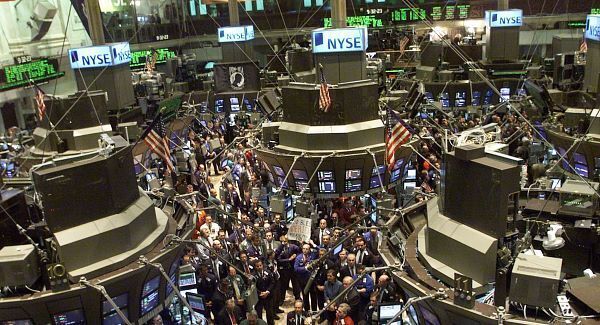
Wall Street extended its losses today as a negative ratings outlook on financial and industrial powerhouse General Electric Co shook an already fragile investor psyche and sent stocks tumbling.
After moving within a narrow trading range for much of the session, the Dow Jones industrial average dropped nearly 220 points. The broader Standard & Poor’s 500 index lost more than 2%.
Stocks struggled to find a direction in early trading as investors sifted through a number of signs about the economy, including more lay-offs and dismal earnings forecasts.
But a negative outlook from Standard & Poor’s on GE added further pressure on the market.
Standard & Poor’s Ratings Service lowered its outlook for GE and its GE Capital finance arm to negative from stable. The ratings agency affirmed their Triple-A ratings, but said there is a one-in-three chance they could lose them because of the ongoing financial struggles at GE Capital.
GE shares fell 1.43 dollars, or 8.2%, to 15.96 dollars.
At the same time, energy stocks tumbled as oil prices plunged. Crude briefly dropped below 36 dollars a barrel today on worries of a drastic pullback in energy spending, even after a record production cut from Opec earlier this week.
Oil prices have been on a downward march since reaching a high of near 150 dollars(€105) a barrel in July.
“The fear is that if oil does fall down to 25 or 30 dollars(€18 to €21) a barrel, that could indicate that the economy is even weaker than market perception and that obviously is negative,” said Peter Cardillo, chief market economist for Avalon Partners.
Chevron Corp fell 3.79 dollars, or 4.9%, to 73.03 dollars, while Exxon Mobil Corp dropped 4.06 dollars, or 5%, to 77 dollars.
The expiration tomorrow of some options contracts for December added to the downward pressure, Mr Cardillo said.
Today’s news reinforced perceptions that the economy’s troubles are far from over. The market remains unsure how steep and prolonged the recession will be.
Wall Street’s sharp decline late today overshadowed some of investors’ earlier enthusiasm over a potential economic stimulus package.
President-elect Barack Obama’s aides are working on assembling a two-year plan which could cost 850 billion dollars(€595 billion) and include new jobs, middle-class tax relief and expanded aid for the poor and the unemployed.
The Dow fell 219.35, or 2.49%, to 8,604.99.
The Standard & Poor’s 500 index fell 19.14, or 2.12%, to 885.28, while the Nasdaq composite index fell 26.94, or 1.71%, to 1,552.37.
The Russell 2000 index of smaller companies fell 7.42, or 1.52%, to 479.17.
Declining issues outnumbered advancers by about 3 to 2 on the New York Stock Exchange, where volume came to 1.25 billion shares.
Further weighing on the market were lacklustre economic data and mixed corporate earnings reports.
The Labor Department reported that initial jobless claims fell by more than economists anticipated to 554,000 last week. The claims remain near last week’s 26-year high, and the four-week moving average for claims is up, but investors had been bracing for a gloomier reading.
Meanwhile, a private research group’s measure of the economy’s health fell again in November and its six-month rate of decline hit the worst level since 1991.
“Most of the data was better than the market expected, but showed that the economy is still contracting,” Mr Cardillo said.
FedEx Corp reported a 3% rise in quarterly earnings, but announced further cost cuts as demand continues to wane. Ingersoll-Rand Co cut its fourth- quarter earnings forecast by more than half, and motor home maker Winnebago Industries Inc swung to a loss.
But Discover Financial Services swung to a profit and homebuilder Lennar Corp’s quarterly loss was smaller than last year’s.
In recent weeks, the market has moved away from the wild 300-point swings of September, October and early November, leading some analysts to believe that Wall Street was beginning to show some stability.
Since the S&P 500 and the Dow hit multi-year lows on November 20, the Dow is still up 13.9%, while the S&P 500 is up 17.7%.
But today’s decline, which extended a 100-point drop in the Dow yesterday, showed just how fragile the market still is. Precisely because stocks are up so much from their November 20 lows, the market is more sensitive to news, said Chris Hensen, senior portfolio manager with MFC Global Investment Management in Toronto.
“News like this out of General Electric would make the market roll over,” he said.
Yesterday, the Dow fell nearly 100 points as enthusiasm over the Federal Reserve’s historic rate cut on Tuesday dampened on news of a larger-than-expected loss at Morgan Stanley and layoffs at Cooper Tire and Rubber Co and Newell Rubbermaid Inc. The Dow and the S&P 500 are still down more than 30% for the year.
Also today, Mr Obama named three veteran regulators to round out his economic team and vowed to overhaul regulatory rules to prevent a repeat of the financial and economic turmoil the country is currently suffering.
If confirmed by the Senate, Mary Schapiro would take over the Securities and Exchange Commission.
Ms Schapiro, who currently heads a non-government regulatory group for securities firms, is also a former head of the Commodity Futures Trading Commission and former member of the SEC.
The SEC faces mounting criticism for its failure to protect investors and detect trouble on Wall Street. Its latest blemish comes from the fraud investigation of prominent money manager Bernard L Madoff, who is accused of running a 50 billion-dollar pyramid scam.
General Motors Corp was the biggest loser among the 30 stocks which make up the Dow, plunging 16%, or 71 cents, to 3.66 dollars as the Bush administration said it is seriously considering “orderly” bankruptcy as a way of dealing with the struggling US auto industry.
Long-term Treasury prices soared, sending yields down to new record lows. The yield on the benchmark 10-year Treasury note fell to 2.07% from 2.19% late yesterday. The yield on the popular three-month T-bill – whose yield has at times gone negative due to frenzied buying – was at 0.01%, unchanged from late yesterday.
The strong surge in buying has been stoked by the Fed’s decision on Tuesday to lower its federal funds rate target to a range of zero to 0.25%, and express an interest in buying long-term government debt.

CONNECT WITH US TODAY



Be the first to know the latest news and updates











