‘I did not know what was going to happen to Ireland,’ admits head of taskforce
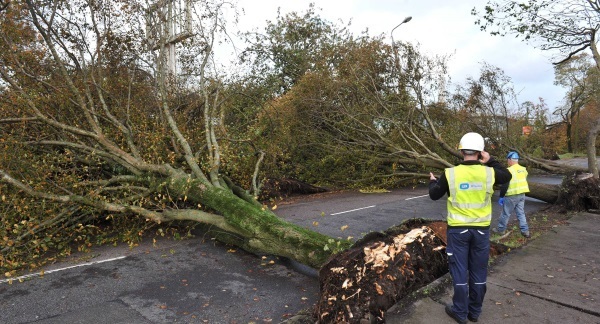
Last Sunday night, as storm Ophelia approached Ireland, a status- red weather warning had been issued for the entire country.
“This is not the remnants of a hurricane — this is a hurricane,” warned meteorologist Joanna Donnelly on the evening news.
By Monday morning, primary and secondary schools and third-level institutions were closed, retailers and businesses had shut down, and a state of national emergency had been declared.
By that evening, three people had died as a direct result of the storm and hundreds of thousands of people were left without power or water while, in the background, an emergency taskforce managed the crisis.
Seán Hogan, of the Department of Housing, Planning, and Local Government,
co-ordinated this taskforce, which included up to 90 people from local authorities all around Ireland, the HSE, An Garda Síochána, and various statutory bodies.
Despite extreme levels of “preparedness” and working from a long-established framework for major emergency management, Mr Hogan admits that Sunday night was a “difficult” one for him.
“We had done what we could do. Sunday night was a difficult night for me. I did not know what was going to happen to Ireland the next day,” said Mr Hogan.
“We didn’t know the script. When you’re dealing with nature there is no script.”
Mr Hogan co-ordinates what is officially called the National Emergency Co-ordination Group. It met last Friday when Met Éireann warned of the weather that was on its way to Ireland. It continued to meet over the weekend and share information with bodies such as the Department of Education and Transport Infrastructure Ireland.
However, before Friday, a framework to manage such events had been in development for more than 10 years.
“We have been working on preparedness for a decade, developing a framework for major emergency management,” said Mr Hogan.
“It is an interagency approach with local authorities, An Garda Síochána, and the HSE. The fact that the local authorities, the guards, and the HSE were working together is no accident. The need for co-ordination comes from all of us needing to have the same objective, that objective was public safety.”
The co-ordination group kicked into gear late last week.
“Last Thursday, we started to get nervous and realised how serious the situation was,” said Mr Hogan. “We followed up with local authorities as we were pretty sure something significant was going to happen.
“Then at 10am last Friday a notice was sent around and a meeting of the National Emergency Co-ordination Group was called. As well as transport, the school issue was now emerging, but a decision would be made later in the day on it.
“At 3pm we reassembled and activated the group and all of the other agencies were notified. We monitored the situation and had a meeting on Sunday morning. As the day was going on, the more serious the situation became. Then by evening, the entire country had gone ‘red’.
“At this point, schools were the key issue and this was hitting when everyone making their way to school. We had never had this sort of experience before, we did not know what was coming. We did not know what the impact of the hurricane was going to be. We’re a bit in unchartered territory.”
Mr Hogan said the group was “positioned right at the heart of Government” with access to the Taoiseach and several ministers as the storm approached Ireland.
The group was also in contact with all governmental departments, the statutory agencies, the Office of Public Works, the Irish Coast Guard, and the HSE.
“It was a complete canopy of government with between 50 and 90 people,” said Mr Hogan.
The group worked off several “boards”. The first was to recognise the situation and receive up-to-date information, the second was identifying key issues such as transport and schools and the third was public safety.
“My objective was absolutely public safety. We had very deep concerns about public safety, about deaths. We had Hurricane Debbie behind us when there was 11 deaths,” said Mr Hogan.
The fourth board was actions, and sharing information with the public was central to this.
“It doesn’t matter what you do unless you inform the public. The media were absolutely fantastic. RTÉ as a public service broadcaster can really take a bow on this one. The local authorities made huge use of social media and local radio was very helpful. My sense is that people heard and heeded the message.”
As Storm Brian hits, with trees weakened from Ophelia, it is hoped that the public also heeds the latest warnings.