Army depletion bad news if Brexit is hard
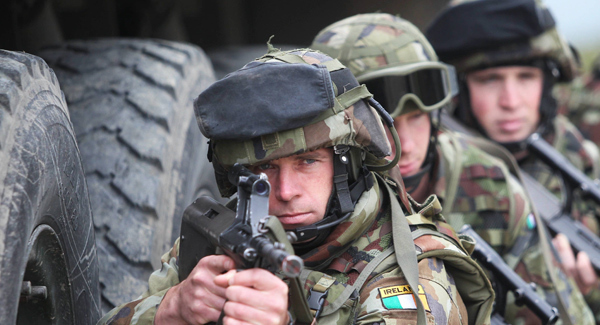
The closure of army barracks along the border, the disbandment of another brigade, and the decline in Defence Forces numbers all militate against proper policing of border crossings.
The Government is examining potential solutions to a number of scenarios which could unfold in the wake of Brexit.
But Dr Tom Clonan, a retired Irish Army captain and a respected security expert, said he is concerned the Government has trimmed the Defence Forces so much that they’ll be unable to protect the border. He is particularly concerned about cutbacks, especially with the risk of increasing activity from so-called dissident Republicans.
Only two army barracks are located near the border, at extreme ends — Finner Camp, near Bundoran, Co Donegal, and Aitken Barracks, in Dundalk.
Since 2009, army borders located close to key crossings, such as Letterkenny and Lifford, in Co Donegal, Monaghan Town, and
Castleblayney, along with Cavan Town and Cootehill, have all been closed. A barracks in Longford was also decommissioned.
Significantly, Garda stations have also been closed in a number of border areas.
Minister for Foreign Affairs Simon Coveney earlier this week said “diseases and animals don’t respect borders”. Ironically, he echoed the words of three years ago of retired brigadier general, Ger Aherne, who said the dwindling numbers of Defence Forces personnel, allied to barracks closures, made it unlikely the State could prevent the spread of foot-and-mouth into the Republic, if there was a repeat of an outbreak which first occurred in the North in 2001.
The has discovered huge gaps emerging in the Defence Forces, with personnel having to travel on a regular basis from Finner and Aitken camps, as well as Athlone, to conduct security duties at army barracks in Dublin.
It was a scenario forced on the Defence Forces, as a result of a major civil service-driven reorganisation in 2012/2013, which led to the disbandment of the Fourth Western Brigade.
The 4th Cavalry Squadron, based in Longford, was disbanded around the same time and it was said to be the most effective unit to deploy in the event of the return of a hard border.
Cost-cutting, through reducing barracks and reducing the payroll, saw the monies transferred to the modernisation of the Naval Service fleet and the purchasing of badly needed military vehicles for the army. The end result, however, is that in the event of a border that has to be strongly controlled post-Brexit, huge investment will be required, in terms of recruitment, training, and the reopening of some barracks.
Dr Clonan said it was “unprecedented” and “shocking” that troops were being deployed such long distances, from Donegal and Louth, for routine duties in Dublin.
Such deployment, in the past, was necessary only to aid gardai in major incidents.
He described the temporary postings as “an abuse of troops” and “a poor use of taxpayers’ money”.
Dr Clonan said: “If they are shipping troops to carry out routine duties, then they’ve crossed the line already.
“This is not sustainable and is also dangerous.”
He said if new border controls were put in place on the northern side of the border, in areas such as South Armagh, he said there was a risk of attack by dissident republican groups. On the southern side, he said, with the present condition of the Defence Forces, the security services would not be able to patrol and protect “hundreds of miles of meandering border”.
“We won’t be able to monitor all of it and it’s laughable to think we could secure or surveil it.”
Dr Clonan said it was “completely reckless” of the Government to allow the number of Defence Forces members drop so low. He also believes vital local intelligence has been lost on the ground, since the closure of barracks. Those closures could be overcome, he said, but the sheer lack of numbers in the Defence Forces, and expertise in certain sections of it, was an entirely different matter.
Dr Clonan also noted the Defence Forces were critically short of bomb-disposal experts and engineers — two components which were likely to be in major demand, if a hard border ensued and dissident republicans decided to cause trouble.
“It’s a perfect storm. The unionists are supporting the British government on Brexit, against the wishes of the majority of the population [in the North] and the EU is likely to play hardball with Britain on the border.
“There are a large number of dissidents who pose a serious threat. We could slip back into violence very quickly.”

CONNECT WITH US TODAY



Be the first to know the latest news and updates