Dining out on the dignity of a time-honoured tradition
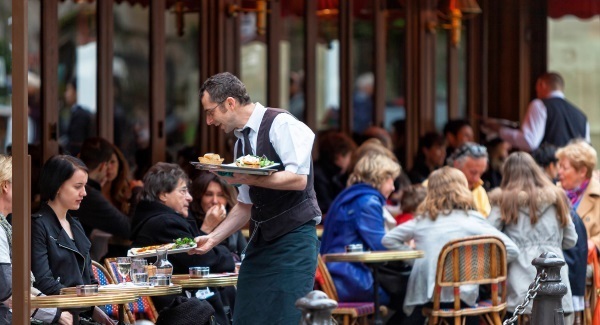
I have to admire his⊠Iâm searching for the right word, but letâs just call it his je ne sais quoi. He is French, after all, and itâs a nicer phrase than hubris or stonking rudeness, though those words capture something of his spirit too.
Iâm delighted to report that the clichĂ© of the proud, disdainful waiter is still incarnate in that wonderful vestige of real civilisation, the French cafĂ©.
There he is mincing in between the tables that spill out onto the terrace.
The tray, silver I think, is held high on a steady hand loaded with big cups of steaming café au lait, croissants nestling in little baskets, and tall glasses full of freshly-squeezed orange juice. I try to catch his eye. I might as well be trying to catch a sunny spell in Tralee.
He bypasses our table and quicksteps over to his destination. To watch this man deliver the order is to see organisation at its peak.
He delivers breakfast and all its awkwardly-shaped accoutrements onto a table top not much bigger than the surface of a bodhrĂĄn. What agility. What grace.
It makes anything that happens on the assembly line at Starbucks seem like a poor and very crass imitation.
Heâs off again with the air of a peacock in his white shirt and black waistcoat that has been pressed so often, itâs shiny.
I try to catch his eye again. Bof!, as the French might say when a situation is baffling or hopeless. Anyone with a shred of wit knows never to call a French waiter garçon, although Iâm tempted to call him something, anything, to get his attention.
He glides away with the practised look of a man who has been avoiding the gaze of his customers for decades. They talk about trans-generational traits and, it seems to me, that modern French waiters work with the steely assurance of people who have been doing this for centuries.
French cafĂ© culture stretches back to the 17th century and its history is dotted with wonderful stories about the intellectuals who, throughout the ages, gathered to drink coffee and talk about revolution, philosophy, and other lofty themes. Thereâs a story that the Enlightenment philosopher and writer Voltaire was a seasoned cafĂ©-goer and drank up to 100 cups a day.
He mixed it with chocolate to blunt the bitter edge, apparently.
Youâll find any number of suspect anecdotes, myths, and legends about French cafĂ©s and the great literary and philosophical figures who frequented them. With that kind of a backstory, no wonder a French waiter might take a bit of pride in his work.
Ernest Hemingway, himself a great café patron, talked about the dignity of the French waiter and said that they should never be treated as servants.
The cafés of Paris and the people and waiters who worked in them became characters in his stories.
Jean-Paul Sartre made several cafĂ©s in Paris famous where he and Simone de Beauvoir spent hours writing over a single cup of coffee. He, too, wrote about the French waiter in Being and Nothingness. He said that the man who brought him his coffee â brusquely and efficiently â was acting out the role of a typical Parisian waiter.
He used the example to argue that we are all guilty of role-playing. People in every profession shoehorn themselves into a persona, whether it is the officious businessman or the efficient schoolteacher.
He thought it a bad thing, saying that we were no longer being our true selves, yet the pride, real or imagined, that a French waiter takes in his job â itâs nearly always a âheâ â is striking in an increasingly slap-dash world.
And they do break out of the straitjacket occasionally. I remember sitting in a café near closing time once and the waiter brought us some pain perdu (French toast) from the kitchen and lingered uncharacteristically for a chat.
There are others who will whisk a lighter from their waistcoat pocket with a theatrical flourish to offer a light, or give you detailed and warm directions if needed.
At a time when traditions are being lost at speed, itâs a joy to see one vestige of a bygone era.
In Paris, itâs now easier to find a Starbucks than an old-style cafĂ© but here in Aix-en-Provence, thankfully, the green medusa has not yet made her presence felt.
As for rudeness, that can cut both ways. A few years ago, a café in Nice, the Petite Syrah, turned the tables on those of us who complain about rude waiters.
The cafĂ©âs manager put a chalked sign on a blackboard outside the cafĂ© that read:
âUn cafĂ©: âŹ7 (a coffee: âŹ7) âUn cafĂ©, sâil vous plaĂźt: âŹ4.25 (a coffee, please, âŹ4.25) âBonjour, un cafĂ©, sâil vous plaĂźt: âŹ1.40.â(Good morning, a coffee, please, âŹ1.40). In the way of these things, his little joke went viral.
Later, the manager said he had taken the idea about politeness from the internet in the first place.
It is simply not true to fall into the trap of saying that the French are impolite. Au contraire, they are exceptionally polite. Youâll get a âBonjour madameâ â mademoiselle disappeared long since, alas â in every boulangerie, no matter who is behind the counter.
In shops, Iâm always struck by how friendly, yet unintrusive, the staff are. They will always say a cheery hello and a equally cheery goodbye, whether you buy something or not.
Meanwhile, back on the cafĂ© terrace, I finally catch the waiterâs eye. He acknowledges me with the tiniest bat of an eyelid, an infinitesimal movement that is barely perceptible, yet itâs clear that he will soon deign to visit our table.
He arrives and my heart skips a beat. It feels as if we are in the presence of something from a bygone age: A master who takes pride in practising his art. I splutter: âBonjour, un cafĂ©, sâil vous plaĂźt.â