It all boils down to taxpayer losing out
Any future decision on water will be a political one and nothing to do with good sound public policy, writes Political Editor Daniel McConnell

It all boils down to taxpayer losing out

SO, THERE he was on his RTÉ radio yesterday for what has become his monthly chat with Sean O’Rourke.

Fianna Fáil leader Micheál Martin was to talk about the “catastrophic cock-up” that has been the water charges issue.

Now that Fine Gael and Fianna Fáil have come to a conclusion on water, Martin insisted his party was not being rank populists living in fear of Sinn Féin and the posh boy of socialism, Paul Murphy.

Martin denied repeatedly and forcibly that Fianna Fáil’s stance on water charges amounted to a flip flop.

At times getting testy with his host, Martin described the implementation of water charges and Irish Water as an unmitigated disaster.

He argued that criticism of Fianna Fáil of this was unfair and inaccurate. He said that water charges didn’t raise money, but lost it.

The only problem is that what he said simply wasn’t credible.

Of course his party’s stance is populist and more over the resolution on water as agreed is one driven by pragmatic politics and has nothing, repeat nothing, to do with what is in the best interests of the country.

The “solution” was one aimed at getting the water issue off the agenda, having bedeviled all and everyone who has attempted to grapple with it.

It is worth recapping at this stage Fianna Fáil’s history on water charges.

It was a Fianna Fáil minister, namely the late Brian Lenihan, who in 2009 announced that preparations for water charges were under way in light of the economic crash and pressure from Europe.

By October 2010, on the eve of the arrival of the troika into the country, the then Brian Cowen government discussed at cabinet plans which would have seen bills of up to €500 per household.

In April 2012, the party rebuked the Fine Gael-Labour government’s attempts at rolling out water charges for lacking in detail, ineptitude in communication, and said there was a crucial failure to appreciate the challenge at hand.

After a decent local elections in 2014, which had seen Labour and Fine Gael decimated over the water issue and saw the departure of Eamon Gilmore as leader and tánaiste, Barry Cowen went on the offensive, describing Irish Water as a debacle of monumental proportions.

He would then go on in July 2015 to call for the suspension of water charges, the first glimpse of the party’s populist approach.

Then in January 2016, in the run up to the general election, at the party’s ard fheis in CityWest, Martin told delegates that in government the party would “scrap Irish Water and the failed loss-making charge which funds it”.

A week or so later, when the election campaign began in earnest, the party’s manifesto committed to “abolishing Irish Water and water charges”.

Martin said the party would suspend charges during the lifetime of the next government and only reintroduce them when the system was fixed.

Then in the wake of the election result and the hung Dáil, Fianna Fáil refused to enter government but signed the so-called confidence and supply deal which saw Fine Gael stay in power with its facilitation.

The price of power was water. Under the deal, the parties agreed to suspend water charges pending the outcome of a commission to make recommendations on the future of water services.

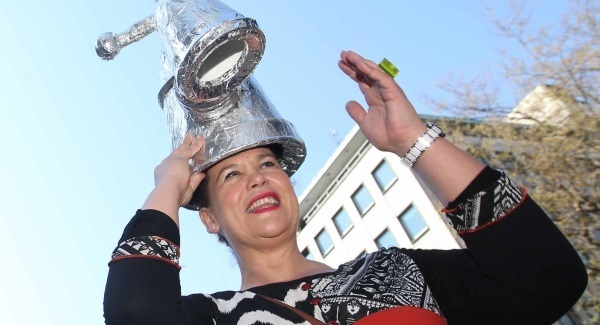
Protests against Irish Water and domestic water charges were rife last year when meters were being installed across the country. Picture: Sam Boal / RollingNews.ie

And then to this week.

At the Oireachtas water committee, Fianna Fáil had wanted to scrap bills and wanted those who used too much water to be fined under the terms of the 2007 water act, which allowed for people to be prosecuted.

But after several days of rancour, Fianna Fáil caved in to Fine Gael demands and have allowed the principle of water bills remain, if in reality only for a small few.

They also appeared to have caved in on whether the level of excessive use will be charged per household rather than per person as Barry Cowen had wanted.

But, while some have portrayed this as a loss for Fianna Fáil, it can hardly be seen as a win for Fine Gael.

What has been agreed is a long, long way from what Fine Gael and Simon Coveney had wanted.

Gone by and large are the bills, gone is the incentive to conserve, therefore making the €500m worth of meters in the ground largely redundant, and gone is much of the need for Irish Water.

Coveney, for his part, must be regretting his appearance on Prime Time last year in which he said the issue of water would need to be looked again, immediately undermining the viability of the embattled utility.

By that stage, up to 70% of people were paying their water bills, the crucial tipping point in terms of making the whole thing viable and in an instant he killed that.

People stopped paying their bills because they knew charges were likely to be suspended and nobody was going to be chased for the money.

Yesterday in the Dáil, the high priestess of indignation Mary Lou McDonald lashed both Fine Gael and Fianna Fáil over the deal on water.

“It was confirmed, for once and all, that the Government’s confidence and supply agreement is in reality an agreement for connivance and cute-hoorism. The connivance is provided by the Taoiseach’s party in its blatant undermining of the democratic and political processes within the Oireachtas.

“The cute-hoorism is, as ever, provided by Fianna Fáil, which has flip-flopped once again,” she said pointedly.

“Fianna Fáil members have used their political strength not to be constructive, as they proclaim, but to face down and thwart the will of the people. In a most spectacular U-turn, Fianna Fáil has shown once again that it cannot be trusted,” she added.

While Sinn Féin’s credibility on water charges is questionable too, her criticisms of what happened this week were somewhat valid.

Such was the rancour that the very deal which underpins the Government’s survival came into question.

“There were strains certainly because of this,” Martin told O’Rourke yesterday.

The ultimate loser in all of this is the general public and the taxpayer.

It is a victory for political expedience over good sound public policy. It is the latest example of how toxic the so-called new politics has become.

Any decision taken now will be done on purely political grounds, no matter what the cost to the taxpayer or how bad a policy will be. This is not what Government is supposed to be about and it is a clear example of why this shoddy edifice needs to be brought to an end and a proper functioning government installed.

It truly has been a sorry week for the political class and it will be us, you and I, who have to pay for it.

x

More in this section

The Business Hub

Newsletter

News and analysis on business, money and jobs from Munster and beyond by our expert team of business writers.

Cookie Policy Privacy Policy Brand Safety FAQ Help Contact Us Terms and Conditions

© Examiner Echo Group Limited