Bank of England governor Mark Carney illustrates Brexit risks
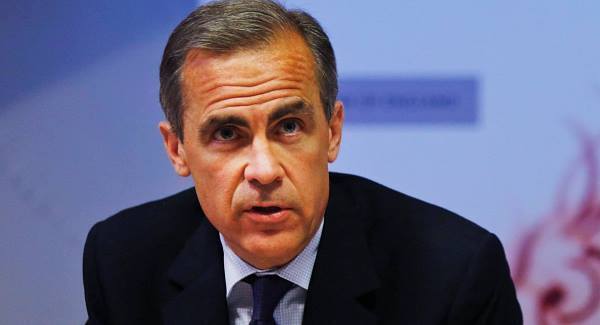
As expected, the May meeting of the Bank of England’s Monetary Policy Committee (MPC) last week concluded with no changes to policy.

Bank of England governor Mark Carney illustrates Brexit risks

The decision to leave the key interest rate unchanged, at 0.5%, was once again unanimous.

However, the minutes of the meeting and subsequent press conference by BoE governor Mark Carney showed that there are concerns in the BoE about the risks to the economic outlook from the upcoming referendum in the UK on EU membership.


The MPC stated that there are increasing signs that uncertainty associated with the EU referendum has begun to weigh on activity.

In the press conference, Governor Carney said that the forthcoming referendum has “pushed up uncertainty measures to levels not seen since the euro-area crisis”.

He elaborated further by saying that a vote to leave the EU could have material economic effects — on the exchange rate, on demand and on the UK economy’s supply potential.

Indeed judging by the text of the minutes, there appeared to be a detailed discussion at this month’s meeting on the economic impact of a vote to leave.

The minutes state that a vote to exit the EU could materially affect the outlook for output and inflation.

The MPC noted that sterling was likely to depreciate further, “perhaps sharply”, and that households could defer consumption and firms could delay investment decisions, lowering labour demand and increasing unemployment.

The BoE Governor went as far as to say that a “technical recession” was possible in the UK in the wake of a vote to leave the EU.

He also noted the possibility of spillover effects into global financial markets.

We would expect a severe and immediate negative reaction in financial markets if there is a vote to leave the EU.

Markets would be unnerved by the prolonged period of uncertainty that would follow.

This uncertainty would be also very damaging to the economy, as the BoE notes.

Indeed, the preliminary estimate of UK GDP in quarter one showed that the pace of growth slowed to 0.4%, from 0.6% in the final quarter last year.

Monthly indicators suggest that activity lost momentum over the course of the quarter. Retail sales were down by 1.3% in March, the second monthly fall in a row.

Meanwhile, manufacturing output remained flat in March following a near 1% fall in February.

The slower pace of growth is starting to weigh on the job markets. Employment rose by just 20,000 in the three months to February, versus 267,000 in the previous three months.

This equates to year-on-year jobs growth of 1.2%, down from 1.9%. The timelier composite employment PMI fell further in April to 52.1, more than a two-and-a-half-year low.

This suggests that employment growth could weaken further in the coming months.

Meantime, the downtrend in unemployment over the past few has ground to a halt in recent months.

In terms of other recent data, leading indicators suggest that growth slowed further at the start of this quarter.

The composite PMI, a good activity indicator, fell to 51.9 in April, a three-year low.

The data suggest that the services sector, which has been the main engine of growth in the UK, is now starting to weaken.

Meanwhile, the data from the manufacturing PMI survey indicate that the sector is continuing to contract.

The PMI trends are mirrored by the latest EC sentiment readings.

The sentiment index for the UK fell to a near three-year low of 104.4 in April.

Overall then, there are clear signs that the uncertainty in regard to the outcome of the EU referendum vote on June 23 is beginning to impact on UK activity.

Growth, though, can be expected to rebound in the second half of the year if the UK votes to remain in the EU, allowing the economy to expand by close to 2% this year.

By contrast, a vote to leave the EU is likely to generate an economic shock and result in a prolonged period of great uncertainty, as well as instability on financial markets.

Growth is likely to slow sharply in the UK in the second half of the year and into 2017 on such a vote.

x

More in this section

The Business Hub

Newsletter

News and analysis on business, money and jobs from Munster and beyond by our expert team of business writers.

Cookie Policy Privacy Policy Brand Safety FAQ Help Contact Us Terms and Conditions

© Examiner Echo Group Limited