Stocks drop worldwide amid flight to safety
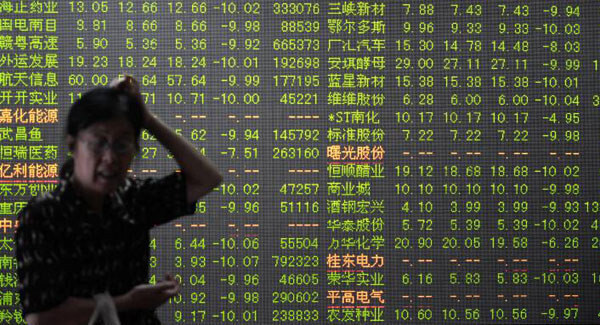
Signs of distress in financial markets accumulated amid deepening concern over the health of the global economy, sending the Dow Jones Industrial Average more than 300 points lower.
Stocks drop worldwide amid flight to safety

The Standard & Poor’s 500 Index headed for its lowest close in 22 months, as US shares joined a retreat in European and emerging-market stocks.

Investors sought the safest assets, sending yields on Treasury 10-year notes to the lowest level in a year, and those on Germany’s 10-year bunds to the lowest since April.

Meanwhile, yields on bonds of Europe’s most-indebted countries rose, while the cost of protecting against default by US junk-rated companies climbed to the highest since 2012.

Oil traded around $30 a barrel.

As the global market rout deepens, Greek assets are again the ones that are suffering the most.

The nation’s stocks are back to being the biggest decliners of the year as they fell to their lowest prices since 1990.

Its bonds, which have already lost more than three times as much as the second-worst performer in the eurozone in 2016, saw yields on securities maturing in a decade rising to more than 10%.

With growing concern over global market turmoil and yet another stalled bailout review in Greece, investors are abandoning assets deemed riskier.

Greek banks, which have already lost almost all of their market value, plunged a further 24% yesterday, the most since August.

“We’re still seeing selling pressure from the tech valuation resetting last week, as well as the drop in oil,” said Matt Maley, an equity strategist at Miller Tabak in New York.

“But it’s not just a problem with technology and some of the high-flyers that have rolled over in recent days, but also the recent stresses in the credit markets,” he said.

US stocks sank last week, as concern about everything from China to oil and interest rates spurred strategists to lower year-end projections for equities.

In Europe, data showed the Sentix investor confidence index dropped to the lowest in more than a year in February.

The S&P 500 declined last week for the first time in three, with a jobs-day tumble on Friday turning into a full-blown selloff.

A rout in high-valued software and Internet companies continued Monday with Facebook falling 3.9% after its steepest retreat in more than a year.

While the S&P 500’s valuation of 15.3 times forecast earnings is in line with the average of the past five years, the measure has plunged 12% since the start of the year.

The gauge remains more expensive than developed markets in Europe, where the Stoxx Europe 600 Index trades for 13.8 times estimated earnings.

Equity benchmarks in Germany, France and Spain dropped at least 3.2%. Markets closed yesterday included those in China, Hong Kong, Indonesia, Malaysia, the Philippines, Singapore, South Korea, Taiwan, Brazil and Argentina.

China reported on Sunday its foreign-exchange reserves shrank $99.5 billion (€89.1bn) in January to $3.23 trillion, the smallest level since 2012.

Germany’s government bonds advanced, pushing the two-year yield to the lowest on record. Meanwhile, Portugal led a drop in the bonds of Europe’s higher debt and deficit nations. Portugal’s 10-year bond yield rose 25 basis points to 3.36%, the highest since October 2014.

Oil fell for a third day after no supply agreement emerged from Venezuela’s tour of crude-producing nations.

x

More in this section

The Business Hub

Newsletter

News and analysis on business, money and jobs from Munster and beyond by our expert team of business writers.

Cookie Policy Privacy Policy Brand Safety FAQ Help Contact Us Terms and Conditions

© Examiner Echo Group Limited







