Mario Draghi in ‘exceptional boost’ to Irish exporters
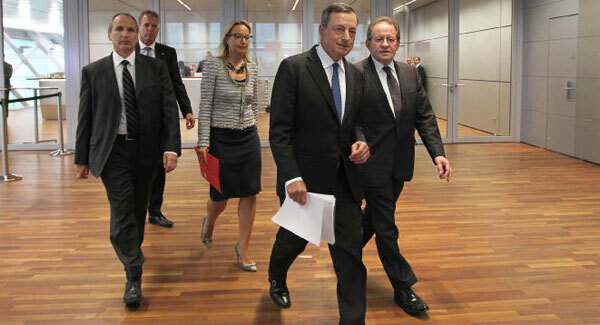
European stocks surged to a two-month high and bonds in the region jumped. American equities joined the rally, with gains underpinned by strong results from blue-chip companies.
The euro fell to a three-week low.
“The fall in the euro provides a further exceptional boost,” said Alan McQuaid, chief economist at Merrion Capital.
“Ireland is probably the biggest beneficiary of the weaker euro in the eurozone and Irish exporters will benefit.”
Philip O’Sullivan, chief economist at Investec Ireland, said ECB president Mario Draghi was “happy to talk down the euro as needs be”.
That is good news for exporters in the months ahead.
Mr Draghi “opened the door widely for an extension of quantitative easing”, said Guillermo Hernandez Sampere, head of trading at MPPM EK in Germany. “It was what the market wanted to hear.
"It will be a positive outcome for the equity market.”
The ECB became the latest central bank to signal a willingness to loosen monetary policy if slowing international growth and tepid inflation continue.
The move sparked purchases of risk assets from oil to metals and emerging-market assets.
The ECB decision to hold key interest rates at record lows was widely expected ahead of yesterday’s meeting of its top policymakers in the Maltese capital of Valletta.
Most attention was on clues as to whether the ECB was ready to expand or extend the bond-buying scheme launched in March.
The bond purchases, originally due to end next September, will continue until the ECB sees a sustained increase in the inflation outlook, he told reporters.
Policymakers discussed a further cut to the bank’s negative deposit rate, he said.
Mr Draghi said the bank would fully pursue its asset purchase scheme up to €60bn a month, as part of efforts to boost eurozone growth and bring inflation closer to its target of close to 2%.
However, in a direct call to eurozone governments to add their weight to a still tentative recovery in the region, he stressed that monetary policy “should not be the only game in town”.
“Fiscal policies should support the economic recovery, while remaining in compliance with the EU’s fiscal rules,” said Mr Draghi.
Although some rate-setters have argued that the ECB should tweak the asset purchases now, most believe that quantitative easing needs to be given more time to work as its positive effects are just starting to pass through.
Mr Draghi emphasised that argument, saying that while risks to inflation and growth remained on the downside, deeper analysis was required before taking further action.
The euro weakened against all its major peers yesterday. German government bonds fell four basis point to 0.53%, and French yields fell the same amount to 0.88%.
The Irish 10-year bond fell 9 basis points to 1.06%. Yields on Italian and Spanish bonds dropped at least six basis points.
The Stoxx Europe 600 Index jumped 1.2%, heading for the highest close since August 20, but the MSCI Emerging Markets Index was little changed.
CONNECT WITH US TODAY



Be the first to know the latest news and updates