Super Mario tackles deflation risk
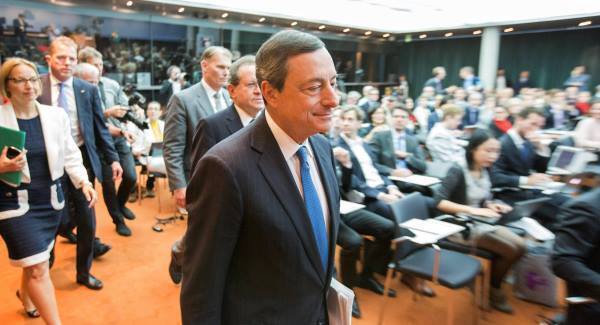
Will Mario Draghi’s unprecedented measures manage to revitalise the eurozone economy? asks Kyran Fitzgerald

Super Mario tackles deflation risk

LAST week, the commander of European Allied Financial Forces, Mario Draghi, unleashed his latest financial offensive. Early progress was reported by Supreme Command. The enemy forces appear to have melted away — for now. Sort of. So who are the enemies and what precisely has Mario done?

The real enemy, we are told, is deflation — falling prices, implying rising real indebteness. As prices fall, the mountain of debt in real terms grows. This is bad news for a country like Ireland which has, pretty much, the highest public and private debts combined as a proportion of national output in the world for an economy of its size.


In the eurozone, core inflation over the past six years, has averaged 1.3%, well below the 2% benchmark target set by the European Central Bank. In the year to May 2014, it was just 0.7% away. In the words of Financial Times commentator Martin Wolf, “inflation is just a shock away”.

Such a shock could take the form of a steeper fall in commodity prices, or in the price of goods arriving from Asia, encouraging consumers to put off making purchases in the shops, or so the theory goes.

Draghi has acted by unveiling a package designed to reassure increasingly skittish commentators and investors concerned at the rise in the value of the euro which is not merely pushing down the price of imports, but is hobbling the ability of exporters to capture market

Highly trade dependent Ireland is being hit on the double. It is ironic that one of the achievements of Draghi’s 2012 measures, the propping up of the euro, has now turned into something of a millstone around the necks of eurozone economies, particularly those with large export sectors.

All this is weighing heavily on the real economy. In the first quarter of 2014 real GDP in the eurozone rose by just 0.2%, with a similar performance expected for the second quarter. As Mr Draghi put it: “Unemployment in the eurozone remains high and overall, unused capacity continues to be sizeable. The risks surrounding the economic outlook for the eurozone continue to be on the downside.” In other words, expect unpleasant surprises.

Draghi is one of the few figures on the European scene with real credibility. No other EU leader attracts the sobriquet ‘Super’ these days. In 2012, rates charged on Government bonds in periphery eurozone countries reached dangerous levels and the future of the eurozone was called into question. In August 2012, Draghi made his famous pledge to “do whatever it takes” to prevent such a break up. He backed up this pledge with a programme for the acquisition of government bonds under which €175bn was pumped into the economy.

The yields on the bonds issued by Greece, Ireland, Portugal, Spain and Italy have since plummeted.

It has become clear, however, that while this measure — opposed incidentally by the German representative on the ECB Council — has brought stability, it has not jumpstarted economic revival. The rise of radical populist forces across Europe and the very real threat of a break up of Spain, serve as a reminder that the current stagnation threatens the status quo.

Draghi cannot revive Europe’s currency union and economy on his own. A real move in the direction of a European debt union, complete with stringent safeguards designed to stem irresponsible activity in certain countries, will almost certainly be required. Such a move, however, is meeting with huge resistance in the wealthier eurozone countries.

The Draghi Plan is a concoction made up of a number of elements. The benchmark ECB interest rate is down again to just 0.15% from 0.25%. This is helpful for people with tracker mortgages, but not good news for savers.

However, his decision to get the ECB to start charging banks at a rate of 0.1% of funds lodged on deposit with the bank has been described as ‘daring.’

There are indications that this penalty could be hiked to a more painful 0.4% if the desired reaction — more lending out of funds — is not secured.

A more striking initiative designed to encourage the banks to engage in lending to SMEs, in particular, is provided through what is termed ‘targeted long-term refinancing operations.’

Under TLTRO, up to €400bn in cheap fixed rate loans will be on offer, with another €150bn being made available immediately under more favourable lending terms designed to coax more borrowers to take up the lending on offer. It has been reported that economists view these terms as being more attractive than expected “raising the chances of the banks taking up a significant proportion of the €400bn” in the words of FT reporter Claire jones.

The offer is, it seems, modelled on the Bank of England’s Funding for Lending Scheme, with one important difference: mortgage borrowing is not included. Draghi accepts that boosting transmission of lending to the real economy is a key goal along with the easing of the monetary stance. as he points out, “80% of our economy is based on banks.”

He warns that the impact of the measures may not be felt for three or four quarters — up to a year, in other words. However, he insists that the cheap finance initiative is something new. However, he was quick to reject the rather farfetched accusation by the president of the German Savings Bank Association that the ECB is engaged in “the expropriation of savers”.

“Our package of measures means the opposite (of expropriation). They are meant to restore growth. This will allow interest rates to return to a higher level.”

He also rejected suggestions by the association that the measures would stall structural reforms across the eurozone.

Mr Draghi made it clear that he may well resort to more radical measures if his latest initiative does not have the desired effect. Quantitative easing in the form of a full blown heavy hitting asset purchase programme is very much on the table.

A further question to be addressed, however. Can Draghi and the ECB engineer recovery on their own, with real commitment to a European wide fiscal plan, a Marshall plan for the eurozone? The answer, again, is almost certainly, no.

More in this section

The Business Hub

Newsletter

News and analysis on business, money and jobs from Munster and beyond by our expert team of business writers.

Cookie Policy Privacy Policy Brand Safety FAQ Help Contact Us Terms and Conditions

© Examiner Echo Group Limited