Firm’s vision becomes a virtual reality
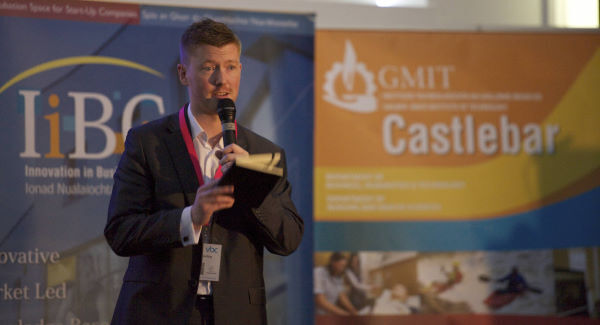
A small West of Ireland firm has become the first in the world to take interactive holograms off the movie screen and make them real.
Castlebar-based Visual Brand Communication has recently sold its first interactive holographic assistant to Shell Ireland, which is using it for health and safety training at the Corrib Project in Mayo.
The company is now in discussions with a number of large UK-based retailers who are interested in using the holographic assistant to provide information for shoppers.
The product — called Hologuide or Hali (Holographic Lifelike Intelligence) — is a human-sized and shaped display which uses the image of a real person and a real person’s voice. “It interacts with and guides customers and comes with an array of features including gender, age, and mood recognition,” explains VBC founder and CEO Alan Dowling.
In coming up with the idea to develop a holographic assistant for the retail market, he was inspired both by market research and the movies. “There was a hologram of Princess Lea in Star Wars and in the movie Minority Report a hologram talks to the Tom Cruise character in a department store and gives him information,” says Mr Dowling. “I thought it should be possible to make this real.”
The setting-up of this unusual venture came about in 2011 after Mr Dowling’s signage business closed in the recession.
He decided to establish a new business using his knowledge of signage in the retail world. He noticed that, in order to cut staff costs, retailers were beginning to use technology such as touch screens and kiosks to provide information for customers. Deciding that technology could be used to provide something more engaging than an inanimate screen, he started looking at the idea of using holograms of real people.
In 2012, Mr Dowling signed up to the New Frontiers programme in Castlebar and began talking to retailers and customers about his idea. He secured Enterprise Ireland funding, which he used to start developing a basic prototype.
Mr Dowling discovered that, although holograms or “virtual mannequins” had already been developed and were being used in some airports, they weren’t interactive and couldn’t respond to questions. “Market research showed that people wanted face-to-face interaction and they wanted to get a quick answer to a simple question,” he adds.
VBC developed the hardware, manufactured by a Swedish company based in the UK, and developed the software and video content.
During 2012, VBC reached an agreement with Toshiba to install and provide technical support for the new Hologuide product, helping it gain credibility.
At the end of the year, an early prototype which could measure gender and age but couldn’t recognise speech, was shown to retailers and was tested in Dublin Airport.
In 2013, Enterprise Ireland provided further support, enrolling VBC in its High Potential Start- Up programme and providing investment.
Through venture capital companies, private investors and Enterprise Ireland, the company raised €340,000 last year.
The funding was used for R&D and, by early 2013, an upgraded version of the holographic assistant was released which could greet customers and answer questions in up to 26 languages.
VBC is now preparing to release a Live Wall version, which projects a small interactive hologram onto a wall.
The plan now is to sell to the retail market and VBC sees opportunities to sell to theme parks, the entertainment industry, fashion, food, and sports retailers The cost of the units ranges from €14,000 to €40,000.
One key advantage is novelty and the fact that there is no competition in this space. However, the newness of the product is also a disadvantage and the company has to create a market for hologuides.
“We have to explain what it is and what it does; it’s very new and very different,” says Mr Dowling. He says the company, based in the Innovation in Business Centre, GMIT, Castlebar, is in advanced negotiations with several large UK retail companies and he expects two wall holograms to go into a large retail store in London within months.
“What we need now is one big early adopter who has the budget and is willing to take a risk on something new. If we get one big retailer, more will follow,” says Mr Dowling.
CONNECT WITH US TODAY



Be the first to know the latest news and updates











