Troika in battle to conclude Cypriot bailout
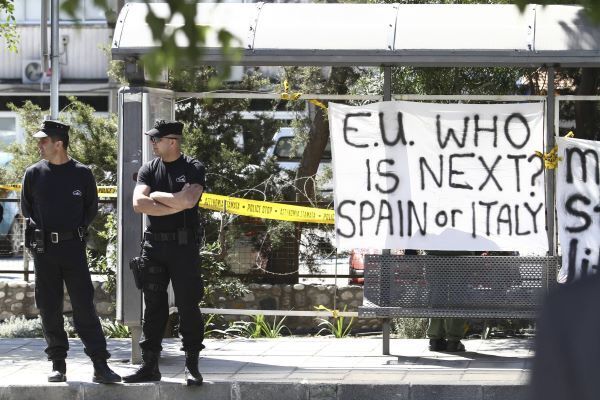
One of these stark facts is that the intention is to cut each country’s banking sector to an EU average that is based on population size. The other is that, in future, everyone with money in a bank will be asked to bear the cost of a country’s problems.
The one target Cyprus appears doomed to reach is that its banking sector will be reduced to an EU average, as stated by eurozone ministers following their previous Cypriot bailout meeting a week ago.
But if nobody is allowed to have a larger financial sector than this, then the likes of Ireland and Luxembourg, for example, will need to substantially cut their industries, leaving the field to the larger economies.
While Finance Minister Michael Noonan has insisted there are no conditions under which savings of less than €100,000 in Irish banks would be touched, the principle of hitting depositors has been established.
Ministers from three small eurozone countries — Ireland, Finland, and Estonia — have acknowledged as much.
At a conference in Finnish Lapland, Lucinda Creighton, the European affairs minister, told journalists: “There must be some private sector involvement.”
Her Finnish counterpart, Alexander Stubb, said that, in future, there must be some private bail-in, with savers losing part of their money to help rescue a bank.
“We are moving from a system of bailout to a system where we decouple the connection between the bank and the sovereign. We are going towards a system of bail-in,” he claimed.
“I think that is the message that has been sent in this particular rescue package,” he said, adding that each rescue had its unique elements.
Toomas Hendrik Ilves, the Estonian president, said that citizens and their parliaments were not anxious to bail out banks using taxpayers’ money, and so the other option was to use the funds of all investors in those banks.
The enormity of the situation was evident from the comments of finance ministers on their way into the emergency meeting in Brussels last night.
Wolfgang Schäuble, the German finance minister, said he believed any deal reached “would be the same as last week”.
Mr Schäuble was closeted with Herman Van Rompuy, the president of the European Council, and José Manuel Barroso, the president of the European Commission, for several hours before being joined by IMF chief Christine Lagarde, EC economics commissioner Olli Rehn, and ECB president Mario Draghi.
While the other eurozone economies escaped almost unscathed last week as markets punished only the value of the euro against the dollar, and leaving borrowing rates almost untouched, the finance ministers appeared confident that Cyprus did not present a risk of contagion.
French finance minister Pierre Moscovici insisted that the Cypriot situation was specific only to that country.
“There is no other economy in the eurozone that has the same characteristics. There is no risk of contagion for other depositors,” he said.
But he did concede that “the devil is in the details” of a solution.
A plan to move the operations of the Cypriot banks in Greece to the Piraeus Bank appeared to have hit the rocks yesterday evening.
The Cyprus News Agency reported that the move had been halted on the instructions of Nicos Anastasiades, the Cypriot president.
The agency reported that he hoped to use the fact that Greeks had substantial funds in the bank branches in Greece as a bargaining chip during negotiations with the EU/IMF.












