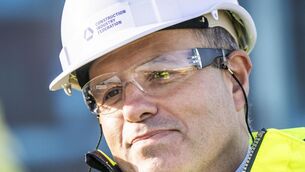
Armen guides Elan to new waters
Seasoned market watchers were having none of it and the stock soon gave up much of its gains.
But there is no doubt new Elan chairman Garo Armen has steadied the ship. He gave an assured performance at the company's AGM last week, though there were raised eyebrows about the non-attendance of key members of the company's management committee at the event.
Based in Manhattan, he is chairman and chief executive of biotechnology company Antigenics which he co-founded with well-known research scientist Dr Pramod Srivastava. He has also established a new foundation, Children of Armenia, which is involved in demining activity in Armenia.
Armen is of Armenian origin. The son of a mechanic, he grew up in Turkey. Turks and Armenians have difficulty getting along, not surprising given that the Turks massacred hundreds of thousands of Armenians during World War One.
According to one biographical source, "Dr Armen emigrated at age 17 to New York at the behest of his father who feared that his son's headstrong temperament in a politically charged atmosphere would land him in trouble."
After reaching America in 1968, he gained a degree in biochemistry from the City University.
His mother by then had fallen gravely ill with breast cancer and she came to New York in search of a cure.
But she died four months later.
Fast forward to 1993. Pramod Srivastava was researching tumour immunity, the key factor in the spread of cancers. Srivastava had been working on the development of a cancer vaccine. He was a controversial figure in the medical world.
Armen was running a money management firm which provided advisory services to firms in the biotech/pharmaceutical industries.
He had started out in Wall Street as an analyst back in 1981, moving eventually to head up a team at the leading Wall Street firm Dean Witter Reynolds before setting up his own business in 1990.
The two men joined forces to found Antigenics, the biotech firm which the two men still run today.
Antigenics currently has a market value of around $300m.
Its share price tumbled earlier this year and the company has racked up significant losses, of $70m over three quarters, as its research programme moves to a critical stage. But sources close to Dr Armen point to the fact that Antigenic's share price fall has been well below the average in a sector Biotechnology which has taken something of a battering as a result of the spread of so called "Enronitis" and the increased concern among investors about accounting transparency.
Companies with drug pipelines and royalty income flows have suffered more than most from this understandable upsurge in investor concern, few more so that Elan.
Antigenics did raise $60m, earlier this year, and Dr Srivastava's cancer vaccine product, Oncophage, targeted at patients in the late stages of malignant Melanoma (skin cancer) and kidney cancer, has now reached the critical third phase in its patient trials.
This is a crucial time for Antigenics. It is expected that FDA (US Food & Drugs Administration) approval will be sought by 2004 in time for a launch of the new drug into the marketplace.
Antigenics was hit by an embarrassment recently when Sam Waxal, the founder of Imclone, the company at the heart of a major US insider share dealing investigation, was forced to resign as a director of Antigenics.
Waxal was approached by the company to join as a director because he had secured "the largest ever deal in the biotech and pharma space". Once news of the insider dealing allegations broke, he was "let go".
One would have thought that Armen would have enough on his plate steering Antigenics towards a profitable port.
There is after all little overlap between this company and Elan Corporation. However, Armen has served on the Elan board since 1994, a dubious distinction insofar as it means he cannot avoid the taint of association with the now largely departed CEO/chairman Donal Geaney and deputy Tom Lynch.
What Armen has brought to the table is a distinct change of style.
His handling of a potentially very difficult AGM has been generally applauded in the markets.
But Armen's tenure will be judged by his ability to deliver on an ambitious commitment to raise $1.5 billion through asset disposals over the next 18 months.
A major investigation by the Securities & Exchange Commission hangs over the firm. It could face legal Armageddon in the form of a series of class actions should the SEC issue a harsh finding. It could be years, however, before the outcome becomes clear.
Meanwhile, the chairman has sought to reassure the markets there are "no signs of impropriety or accounting irregularities."
Armen has talked reassuringly about a future for Elan as a smaller sized firm with an annual turnover in the region of $300m to $500m.
Many are sceptical about the prospects of delivery. They argue Elan is in a fire sale situation.
Says one leading analyst: "I am still dubious. We do not yet have the specifics on what Elan intend to sell. How quickly will they be able to realise the assets given their lack of bargaining as a forced seller ? Time is of the essence. They do not have a lot going for them. "
But according to Bernard Swords, a fund manager with Hibernian Investment Managers, "it is essential if the debt levels are to be got back down and stability brought back to the company."
The sceptical analyst has, at least, warmed to Armen personally. "He seems to have built up good loyalty among Elan's remaining top management and he took the heat out of matters at the AGM."
Armen can schmooze, but there is a steely side to him.
Earlier this year, he took successful legal action against Antigenics' Wall Street broker Piper Jaffrey when they threatened to drop coverage of the company after they grew dissatisfied with the terms on offer to them in relation to the company's successful January IPO. Says one source: "Garo was shocked about the way he was treated."
Armen is apparently the classic self driven immigrant entrepreneur.
"He is a high energy guy who gets up at between six and 6.30am and works until 10pm."
When tasked about the fact he now guides the fortunes of two companies separated, in part, by the Atlantic Ocean, he points to the fact that Jack Welch ran 200 companies at GE and did so with the help of good management teams.
Several hundred employees in Athlone will be banking on the expectation that their new chairman comes up with plenty of inspiration during the course of his daily strolls.

CONNECT WITH US TODAY



Be the first to know the latest news and updates