John Whelan: Will Taoiseach’s trade mission prove a turning point for Irish exports to China?
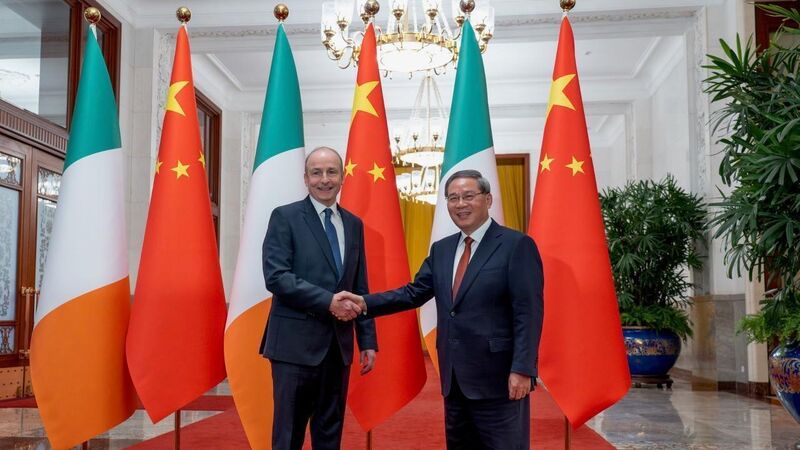
Taoiseach Micheál Martin shakes hands with Chinese premier Li Qiang in Bejing last week. Mr Martin made the case for Irish exporters including agrifood exporters. Picture: Government of Ireland/PA Wire
Despite high hopes, the recent visit of Taoiseach Micheál Martin to China may not be enough to halt the fall in exports to our largest market in Asia, as tensions continue to rise between the EU and China.
Ireland’s exports of goods to the Chinese market have been on a downward path for some years, falling by €3.8bn in the four years to December 2024. Based on Eurostat figures, they are expected to have fallen by a further 13% in the past year.
Of particular concern is the fall in exports of agri-food including lost beef exports from the likes of ABP, pigmeat from Rosderra, and seafood from Connemara Seafoods amongst others. Central Statistics Office figures to the end of October showed sales of agrifood products to China are down to a level not seen in over a decade. While Mrl Martin raised the issue of the suspension on Irish beef exports, there was no obvious solution offered by Chinese officials during his visit.
Over the past few years, significant distrust has emerged between the EU and China. The massive trade deficit of roughly €325bn last year, something European officials warn is not sustainable, is at the core of the distrust. EU leaders said the China trade relationship had become too one-sided, with state back industries under-cutting European producers, particularly in e-vehicles, batteries and solar panels.
In December, the trade relationship soured further with Beijing announcing its latest counterpunch in a dispute over EU duties on Chinese-made electric vehicles imposed in 2024, by setting a punitive 43% provisional import duty on dairy products. The situation could worsen in 2026, as French president Emmanuel Macron wants to resolve global imbalances as the core of this year’s French presidency of the G7 club of advanced economies, stating that either we rebalance economic relations cooperatively — engaging China, the US, and the EU in a genuine partnership — or Europe will have no choice but to adopt more protectionist measures.
America’s lurch into protectionism under Donald Trump has exacerbated the global situation, displacing trade flows, making it even harder to resolve thorny issues such as market access and state subsidies. The US tariff war on China has resulted in a diversion of trade away from the US, and Chinese exports to Europe rising further and are now more than double Europe’s exports to China. At the same time, EU exports to China - along with Ireland’s - have been in decline.
Outside the agri-food sector, Ireland's exports to China characterised by high value-added pharmaceuticals and medical devices, have held up much better, with sales holding steady over the past five years. Unless disrupted by EU increasing its tariff war with China, the pharmaceutical and medical technology sectors offer clear potential for Ireland’s pharma exporters.
With a population of more than 1.4bn and a middle-income group of more than 400m people, China’s accelerating healthcare reform and expanding healthcare spending could unlock significant export sales opportunities for Irish producers, and for US owned companies located here, who may welcome a route around the Trump tariff wall.
Foreign direct investment was also a key feature of the Taoiseach’s meetings in Beijing and Shanghai, as the decrease in foreign direct investment in Ireland of €97.4bn in 2024 was largely attributed to lower investment from the US. It partially offset by increased investment from Europe, but very little from China.
There are over 40 Chinese companies operating in Ireland, including major names like Huawei, WuXi Biologics, TikTok, Temu, and Shein. But their investment pales by comparison to that of the 970 US corporations who to date have invested €388bn in Ireland, compared to the €12bn from Chinese companies.
Greater investment by Chinese corporations would offer Ireland an opportunity to reduce its reliance on the US tech giants such as Facebook, X, and Google who have European headquarters here. More importantly, it may offer a deep source of alternative investments to replace the demand by the Trump administration for global pharma corporations to ‘homeshore' their investments back to the US.
The question remains has the Taoiseach’s visit done enough to reverse the falling exports, or bring in more Chinese investment?