Joyce Fegan: What kind of Ireland do you want to live in?
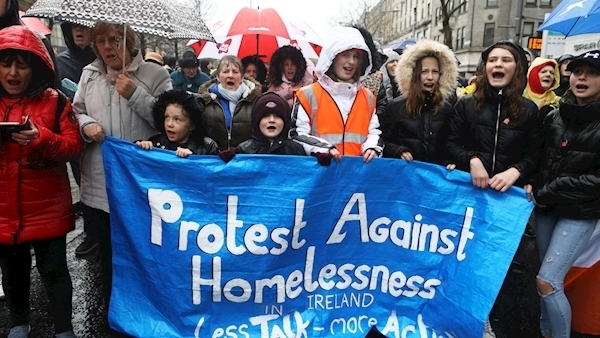
Ireland of 2020 is an Ireland where the quality of life and the cost of living are equally squeezed, but they don't have to be.
The question isn't who are you voting for. The question is what kind of society do you want to live in?
A State where homelessness is now the accepted housing policy? Even though we're a society where 99.99% of us would find it hard to walk past a man, woman or child begging on the street.
A State where daily traffic congestion is boasted about as a sign of economic prosperity? Whereas in reality, we're a society of drivers cursing the third bedtime story missed this week.
A State where childcare is euphemistically referred to as a "second mortgage"? Whereas in reality, we're a society where the lower income in the household just about justifies paying that second mortgage?
A State where caring for our elderly is not a certainty? Whereas in reality, we're currently a society where grandparents prop up the childcare system free of charge.
There are many other unacceptable ills-at-large in Ireland of 2020. There's the fact that our State pays private contractors tens of millions of euro every single year to house people who've sought refuge here, only for those asylum seekers to be left in limbo for years on end.
There is of course the other ill of renting, because salaries will not match the average cost of a three-bed semi-d. Even though, ironically, it's cheaper to own than rent. Other factors in that equation include mortgage approval rules, a lack of will to build social housing not a lack of private housing, and a lack of will to seriously invest in innovative housing solutions.
There is also the generation of workers without pensions and much benefits at all, because unions and collective bargaining are so yesterday.
But enough of the problems we all not just know and are sick of hearing about, but that we have the intimate lived experience of.
Ireland of 2020 is an Ireland where the quality of life and the cost of living are equally squeezed, but they don't have to be.
Let's take homelessness for example. Did you know it is not an inevitable fact of human existence? It's more policy driven and a problem that's caused by bad policy, can be fixed by good policy.
Finland is the only EU country where homelessness is falling. Not because it's wealthy, but because of a specific policy - Housing First.
This policy was devised a decade ago by a social scientist, a doctor, a politician and a bishop. In Finland, those affected by homelessness receive a small apartment and counselling. About 80% of people make their way back into a stable life.
For the economists reading this, or for those sneering at the "idealism of socialists" - Housing First is cheaper than accepting homelessness.
Yes, Finland has spent €250m creating new homes and hiring 300 extra support workers. But a study showed the savings in emergency healthcare, social services and the justice system totalled as much as €15,000 a year for every single homeless person in properly supported housing.
Financial cost aside, the human benefit has been rapid and evident. Since the policy was adopted in 2008, the number of long-term homeless people in Finland has fallen by more than 35%, and rough sleeping has been all but eradicated in Helsinki.
This is in a country, where tent villages and huts populated the parks of its capital just 12 years ago. Sound familiar?
Where there is political will, there is always, always a way.
Often the better, more human solution, is far cheaper than the problem at hand.
It's a bit like how we manage refugees that come to us for sanctuary. We outsource their bed and board to private companies, and as a result the standards of care vary widely across the country. But again, putting on a purely economic hat and to sneer at those "idealistic socialists" again, let's look at cost.
Going private is actually more expensive. Really? A 2019 report from Department of Justice and Equality found that the operational costs of commercially owned direct provision centres are approximately 44% more per person per day than State owned centres.
But what about those who are neither homeless nor a refugee? What about the life of the squeezed middle? Those commuter belt citizens, where their home's second job barely justifies the costs it covers?
This January, a woman in her early 30s was returning to work having had her first baby. Parental leave and childcare was organised. However, the arrangement between employer and employee fell through at the last minute, with the woman getting one instead of two days of this unpaid leave, leaving her having to rearrange her childcare and work out if her three-hour daily commute was going to be worth it all.
She is an extremely diligent and hardworking employee, whose presenteeism, productivity and punctuality all rate equally 10 out of 10. She ended up talking to a work contact, not a colleague, about her return to work. This older man is an employer and confided in her that his best employees were in fact parents, mothers in particular, particularly mothers who fit three or four days into five.
"They're more effective and productive on a shorter week when they return work after maternity leave," he said.
So what about a four-day work week Ireland?
Back to those who think purely in economics first and in human terms thereafter.
A recruitment and training company in Galway, ICE Group, started to trial a four-day work week last July and the results have been very impressive. How impressive? For those who seek to only quantify life, the company estimates that productivity is up 27% as a result.
Aside from the benefits to a company, what would some of the benefits to society be?
In a dual-income family household, one parent could work Monday to Thursday and another could do Tuesday to Friday, meaning less commuting, less polluting and the cost of childcare would go from five days down to three. Not to mention an increase in the unquantifiable quality of life and a reduction in stress.
But as the saying goes in politics, if you want different, vote different. Because the solutions to our ills are there, and it's about will, not way. And it's up to us, the electorate, to lead the way and tell those who we elect, exactly what kind of society we want to call home.