Pádraig Hoare: Will the environment be the beneficiary of Covid-19?
Wildlife roaming the empty streets of the world's busiest cities prompts the question as to whether the pandemic might actually be good for nature and the climate. Experts discuss this idea with
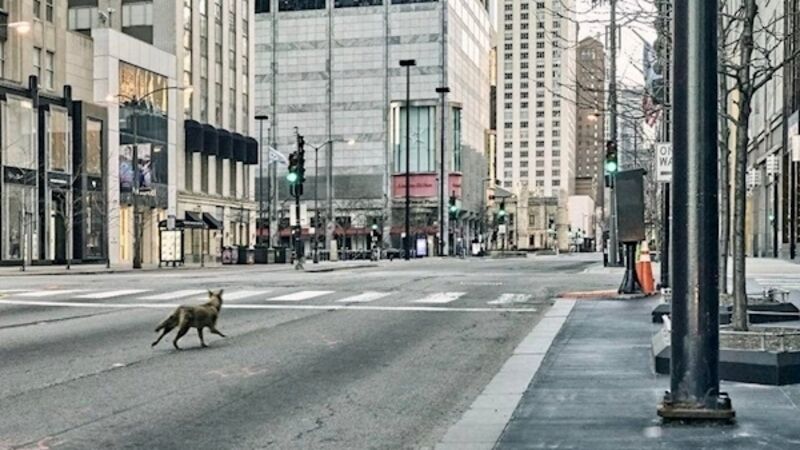
There is a wild coyote leisurely ambling down a deserted Michigan Avenue, the busiest thoroughfare in Chicago, Illinois, which is the third-most populous city in the USA with almost three million people.
While we are now a mass data-driven society, relying on numbers, patterns, codes and algorithms to paint a picture of where we are as a species, sometimes it is visceral imagery that tells you we live in the strangest of times.
Wild animals roam freely in our neighbourhoods, the roads are deserted, the air somehow smells fresher, and the rumblings of giant passenger aircraft almost seem a distant memory.
The Covid-19 pandemic of 2020 will take a terrible toll on humanity, forever changing the lives of families caught in its insidious grasp.
However, could this be an inflection point in how we tackle climate change and sustainability?
NASA and the European Space Agency (ESA) pollution monitoring satellites detected significant decreases in nitrogen dioxide (NO2), a noxious gas emitted by vehicles, power plants, and industrial facilities, over China in the months since the Covid-19 outbreak began.
New York City researchers have found carbon dioxide emissions down 50% compared with the same period last year.
Irish native and assistant professor from Columbia University, Róisín Commane, who undertook the New York City air monitoring, told the BBC: “This is the cleanest I have ever seen it. It is less than half of what we normally see in March."
With more than three billion people worldwide now under lockdown, emissions will be significantly reduced worldwide.
The question now is can the world capitalise on the enforced changes and adapt for a more sustainable future?
"I expect we will have the smallest increase in May to May peak CO2 that we’’ve had in the northern hemisphere since 2009, or even before," added Ms Commane.
Carbon Brief is a UK-based not-for-profit website covering the latest developments in climate science, climate policy and energy policy.
Christiana Figueres, an internationally recognised leader on global climate change, convened a panel of major experts to gauge if and how the pandemic could provide an impetus for meaningful sustainable change when it comes to the environment.
She said: “We will emerge, albeit more slowly, from the unprecedented economic paralysis.
The question is how we emerge: whether we return to the ways of the past or whether we derive valuable lessons, to emerge wiser and better equipped to continue to deal with our longstanding emergency of climate change.
“Over the past few weeks, governments and businesses have acted swiftly to mandate drastic, but necessary measures to stem the coronavirus, keeping people indoors, grounding air travel, cancelling events and closing borders.
"Citizens, equally, are uniting to shift their behaviour en masse, by working and teaching their children from home, washing their hands more frequently, protecting the elderly, and helping neighbours shop for food.”
The same decisive spirit is needed in the climate crisis, the former Executive Secretary of the United Nations Framework Convention on Climate Change (UNFCCC) added.
“We need both significant government policies and important personal behaviour changes.
"Governments will need to intentionally design economic recovery packages that support the most vulnerable and promote innovation and clean technologies as the moving force of the economy, while removing subsidies from polluting industries.
“Businesses will need to decarbonise their operations and investors their portfolios.
"Individuals will need to change their diets, consumption patterns and travel behaviour. We have learned that every person’s individual effort actually does count.
“The Covid-19 pandemic has unleashed humanity’s instinct to transform itself in the face of a universal threat and it can help us do the same to create a livable planet for future generations,” she said.
Dr Maria Kirrane, sustainability officer at UCC, which has garnered international accolades for its commitment to the practice, told : "The first thing to say is that sustainability means balancing environmental, social and economic considerations; what we are seeing now is an unprecedented disruption to or economic and social systems.
“It is likely far too early to call any long term environmental impacts, but there are certainly lessons that can be taken from the experience to date.
"Those of us working in organisational sustainability have for some time promoted the idea of remote working to reduce carbon emissions from commuting; these emissions can account for up to 20% of an organisation’s carbon footprint.

“We are seeing dramatic images of reductions in air pollution following lockdowns across the globe.
"What we need to do next is assess employees’’ experiences of remote working, under these extraordinary circumstances, to see how we can improve and support it to build on these gains in a way that works for employees.”
Dr Kirrane said a major outcome of the pandemic has been to highlight the incredible community spirit that exists in Ireland.
“Many of those that have rallied around their neighbours and set up community supports are also the ones that have been working at grassroots environmental and social projects for many years.
"Local shops and online farmer’s markets have sprung up. Supporting these communities will be vital to ensuring that Ireland emerges from this crisis as a more resilient nation, environmentally, socially and economically. The mantra of the UN’’s Sustainable Development Goals (SDGs) – “Global Goals, Local Action” springs to mind.
“Finally, if there is one major lesson to come from the pandemic, it’s that global crises can only be addressed when we listen to expert voices and base our decisions on scientific evidence,” Dr Kirrane said.
The challenge will be to keep climate change and sustainability on the national and international agenda as economies try to pick up the pieces, according to leading International Energy Research Centre (IERC) experts.
The Tyndall National Institute-based IERC’s executive director, Professor Tony Day, said that while the loss of output will give us some drop in short term emissions, “it will remain to be seen if any of this can be locked in”.
He added: “In many western economies GDP growth has been somewhat decoupled from carbon emissions, especially in service-driven economies.
"The UK is a good example of this, where the change of CO2 emissions might not be expected to be as strongly linked to output. However, Ireland has a higher relative industrial base, which might see emissions fluctuations closely tied to output.
Spotted on the playground at the elementary school next door, which has been closed for several days ... wild turkeys! That’s a first. #coronavirus #westoakland pic.twitter.com/tGA4y1l09c
— Charlotte Simmonds (@CharSimmonds) March 20, 2020
“I can’t see this coronavirus event providing a structural change – unless it lasts for any length of time, in which case industry, and society in general, might have to find ways of doing things differently to maintain profitability.
"So it could be that this is a wake-up call to modify the way economies are run.
"But I doubt whether people will make the link between a virus outbreak and climate change, unless it is the shock we need to see things anew. It will require leaders who can make the connections.”
Piyush Verma, Senior Energy Policy Analyst at the IERC, echoed Professor Day’s thoughts on the decoupling of economic growth and carbon emission in many western economies.
“In Ireland also we are seeing this decoupling since the last few years. The latest SEAI Energy in Ireland 2019 reports 1.7% increase in economic growth with a 1.2% reduction in energy related CO2 emissions.
"The driving factor is different here though.
“The Covid-19 outbreak will also result in reduction in emissions at some extent, but it will not be sustainable in the long-term.
"We are seeing an economic crisis now and are not sure how serious it will be and for how long. We might see for a year or so the reduction in carbon emissions as a result of loss of industrial production and closing of commercial facilities.
"But, the outbreak is a threat to long-term climate action as there is a potential risk of undermining investment in the clean energy sector due to this economic crisis.”
When the situation returns, the focus will be more towards recovering our economy through the slowdown rather than a direct focus on meeting our climate action agenda, Mr Verma said.
“Now during this outbreak, we are seeing a tension between health policy and economic policy.
"While health policy aims to lower down the intensity of the epidemic, even if longer lasting, economic policy, by contrast, aims to minimise the duration of the closing of factories and facilities, and may bring new policies to support this.
"Although priorities will be/have to be towards slowing down the pandemic, eventually government policies will really need to strike a balance here otherwise, there will be serious unintended consequences.
“Similarly, when we are out of the outbreak phase we will really need to strike a balance between economic policy and climate policy otherwise, we might see a reverse trend.
"Economic recovery will result in a significant increase in emissions, if appropriate policies and measures are not considered.
"We should not allow Covid-19 to compromise our future climate and energy investment.
"Government policies and decisions of larger industries and businesses will be really crucial here.”
Covid-19 may affect CO2 emissions
Carbon Brief asked scientists, analysts and policy experts from a range of disciplines for their thoughts on how the lifestyle changes brought about by the Covid-19 pandemic could affect global CO2 emissions in the short and long term.
“The Covid-19 pandemic has unleashed humanity’s instinct to transform itself in the face of a universal threat and it can help us do the same to create a livable planet for future generations.”
“Covid-19 may just demonstrate that solving the climate problem is going to have to focus on solving the technological challenge.”
“What’s important…is using this opportunity to create better systems and structuress.”
“Long-term, stimulus packages may hold the key to whether this disaster significantly delays or advances progress on climate.”
“Even the most stringent responses to the climate crisis would be much less abrupt than what we are seeing now.”
“Covid-19 is a re-evaluation and re-wiring opportunity. It won’t be much fun but it does give humanity an enforced chance to stop and think.”
“Given the links between zoonotic diseases and habitat loss, we could see impetus to stop biodiversity loss.”
“The climate benefits of a modal shift to online for things like conferences can be big.”
“These trillion-dollar measures show once again that if political will is present and society acknowledges the acute need to act, drastic measures can be implemented in a short period of time.”


CONNECT WITH US TODAY



Be the first to know the latest news and updates