Qatar: A city in preparation for the World Cup
Preparations are already underway in Qatar for the World Cup, writes Ed Power.
Sixty kilometres south of Qatar’s hyper-modern capital Doha lies the Inland Sea, where the azure waters of the Persian Gulf intersect with the Arabian Desert.
On a typically cloudless day, with sand dunes stretching into the horizon, this gleaming blue channel could be mistaken for an optical illusion. Bright, foamy surf laps against the barren shore. In the distance four wheel-drive trucks, the only means of accessing the sea, slalom down huge swells of sand.
Occasionally the silence is punctured by the tap-tap of someone using a smartphone The 5G broadband signal is a reminder of Qatar’s super-charged economy and of this young state’s determination to position itself as the shiny new face of the Arab world.
Centuries ago, the Inland Sea was a refuge for pirates. In the 1800s, when Qatar was a British protectorate, corsairs used it as a base from which to plunder the surrounding coastline. Tensions came to a head in 1837 as Abu Dhabi sent a fleet to oust the freebooters, leading to war between Qatar and the neighbouring emirate.
Today, by contrast, the Inland Sea is a popular destination for Qataris fleeing the bustle, traffic and punishing heat of Doha, where summer temperature can reach 50 degrees celsius. Scattered amidst the dunes are caravans bristling with satellite dishes: holiday retreats for locals wishing to connect with the uncompromising environment which their ancestors would once have traversed.
Having travelled all the way from Ireland to gaze upon the Persian Gulf, it would be a shame not to dip a toe into those achingly vivid waters. Stepping into the swell, the biggest surprise is its pleasing coolness. It’s a strange sensation – a shiver that running up your toes as you gaze at the dunes pressing around.
December is as close to winter as you get on the Arabian Peninsula, temperatures bobbing along at a relatively chilly 22 degrees. Later a tour guide remarks that, at this time of the year, you are more likely to freeze to death in the desert – lack of cloud cover means it gets considerably colder at night – than be done in by thirst or exhaustion.
This is my second day in Qatar and it has been a whirlwind introduction to the tiny Gulf state. A “Dune Safari” in the company of a driver from Pakistan has seen our travelling party bounce along the desert, cresting peaks and plunging downwards at rollercoaster velocity. The “not in Kansas” sensation is heightened by the Arabic music blaring from the sound system and by our guide’s nonchalance in the face of the towering heights we are traversing.
Back in Doha, the contrast could not be starker. Once a poor and obscure British outpost, Qatar is today one of the most high-powered economies in the Gulf. And one of the wealthiest thanks to the world’s second largest liquid gas reserves, which allow the government pay state employees on average $14,000 tax free per month. Such dynamism is all the more remarkable considering the modest population of 2.2 million, including just 330,000 native Qatari citizens.
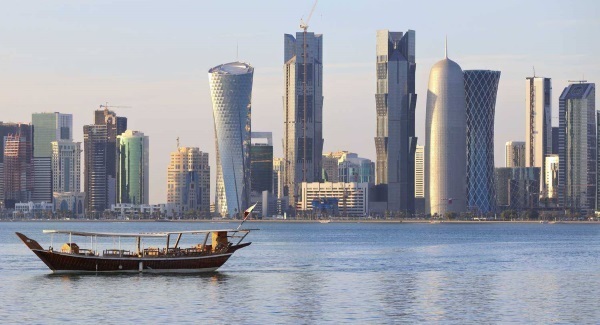
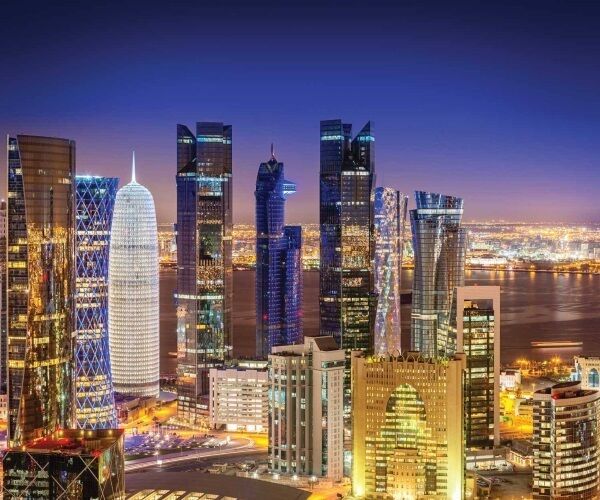
Downtown Doha looks as if it was teleported to the Middle East from the 23rd century. More than 160 glittering towers line the city’s West Bay. By the time Qatar hosts the World Cup in 2022 the figure is predicted to exceed 200.
Across the bay, meanwhile, stands the Pearl, an artificial island of four million square metres bristling with sky-scrapers, apartment complexes, a replica of Venice’s Rialto Bridge and – this being the megabucks Gulf – Ferrari and Rolls Royce show-rooms glaring at each other from across the street.
With the World Cup just five years away, Doha feels as much construction site as city. The Emir, Sheikh Tamin, has ordered the raising, from the desert dust, of a new capital city, adjacent to Doha, where the opening match and final of the competition are to be hosted. At a cost of $45 billion, Lusail is slowly taking shape, its 80,000 capacity stadium, the Sports Arena, to be modelled on the swooping profile of the traditional Arab vessel the Dhow.
Work is also proceeding on a metro system, to open ahead of the World Cup. As with everything else in Doha the Emir’s will is being carried out largely by imported labour. In my three days in Qatar interactions with locals were at a minimum. The swish Western-style hotels are managed by Europeans and staffed by migrants from Pakistan, China, the Philippines and India; the construction crews toiling into the night are drawn from across South Asia and the rest of the Middle East Qatar’s emergence as regional player has been assisted by Al Jazeera the Doha-headquartered news network funded by the state.
The country’s new-found prominence has not gone unnoticed, however. Last June, Egypt, Saudi Arabia, the United Arab Emirates and Bahrain cut official ties with Qatar, accusing it of funding terrorist groups such as Hamas and ISIS – claims rejected by the Qatar government.
Diplomatic isolation does not appear to unduly impinged on the locals. The stylised likeness of the Emir is ubiquitous – adorning the sides of skyscrapers, car windows, even t-shirts. Qatar is not a democracy and a 2017 report on press freedom concluded that “Media outlets and professionals… are subject to significant restrictions, and the overall landscape encourages a high level of self-censorship”.
Nonetheless, the Emir would appear to be genuinely popular and there is a palpable pride in the fact that Qatar, for decades far poorer and less developed than Saudi Arabia, is standing up for itself.
The best way to experience life as lived by ordinary Qataris is to visit Souq Whaqif in central Doha. A marketplace has operated here since the days when Doha was a dusty village. The Souq in its current incarnation was extensively rebuilt in 2006, giving it somewhat of an ersatz Disneyland sensibility. But, having tarried in endless air-conditioned hotel lobbies, a visitor will nonetheless feel they have at last entered the “real” Doha. Along narrow passageways, locals bustle, weighed down with bags of shopping or pushing wheelbarrows laden with spices and confectionaries.
The educational system is Qatar is the envy of the Arab world and, as citizens of a small country surrounded by large and not always friendly neighbours, Qataris share Irish people’s outward looking perspective. At a local club devoted to the ancient board game Dama, a group of elderly gentleman are pleased to be introduced to visitors from Ireland and inquire whether we are from the north or the Republic – a level of knowledge that would put many of our European peers to shame. Hovering over our shoulders meanwhile an attendant waits to serve Kahwa, a bitter hot drink that overwhelms the tastebuds.
Westerners often wonder how easily alcohol is procured in Doha. Technically Qatar is ruled by Sharia law. In practice, attitudes towards alcohol are liberal. In the big western hotels, beer wine and spirits are readily accessible – though, with a lager costing the equivalent of €10, you probably won’t be rushing to buy a round for your workmates.
Qatar is marketing itself as a tourist destination, hoping to take advance of Hamad International Airport’s emergence as a hub travellers between Europe and Asia and onto the antipodes.
The accommodation is certainly impressive: my suite at the Marcel Wanders-designed Mondrian in Luail was larger than several flats I rented in my 20s. And, with so much real estate sprouting more or less overnight, prices are keen, with rooms at the Mondrian starting at €265 per night.
The view from the 15th floor is undeniably stunning. On my first morning, I pull back the curtains and gaze, amid the endless sand, at the bristling West Bay skyline reaching for the heavens. It’s like being on another planet or living in the far future. There aren’t many places on earth that can feel so utterly alien while providing you with every creature comfort. This is Qatar’s unique selling point.
WHAT TO SEE
The Museum of Islamic Art
The most striking aspect of this five-story exhibition space is its design, by Chinese-American architect IM Pei (who oversaw the remodelling of The Louvre).
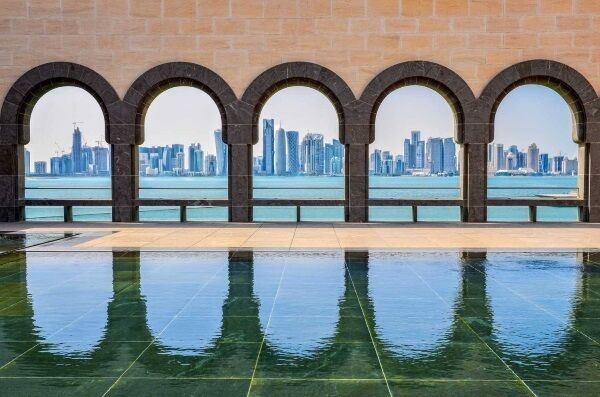
The exterior suggests an Islamic woman peering from over a veil while the spacious atrium is inspired by the eight-century Ibn Tulun Mosque in Cairo.
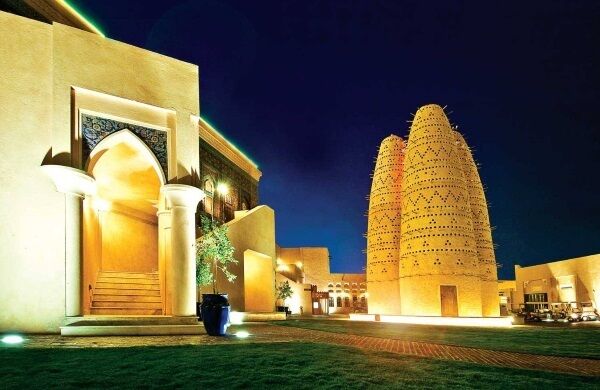
The collection contains Islamic art from across three continents and dating back 1,400 years. mia.org.qa Katara Cultural Village Opened in 2010, this cultural quartet features a state-of-the-art amphitheatre where headliners have included Eric Clapton, a mosque, a souq and a cinema hosting the prestigious Ajyal Youth Film Festival. katara.net
Mall of Qatar
Qataris love their shopping and Doha even features a mall exclusively for children. Its latest retail destination, the Mall of Qatar, opened in 2016 and spans the equivalent of 50 soccer pitches. It boasts an Imax cinema, hotel and five-star shopping, while an adjoining stadium, currently under construction, will host 2022 World Cup games. mallofqatar.com.qa
Hamad International Airport
Qatar Airways is frequently named one of the world’s best carriers and its Dublin route utilises the luxurious new Boeing 787 Dreamliner.
Hamad airport is dominated by a huge “Lamp Bear” teddy bear sculpture by Swiss artist Urs Fischer, weighing 20 tonnes and purchased by a member of the Qatari royal family for $6.8 million. dohahamadairport.com
Ed travelled by Qatar Airways, which operates a daily Dublin to Doha service. He stayed at the Mondrian (mondriandoha.com) and St Regis Doha (stregisdoha.com) hotels.

CONNECT WITH US TODAY



Be the first to know the latest news and updates