Appliance of Science: How was the Moon made?
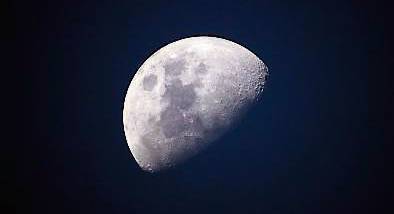

The Moon is a constant feature in our skies and has a significant impact on our planet, but how was it created in the first place? Before we started to physically explore the surface of the Moon there were three main theories on its formation, writes .
The capture theory
This theory proposed that the Moon was originally created along with a young solar system and was captured by the Earth, forcing it into orbit around our planet. It was a plausible theory, but, in 1971, the Apollo 15 lunar mission brought rock samples back from the Moon and these samples shed new light on its likely formation.
If the capture theory were valid, we would expect the composition of the Moon to be quite different to that of the Earth, on the assumption that they were formed in different places. However, analysis of lunar rock samples has revealed that the Moon is actually very similar to the upper layers (crust and mantle) of the Earth. It would appear the Moon and the Earth are too similar in composition to support this theory.
The fission theory
Another Moon formation theory is the fission theory, suggesting that the Moon was formed by material that was literally flung off the Earth due to the force of its (then) rapid spin. This theory may fit with the fact that the composition of the Moon and the Earth’s mantle are similar, but there is no evidence to back up the theory that the Earth ever spun at such high speeds.
The co-formation theory
So could the Moon and Earth simply have formed at the same time? If this was the case we would expect the Moon and Earth to have almost identical compositions; although we know that the Moon it similar to the Earth’s mantle, it is much less dense than the Earth; the Moon does not have the same level of heavy elements (like iron) at its core. This has been determined due to calculations based on the spin rate of the Moon.
The Moon and the Earth are also not actually the same age. The Moon is thought to have formed about 4.5 billion years ago, more than 30 million years after the origin of the early Solar System.
Although each of these theories originally had strong plausibility, they did not eventually hold up to more modern scrutiny. So how did the Moon form?
The giant impact theory
This theory arose in the mid-70s and has gained much support as lunar rock samples undergo more advanced testing. The theory suggests that the Moon was created as a result of a massive collision between a Mars-sized protoplanet and a young Earth.
The impactor, named Theia (after the mother of the moon goddess in Greek mythology) is thought to have slammed into the early Earth at speeds of more than 16,000kph.
The impact would have caused a massive explosion, vaporising the proto-planet and at least some parts of Earth (most likely the lighter, mantle layer).
It wold also have sent the Earth into a rapidly increased spin rate, ejecting the vaporised material into orbit where it likely formed a belt around the planet. Over time (estimates suggest about 100 years) this material would have cooled and coalesced into the Moon.
When the Moon first formed it was much closer to the Earth; both rotated at a much faster rate, resulting in a day of just four to five hours.

CONNECT WITH US TODAY



Be the first to know the latest news and updates