How the Ikea founder’s billions will be broken up
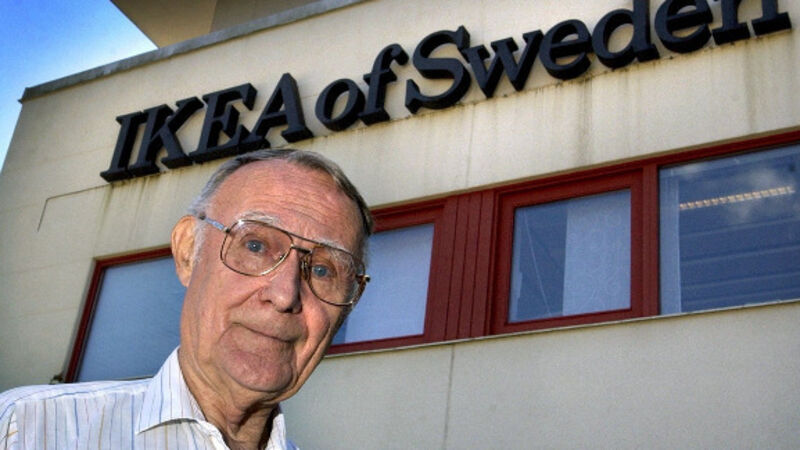
When Ikea’s Ingvar Kamprad died last Saturday at age 91, he was ranked number 8 on the Bloomberg Billionaires Index thanks to his control of a global retail fortune valued at over €47.3bn.
His wealth will now be dissipated because of a unique structure put in place by Mr Kamprad to secure the long-term independence and survival of the Ikea concept.
Mr Kamprad disputed his status as one of the richest men on the planet, having decades earlier placed control of the world’s largest furniture seller into a network of foundations and holding companies.
Mr Kamprad’s heirs now won’t have direct control of the firm.
They will have a more meagre fortune derived from family-owned Ikano Group, a collection of finance, real estate, manufacturing and retail businesses which had total assets of about €8bn in 2016.
Most Ikea stores are owned by the Stichting Ingka Foundation, a Dutch entity with the stated purpose of donating to charity and “supporting innovation” in design, according to its founding statute.
The structure, which Mr Kamprad established in the 1980s, assures that the Sweden-based company stays outside the family’s direct control.
The company’s trademarks, brand and concept were placed under the ultimate control of the Liechtenstein-based Interogo Foundation whose subsidiary, Inter Ikea, is the global Ikea franchisor.
“Interogo Foundation is managed by a foundation council (stiftungsrat) consisting of at least two members and a supervisory council (beirat), as a principle consisting of seven members,” Anders Bylund, Interogo’s head of communications wrote in an email earlier this week.

“The Kamprad family members in the supervisory councils have been and shall always be in minority,” the spokesman said.
Though called a foundation, the mission of the Stichting Ingka is only partly philanthropic.
Its articles also allow for profits to be reinvested in the company, according to Per Heggenes, the chief executive of the Ikea Foundation.
The foundation owns itself, so no Kamprad family members hold shares. The structure was designed to ensure Ikea, in its present form, would long outlive its founder.
Trust experts say the set-up emphasises continuity by making it impossible for an individual, whether a manager or heir, to assume control after Mr Kamprad’s death. The Bloomberg Billionaires Index attributed the fortune to Kamprad in recognition of his role as founder with control over the entire structure.
Mr Kamprad was “not interested in money,” Mr Heggenes said in 2012. “That is clear from the way he structured the ownership,” he said.
Mr Kamprad was known for driving an old Volvo, recycling tea bags, and taking home little packets of salt and pepper from restaurant visits.
He was known as ‘Uncle Scrooge’ and ‘The Miser’ in the Swiss village of Epalinges, near Lausanne, where he moved in the 1970s before returning to Sweden a few years ago.
He also avoided wearing suits and ties and travelled in economy when flying.
The wealth was accumulated by producing furniture for the masses that was affordable and easy to transport. The Ikea flat packs revolutionised the way in which tables, chairs and other items could be stored and shipped, before being assembled by the customer.

“We are mourning the loss of our founder and dear friend Ingvar,” Jesper Brodin, chief executive of the Ikea Group, the largest retailer in the Ikea franchise system, said this week.
“His legacy will be admired for many years to come and his vision —to create a better everyday life for the many people — will continue to guide and inspire us,” he said.
The name Ikea is made up of the founder’s initials and the first letters of the Elmtaryd farm and Agunnaryd village where he was raised.
His flat-pack furniture was invented by Ikea employee Gillis Lundgren in 1956 when he tried to fit a table into the back of a car.
Realising the table was too bulky, Mr Lundgren removed the legs.
Storing and selling Billy book shelves or entire kitchens in pieces has let Ikea cut storage space and fill its trucks with more goods.
CONNECT WITH US TODAY



Be the first to know the latest news and updates