Environmental campaigner brings 'unusual application' to challenge College Green Plaza plans
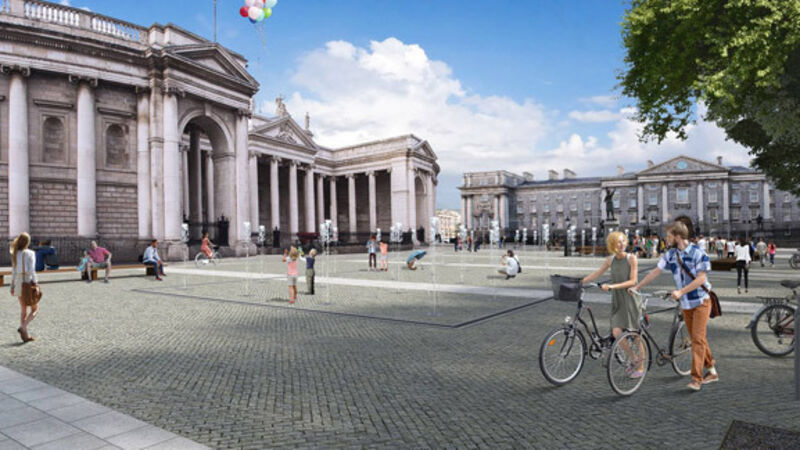
A judge wants to hear from planners and the State before he decides whether an environmental campaigner can bring a High Court challenge to a refusal for the College Green Civic Plaza plan in Dublin.
Mr Justice David Barniville said he wants An Bord Pleanala, the State and Dublin City Council put on notice of John Conway's application for a judicial review of the board's October 17 last decision to refuse permission for the plan before he decides whether to grant him leave to bring proceedings.

The main reason for the refusal was the uncertainty of the city council's proposals for dealing with the banning of buses from College Green so that it can be turned into a pedestrian/cyclist/Luas-only area.
The board, to which the council's plan was referred for a ruling, said there was a failure to demonstrate the capacity of the Quays to take not just the re-routed buses, but the additional pedestrian traffic which would have to use the Quays.
The plan was contrary to proper planning and sustainable development, the board said.
Mr Conway, who is from Dundalk and part of the Louth Environmental Group, wants the board's decision quashed and remitted to it for reconsideration. The council is a notice party.
Mr Conway seeks the quashing order on the basis that there was a divergence of opinion in relation to traffic matters between the board inspector and another in-house inspector appointed by the board to assist in considering transportation/traffic issues.
He says this divergence of opinion "highlights the subjective nature" of the traffic assessment which was the main reason for refusal.
The refusal decision was unlawful because the traffic assessment failed to take account of significant changes proposed by the National Transport Authority (NTA) to the Dublin Bus network, known as "BusConnects", he says.
The board made an incorrect assumption, in making its decision, that the city council, or the board itself, exercised control over the routing of buses when this role was actually vested in the NTA, he says.
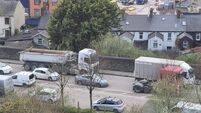
There was also a failure to take account of changing conditions on the ground including that since the opening of the cross-city Luas line there has been a 20% reduction in buses using College Green.
The NTA also plans to implement a morning rush hour ban on taxis going through College Green and to cut bus traffic by another 16%, he says.
Mr Conway's case is also on grounds of an alleged failure by the State to provide an effective remedy to challenge the refusal of the permission, in breach of Constitutional and the EU Charter of Fundamental Rights.
He says the inability under law of the High Court to deal with this matter on its merits or its facts renders judicial review as "something less than an effective remedy", he says.
Mr Justice Barniville was asked by Mr Conway's counsel Paul O'Shea to grant leave to bring judicial review on a one-side only represented basis on Friday.
The judge said Mr Conway had not participated in any way in the planning process and this was therefore "an unusual application to say the least".
While there was a wide discretion for his court, which has been assigned specifically to deal with challenges to strategic infrastructural developments, he had a number of concerns including whether Mr Conway would satisfy "sufficient interest" criteria for bringing this case.
He therefore adjourned the matter to next month so that the board, the State and the council could be in court for the hearing of the application.