Pushing All-Ireland finals into August 'would be no bad thing' says GAA chief Ryan
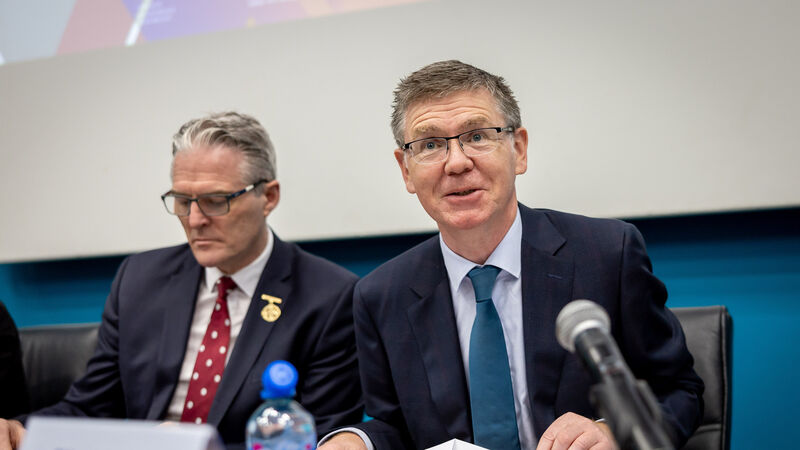
GAA President Jarlath Burns (L) with GAA Director at the GAA Museum, Croke Park. Pic: Morgan Treacy, Inpho
Pushing at least one of the All-Ireland senior finals into August “would be no bad thing”, GAA director general Tom Ryan has claimed.
In his annual report released on Thursday, Ryan acknowledged a growing school of thought for the inter-county season to conclude later in the year.
The 2025 hurling and football deciders take place on July 20 and 27 respectively and, pending a motion at Congress later this month, either or both are subject to a replay in August if the participating teams are level at the end of normal time.
Ryan wrote: “There is a gathering mood to shuffle the finals back by a week or two, and that may well transpire in the future. Stretching the season out a little would be no bad thing – but I don’t foresee a return to September.
“A further opportunity to stretch the season might well present itself at the other end of things, in January. Perhaps the suspension of the provincial pre-season competitions could point to starting the Allianz Leagues a little earlier in future? It’s probably too early to reach conclusions around this yet. 2025 is just a trial and the competitions are still on hold. But it merits debate.”
However, Ryan admits to being “underwhelmed” by the impact of the decision to disband the pre-season competitions for the sake of player welfare. He pointed towards counties continuing to contravene the closed season.
“We dispensed with the provincial pre-season competitions to advance that goal. It was a matter of some contention at the time, and opinions were very much divided as to whether it would work. It’s early days I know, and the definitive data is not yet to hand at the time of writing, but I am somewhat underwhelmed at the outcome.
“If this structure is to persist, we must make it work, otherwise the sacrifice of those competitions is just pointless. So that means everybody stretching their thinking a bit.
“Counties not permitting or sanctioning training, managers trusting and minding their players, and the GPA telling us where breaches arise, and the Association enforcing. It’s a shared responsibility and we’re all letting each other down.”
Interestingly, Ryan has indicated counties other than Galway, Mayo and Wexford will be subjected to risk reviews by the Revenue Commissioners. Referring to those audits at the end of 2024, he remarked: “Clearly, this presents a risk of financial penalties in the counties concerned and a risk to our collective reputation. The latter was not helped by the extent of public commentary on the topic.
“There was also the risk that outcomes in any given county could have wider-reaching implications for others. Most importantly, it placed a huge strain and workload on the volunteer officers in the counties concerned. All of these factors pointed towards a necessity for central involvement and guidance, and hence our interventions in the last weeks of the year.
“This is not a matter to be played out in public; that is not the Revenue Commissioners’ preferred way of doing business and nor is it ours. Suffice to say that our engagement with the Revenue has been positive thus far and we will work together towards an orderly resolution in the counties concerned.
“That resolution will involve participation by other counties in a review process. It may well come at a financial cost, and it will certainly entail significant work, but it will bring certainty as regards how we treat matters and peace of mind for officers going forward.”
Following on from his remarks last year about the GAA being involved in shared facilities, Ryan has gone as far as suggesting units of the organisation should share their own infrastructure.
“We need to approach GAA capital projects differently. Shared development have long been anathema to our thinking, I know, but if we can share with universities, share with other organisations then why not share between ourselves? What would our infrastructure landscape look like if we were to prioritise half a dozen facilities around the country for priortised investment, remove the local funding burden, and designate them as provincially or nationally shared? Don’t dismiss it out of hand.”
Ryan said while the integration process by 2027 is continuing, “many more issues have arisen, and there are still as many questions as answers”.


CONNECT WITH US TODAY



Be the first to know the latest news and updates