Battery energy storage systems are a vital piece of Ireland’s renewable energy puzzle
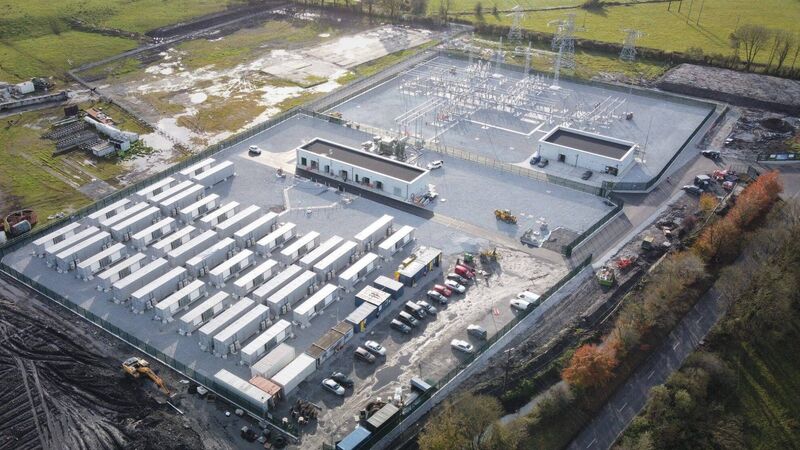
The Lumcloon battery storage facility in Co Offaly, with the Derrycarney 110kV substation next to it. ESB Networks described the project as a “great achievement for battery storage” in Ireland.
Battery energy storage systems, often referred to as Bess, are regarded as a vital part of the Ireland’s fledgling renewable energy sector and demand for them has never been higher.
More than 700 megawatt (MW) of battery storage was active at the end of 2023 and another 500 MW has been contracted to connect over the next five years.
These storage systems house power generated from renewable energy developments including wind turbines and solar panels. This energy can later be released onto the grid to help satisfy growing demand and provide stability when it comes to energy supply.
Battery storage technology can offer unique benefits to the grid by reducing reliance on fossil fuels, cutting the cost to consumers by using renewable energy on the grid and provide flexible energy capacity which prevents blackouts.
The Republic is also widely known as an attractive destination for Big Tech companies, which use data centres that are insatiable consumers of energy, putting extreme pressure on the grid, making the case further for battery storage systems.

Its estimated that the number of data centres in Ireland has reached just over 80, and a moratorium has been put in place to curtail further numbers.
Chief executive of environmental group Friends of the Earth Ireland claimed last year that the Republic is hurtling towards a future where 30% of the country's energy supply will go to data centres.
However, significant strides have been made to grow Bess systems to cope with demand.
There are around 15 of these battery storage systems already hooked up to the grid around the Republic and while major players in the industry continue to work on additional facilities.
Lumcloon energy is at the centre of battery storage in Ireland. The project development company accounted for almost 45% of the battery energy storage systems in Ireland in 2022, according to Statista.
The business has already deployed 200MW of fast acting BESS, “which have been providing vital support to the power system since 2021”, the company said.
“Now Lumcloon Energy is constructing a first of a kind grid stabilisation project which combines battery energy storage and a synchronous condenser in Shannonbridge, Co Offaly,” said Nigel Reams, chief executive of Lumcloon Energy.
The hybrid system will have the capability to provide 160 megawatt hour (MWh) of storage capacity from the battery.
“Grid stabilisation services are essential to support and maximise the utilisation of electricity generated by wind and solar,” said Mr Reams.
Lumcloon Energy’s new facility is due to enter operation next year and “will be capable of instantly compensating for frequency fluctuations and storing electricity when demand is low and releasing it during peak demand periods”, the company said.
The firm said it is also working on a thermodynamic long-duration energy storage system through the use of a CO2 battery instead of a lithium one.
Lumcloon Energy has collaborated with Energy Dome in Italy for the project, which has been pumped with around €100m in investment funds.
The development is located at the site of the former peat-fuelled power plant in Offaly and provides power capacity of 50MW and eight hours of energy storage capacity.
The technology uses carbon dioxide to store energy in the form of pressure and heat that priduces reduced emissions and consumes significantly less water.
The first full-scale CO2 Battery is under construction in Sardinia and will be commissioned this year.
Meanwhile, State-owned electricity company ESB recently opened a major battery plant at its Poolbeg site in Dublin which will add 75MW of energy storage to help provide grid stability and deliver more renewables onto the market in the Republic.
This specific battery energy storage system is the largest site of its kind in commercial operation in Ireland and is part of ESB’s pipeline of projects, worth up to €300m in investments, that aim to be delivered at sites in Dublin and Cork.
This project has a capability of providing 75MW of energy for two hours to Ireland’s electricity system.
ESB Networks also recently announced that Ireland’s electricity grid now has 1 gigawatt (GW), or 1,000 MW, of electricity storage connected to Ireland’s network.
This figure includes 731.5MW of battery energy storage system projects and 292MW from Turlough Hill pumped storage power station.
“Energy storage is a key enabler of our clean energy future, and this achievement is a big step on that journey,” said Bobby Smith, head of Energy Storage Ireland.
He added that these systems are needed to “reduce the use of fossil fuels and drive down energy prices while ensuring a secure, stable electricity system.”

One gigawatt of energy storage is enough to power the equivalent of approximately 450,000 homes for one hour, typically during peaks in demand or when frequency support is needed at times of low levels of renewable generation. For context, peak demand on Ireland’s electricity system is approximately 5.5 GW.
“We have seen in recent years is a major push by the wider industry to deliver large-scale battery energy storage projects that we have been able to support through network connections,” said Nicholas Tarrant, managing director of ESB Networks.
Ramped-up activity in the Bess space among stakeholders aims to not only create better grid security and stabilisation, but also more jobs in the renewable energy sector.
Towards the end of last year, a report titled Energy Storage Ireland and Green Tech Skillnet suggested that the energy storage sector could create thousands of new jobs by 2035.
The report published by professional services firm KPMG added that the lack of clearly defined career paths and insufficient knowledge of employment opportunities in this area are creating a career barrier.
“Ireland’s energy storage sector has grown rapidly in recent years, largely on the back of expertise transferred from the wider renewable energy sector but to deliver its full potential we now need to invest in developing the skills and workforce to meet our much greater future energy storage needs,” said Terence McGovern, director in KPMG sustainable futures in the report.
The report estimated that between 2,000 and 5,000 jobs could be created in this period across the areas of construction, engineering, and financing. This includes both direct and indirect employment.
However, the Bess space remains mired with challenges which could hit growth momentum. Delays hitting renewable energy developments including planning backlogs for wind and solar developments subsequently effect expansion of battery storage systems.
Davy stockbrokers last year said that if Ireland is to catch up with, let alone meet, its binding climate targets, the country is required to accelerate its onshore generation growth, alleviate key planning and grid constraints and provide superior policy and incentivisation for solutions such as battery storage.
“Such initiatives would materially improve the energy transition investment case and help attract much-needed capital back to related sectors,” Davy said in a note.