Sustainable construction to present a confident picture for financial sector investment
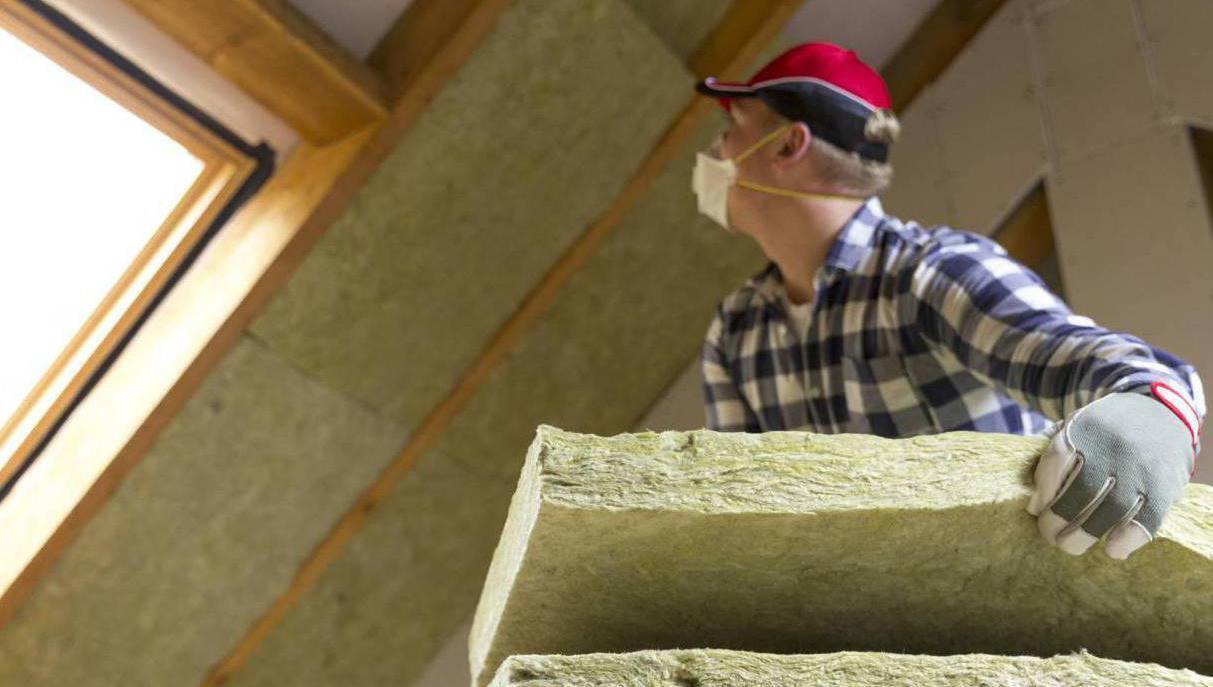
Improving attic insulation is a typical staged project for improving the BER on your current home, and you would be well advised to exceed the recommendations. Retrofit grants with the SEAI are ceilinged at €300, around 30% of the cost to insulate the floor of a standard attic to 300mm in fibre-glass batting. Picture: iStock
2050 might still be more than a couple of decades off, but in terms of preparing the building stock in this country for major changes, this is a short timescale and we’ve quite a bit of progress to make yet.
It has been highlighted in a number of articles on the subject (including my own in an edition from last October) that the Government — far from taking a leading role in the matter — has been lagging behind the private sector.
This isn’t necessarily as terrible as it might sound. The private sector is often the leader in adapting to new technologies. They have the profit motive to look ahead and position themselves in an increasingly fast-paced world.
One member of Government (albeit the European government) spoke recently about the crucial nature of the role of the financial sector in incentivising renovation work to hit targets on energy efficiency.
MEP for Ireland South Seán Kelly was speaking at an event in Dublin in March, hosted by the Banking & Payments Federation Ireland. Entitled “Energy Efficient Buildings — Reaching National and European Goals”, the conference itself was an example of a private-enterprise-led initiative to test the temperature on this very important issue, as well as inviting discussion around the matter.
Deputy Kelly is the Lead Negotiator for the European Parliament’s biggest political group on the Energy Performance of Buildings Directive; a directive that came into European law in December 2023 in relation to energy performance of buildings, setting targets for member states in a European Union with an estimated 75% of building stock at inefficient levels.
In his address, the Kerryman and former GAA President emphasised the importance of coordinating efforts on a number of fronts to achieve our energy-efficient targets by 2050:
“Scaling up the deployment of renewable energy technologies is crucial,” he said, “but maximising the efficiency of our existing building stock is equally essential. It’s a matter of climate, energy security and economic competitiveness.”
He also stressed the importance of finance in allowing buildings to gear up for the greener future: “The European Commission estimates a funding gap of €214 billion annually for green financing,” Deputy Kelly said. “Private finance, particularly bank loans, will play a vital role in achieving energy efficiency targets.”
His words underlined the broadly accepted notion that it is the private sector that has the flexibility and the motivation to act more effectively than the public sector — particularly with regard to achieving energy-efficiency targets in Ireland: “Government actions are crucial but private finance will also be pivotal in achieving our targets.”
According to the RIAI (Royal Institute of the Architects of Ireland), they don’t seem to get into the argument of whether it’s the private industry driving the change or the public sector doing most of the heavy lifting.
The RIAI is keen to underline the theme of collaboration between public and private sectors. It was, says RIAI practice director, Pranash Ramanundh, the main theme of their annual conference last October.
“In terms of whether private industry is leading the public sector in terms of standards, I think that Government and industry are working together… it’s a joint effort. Industry does need clear guidance and standards, especially as standards are changing so rapidly.”
Amongst the many items discussed at the RIAI’s annual conference was that of retrofitting. It’s still very much a live question in the whole business of preparing building stock for the greener challenges ahead, because one has to choose whether or not a building should be retrofitted or demolished and rebuilt.
A number of commentators have suggested that we are a little too quick to demolish and replace with new buildings — sometimes destroying perfectly good building stock or, worse still, buildings that have important cultural significance. The business of measuring the cost of demolition is one that has become a strong point of debate in the UK in recent years and many feel that this debate has not yet been thrashed out enough yet in Ireland — particularly with the many battles to come on this point.
“The second day of the conference was devoted to discussion on retrofitting,” says Pranash, “and there was a lot of discussion around the question of retrofitting vs demolition & rebuild … Retrofitting offers many more environmental benefits, by conserving resources, reducing waste, improving energy efficiency, preserving our national or cultural assets… so it all feeds into a really responsible and sustainable approach to urban development.”
The RIAI’s comprehensive and considered approach involves an environmental accreditation process that is regularly updated.
“We started the process of updating the accreditation process in 2023,” says Pranash, “and at the moment, it’s nearly finalised. What we’re realising is that it does require sophisticated levels of key knowledge and skills.
“The Sustainable Task Force has been heavily involved with this — looking at the learning outcomes, looking at what best practice might be, looking at the skills gaps and mapping the knowledge of lenders against a skills matrix to identify areas of further training. All of this ties in with the RIAI corporate strategy for 2023 and the Climate Change strategy for 2027.”
In getting our building stock ready for the greener deadline of 2050, how realistic does that target date look from the point of view of an organisation such as the RIAI? As an important body involved in the shaping of the building stock to come?
“There will be significant upskilling required for our members,” says Pranash, who says that, following the 2021 launches of the RIAI Sustainable Design Pathways Guide and the RIAI 2030 Climate Challenge, they launched a Complementary Suite of Guidance in October 2023. These are guides intended to help support architects and their clients to sign up to and support the targets of the climate challenge.
“It is a critical time now,” says Pradash. “And it is time-sensitive, but it also brings about great opportunities for change, we believe, to deliver more accountable quality and sustainable resilience for communities to live, work and grow. And one of the most important things is that quality is embedded in all of this.”
Part of the training required, Pradash says, will be provided in the Design4Zero Project — a two-year programme launched in July last year with the Irish Green Building Council (IGBC). It’s a joint programme of research, support tools, guidance and upskilling of professionals to address the de-carbonisation of our national building stock.
This is a programme of some significance behind the scenes, as it were, and it should go some way to realign thinking on all sides to get our building stock and those who examine it and design it firmly on the green page for the future. It is funded by the Sustainable Energy Authority of Ireland (SEAI) and the National Energy and Research Development and Demonstration Programme.
The framework is a dynamic one that is designed to be used to update the RIAI’s own 2030 Climate Challenge and to help move architects away from the mindset of building for compliance and more towards building for performance.
What that all points to is the ongoing creation of a structure of thinking at all levels of the building industry. This will ensure a greener future will be created not just because of a wish to do what is written by the powers that be, but because their approach to thinking about building will be of a greener mindset to begin with. And with such fundamental confidence in the creative heart of the building industry, private finance is sure to follow.