SETU and Glassworks set to accelerate innovation
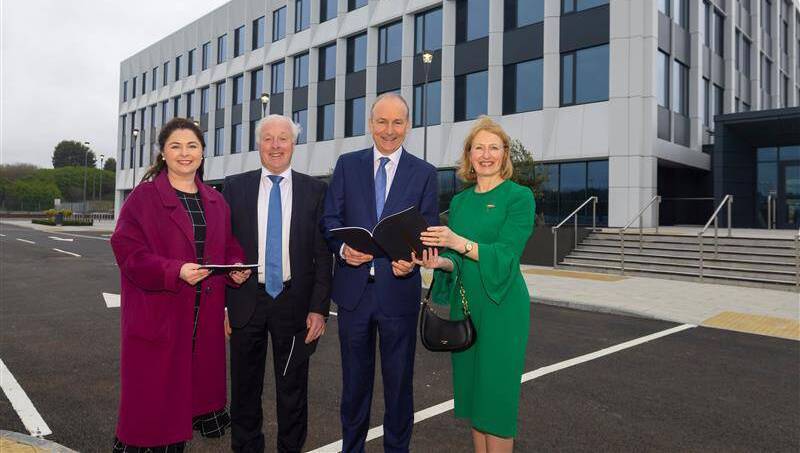
Sarah Hickey, senior investment director at the Ireland Strategic Investment Fund; Noel Frisby snr, founder and director of the Frisby Group; Taoiseach Micheál Martin; and SETU president, Prof Veronica Campbell, at the recent launch of Building One, the first commercial building at the Glassworks campus in Waterford. Picture: Patrick Browne
Glassworks, a new 37-acre campus designed to transform collaboration between academia and enterprise, is set to accelerate the southeast’s innovation potential both nationally and internationally.
Located on the historic Waterford Crystal manufacturing site, Glassworks builds on a legacy of craftsmanship and global reach by creating a dynamic platform to advance research, deepen enterprise engagement and develop the next generation of talent.

Leading this transformative project is South East Technological University (SETU), in partnership with Frisby Group and Ireland Strategic Investment Fund.
Glassworks is strategically positioned within the university and enterprise quarter on the outskirts of Waterford city, a Unesco Learning City. It sits alongside a cluster of multinational companies, and in reach of local government, industry and education partners, all focused on regional growth.
“What sets the southeast region apart is its capacity to act as one, with strong, established partnerships across education, industry, government and civic society aligned around a shared vision to lead innovation growth nationally and internationally,” SETU president Prof Veronica Campbell said.
“Glassworks has the potential to significantly elevate innovation capability, providing the environment through which academic and enterprise collaboration can happen at a much larger scale than previously possible.”Â
As the region’s only university, SETU plays a central role in driving development, generating an economic and social impact of €1 billion annually. With campuses in Waterford, Carlow and Wexford, the university supports nearly 18,000 students and produces about 4,000 graduates each year, supplying a strong pipeline of talent to innovation-driven sectors.
Glassworks builds directly on this foundation, creating a dedicated space where SETU’s teaching, research and innovation activity can come together at a scale not previously seen.
“Glassworks will be transformative for the region. By bringing students, researchers and businesses together in one place, the campus strengthens the region’s existing network and provides a practical launch pad for ideas to move from concept to impact,” Campbell said.
Momentum is already building across the 37-acre site, 20 acres of which are owned by the university. The first commercial building, Building One, was recently unveiled by Taoiseach Micheál Martin and will accommodate up to 800 employees.
The €43 million commercial facility will initially be anchored by Veonet Ireland, a clinical eye-care provider, which is preparing to open a day-hospital unit in the former crystal showrooms. This move brings new clinical activity to one of the site’s most recognisable spaces.
SETU is excited to be engaging with Veonet on potential strategic partnerships in eye health research, education and emerging technologies, with view to establish focused collaboration.
Transformative developments on the academic side of the site are also under way. SETU has appointed a design team for a new academic facility, funded by the Government and dedicated to veterinary medicine and pharmacy. Approval in principle has also been granted by the Higher Education Authority for the One Health building.
Together, these facilities will strengthen regional capability in areas such as biopharma, agri-food and eco-innovation, while supporting SETU’s regional One Health agenda, which brings together human, animal and environmental health.
Early activation measures, including active travel initiatives, are being explored to support sustainable development.
Glassworks intends to build on SETU’s strong track record in research and development, with the University considered among the highest-performing third-level institutions in Ireland. This activity generates €35 million in annual economic value while supporting jobs, discoveries and commercial spin-outs.
Four of Enterprise Ireland’s 17 national Technology Gateways are based within SETU. Together, Pharmaceutical and Molecular Biotechnology Research Centre (PMBRC), ICS, SEAM and Design+ provide applied research expertise and practical solutions to industry across sectors including pharmaceuticals, biomedical, engineering and beyond.
For example, the ICS Technology Gateway acts as the commercial interface for the Walton Institute, an internationally recognised research institute for ICT research and innovation. Based on SETU’s West Campus, Walton Institute hosts advanced facilities, including immersive reality, high-performance AI computing and satellite communications.

“For more than three decades, Walton Institute has been working closely with the European Commission, both in securing research funding and helping shape policy,” said Kevin Doolin, executive director of the Institute.
“That experience has translated into real impact. We have secured €155 million in competitive funding across areas like artificial intelligence, quantum technologies, next-generation communications, smart energy, agritech, digital health and smart cities.
“Walton’s work is multifaceted. We’re also focused on making that experience work for industry, by helping companies understand how to access funding, build the right partnerships, and navigate what can often feel like a complex European landscape through our funding roadmap,” Doolin added.
Glassworks will build on that existing success, further strengthening SETU’s role in driving regional innovation. As Doolin noted, “It will act as a multiplier for SETU’s growing success across a wide range of areas, building on both the university’s and the region’s ambition for innovation-led growth.”Â
Co-location at Glassworks is expected to make it easier for companies to engage with the university through placements, joint research, postgraduate supervision and applied research partnerships. This model is already well-established in PMBRC and Eco-Innovation Research Centre, two leading research centres at SETU, with the PMBRC Technology Gateway, for example, completing more than 50 research collaborations with industry partners nationwide last year.
In addition, SETU also supports entrepreneurs, start-ups and spin-outs in other ways, helping them to grow and scale both nationally and internationally. SETU’s Xcelerate Centres provide incubation space within a supportive and collaborative environment, while the New Frontiers Programme, delivered in partnership with Enterprise Ireland, supports early-stage founders in developing scalable, investor-ready businesses.
Chris Chedgey, co-founder of Waterford-based Structure101, later acquired by global leader Sonar, credits this support ecosystem as critical to the company’s success.
“Put simply, it wouldn’t have happened without SETU’s support,” he said. “I encourage anyone with a business idea to take full advantage of the resources and supports available at SETU, New Frontiers and Walton. Their support was invaluable to the success of my company and can be for others too.”Â
Looking ahead, Glassworks is expected to further strengthen how education and industry interact in the region.

Laurence Fitzhenry, head of faculty for science and computing at SETU (Waterford), said the model represents a step change in collaboration, drawing on successful examples internationally while reflecting the connected approach in the southeast.
“Glassworks will expand on over two decades of engagement between SETU and both regional and national enterprise that has provided employers with direct access to SETU’s talent pool, facilities and technical expertise, while giving students and researchers daily exposure to real industry challenges,” he said. “That two-way interaction helps innovation to reach our community much more quickly, and the new developments at Glassworks will rapidly scale this activity.” The inclusion of specialised facilities in veterinary medicine, pharmacy and one health will create a critical mass of education and research activity across interconnected disciplines.
Importantly, collaboration is built into the design of the campus itself.
“For smaller enterprises, Glassworks will provide specialised laboratories that can accelerate the journey from project idea to commercially available product, while larger employers can benefit from long-term partnerships, shared facilities and talent pipelines,” Fitzhenry said.
“For the southeast, the outcome is an integrated stream of enterprise-ready graduates, industry-facing researchers and a research environment that attracts partners because it is accessible, responsive and ambitious. Glassworks will deliver this at scale,” he added.
Ultimately, Glassworks provides the platform for one university to support one region, unlocking its full potential to drive economic growth and place the southeast firmly on the global innovation map.





